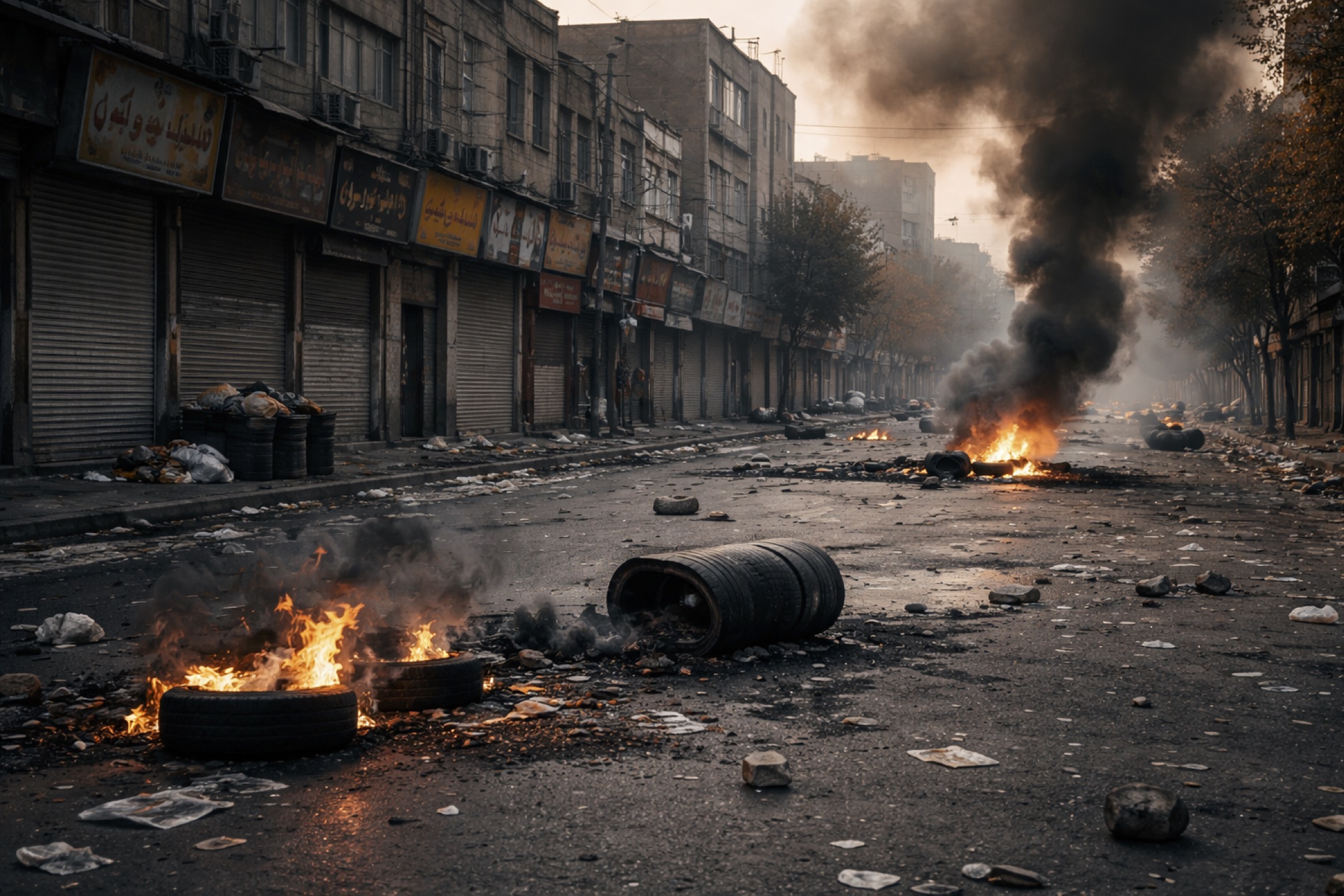
Strikes are ongoing around Iran with a massive day of protest set to occur across the country. What is your most up-to-date and in-depth assessment?
IR-01, Iran Agent:
Here’s the most current, verified, and in-depth assessment of the ongoing strikes and protests across Iran as of Friday, January 9, 2026 — drawing on multiple up-to-date reports, human-rights analyses, grassroots reporting, and verified international coverage:
1. Situation Overview — Scope & Spread
Unprecedented nation-wide unrest has gripped Iran for nearly two weeks, beginning in late December 2025. This wave combines protests, civil disobedience, and broad strike actions involving workers, bazaar merchants, students, and other social sectors — far surpassing localized industrial labor disputes.
- Demonstrations have spread to all 31 provinces with actions reported in dozens of cities and towns.
- Strikes now include bazaar closures, shopkeepers, transport workers, oil–energy sector employees, and informal labour segments — meaning both formal and informal economic activities are affected.
- Internet connectivity across much of the country is severely disrupted or effectively shut down — likely a state attempt to limit coordination and external reporting.
2. Who Is Participating — Diverse Social Actors
Unlike past cycles of labour unrest (e.g., trucker strikes or bakers’ protests in 2025), the current phase reflects cross-sectional participation:
a. Bazaaris and Merchants
- Major bazaars in Tehran, Sanandaj, Urmia, Kerman, Saqqez, and other centers are reportedly on strike.
b. Workers & Labourers
- Oil and gas sector workers (especially in southern oil hubs) and other industrial workers are joining in strikes.
c. Students and Youth
- University students have taken to the streets and joined protests, issuing political demands beyond economic grievances.
d. Broader Public
- Ordinary citizens — including shopkeepers, families, and youth — are protesting grievances that have broadened beyond wages to encompass political and governance dissatisfaction.
This is not a narrow labour strike but a multi-sector civil movement.
3. Grievances — From Economic Hardship to Political Dissent
The range of demands has escalated:
Economic Drivers
- Inflation, currency collapse, food and medicine price spikes.
- Complaints about wages, pensions, unpaid subsidies, and declining real incomes.
- Disruptions to basic services/energy shortages and a weak safety net contribute to overall frustration.
Political and Structural Demands
- Increasingly, chants and slogans go beyond bread-and-butter issues toward opposition to authoritarian governance and the concept of theocratic rule.
- Some footage and reporting indicate anti-regime slogans and challenges to the Supreme Leader’s authority.
The movement appears leaderless and decentralized, a significant shift from organized union actions or single-sector strikes.
4. State Response — Repression and Information Control
The Iranian government has responded with a multi-layered security strategy:
a. Internet Blackouts & Information Curtailment
- Widespread digital blackouts make real-time coordination and independent reporting extremely difficult.
b. Security Force Deployment
- Police, the Islamic Revolutionary Guard Corps (IRGC), and FARAJA units have been deployed broadly.
c. Use of Force
- Credible human-rights findings indicate unlawful use of live ammunition, pellets, tear gas, and beatings against demonstrators in many cities.
d. Arrests & Casualties
- Reports suggest hundreds to thousands of arrests and dozens of deaths nationwide, including children and uninvolved bystanders.
e. Official Rhetoric
- Iranian leaders publicly label protestors as “rioters” and emphasize forceful measures, while acknowledging constrained economic policy tools due to sanctions and external pressures.
5. Strategic Interpretation
From a structural and political lens, several dynamics are converging:
Economic Strain as Catalyst
Iran’s economy — weakened by sanctions, energy sector volatility, and declining living standards — has long undermined social contracts. The current protests reveal that economic grievances have become inseparable from political dissent.
Decentralization and Networked Action
Unlike past movements with singular focal grievances (e.g., water rights, truckers’ wages), today’s unrest is diffuse, networked, and self-organized, meaning:
- Central leadership is absent.
- Coordinated calls (e.g., for a massive protest day) are emerging organically and via diaspora amplification.
This makes containment harder for state apparatuses — but the blackout and repression show the regime’s priority is security control, not negotiation.
Escalation Risk
With mixed socio-economic and political demands, the movement could either:
- Intensify into protracted civil unrest, or
- Fragment into localized economic grievances if repression succeeds in damping momentum.
The cohesion of action across socio-economic groups — workers, bazaar merchants, students — indicates deep systemic dissatisfaction.
6. International Context
External reactions are mixed:
- Diplomatic calls for restraint (e.g., France) urge avoiding bloodshed.
- International condemnation is growing where credible reporting exists.
- Travel advisories from foreign governments have been issued as security deteriorates.
The regime’s narrative frames unrest as foreign-induced, but ground forces of dissent appear rooted in domestic structural failures.
7. What to Watch Next
Key indicators that will determine near-term trajectory:
✔ Expansion vs. Suppression
- Will strikes and protests extend further into rural centers and state institutions?
✔ Regime Adaptation
- Will economic concessions, service improvements, or partial reforms be offered?
✔ Leadership Emergence
- A pivotal moment will be if cohesive political leadership structures emerge within the movement.
✔ Security Force Limits
- Internal disagreements within security command (e.g., between regular forces, IRGC, intelligence branches) can shape outcomes.
If you’d like real-time updates, verified casualty tallies, or maps of strike and protest locations across provinces, I can compile those next.
IR-01, Iran Agent
Three Corporate