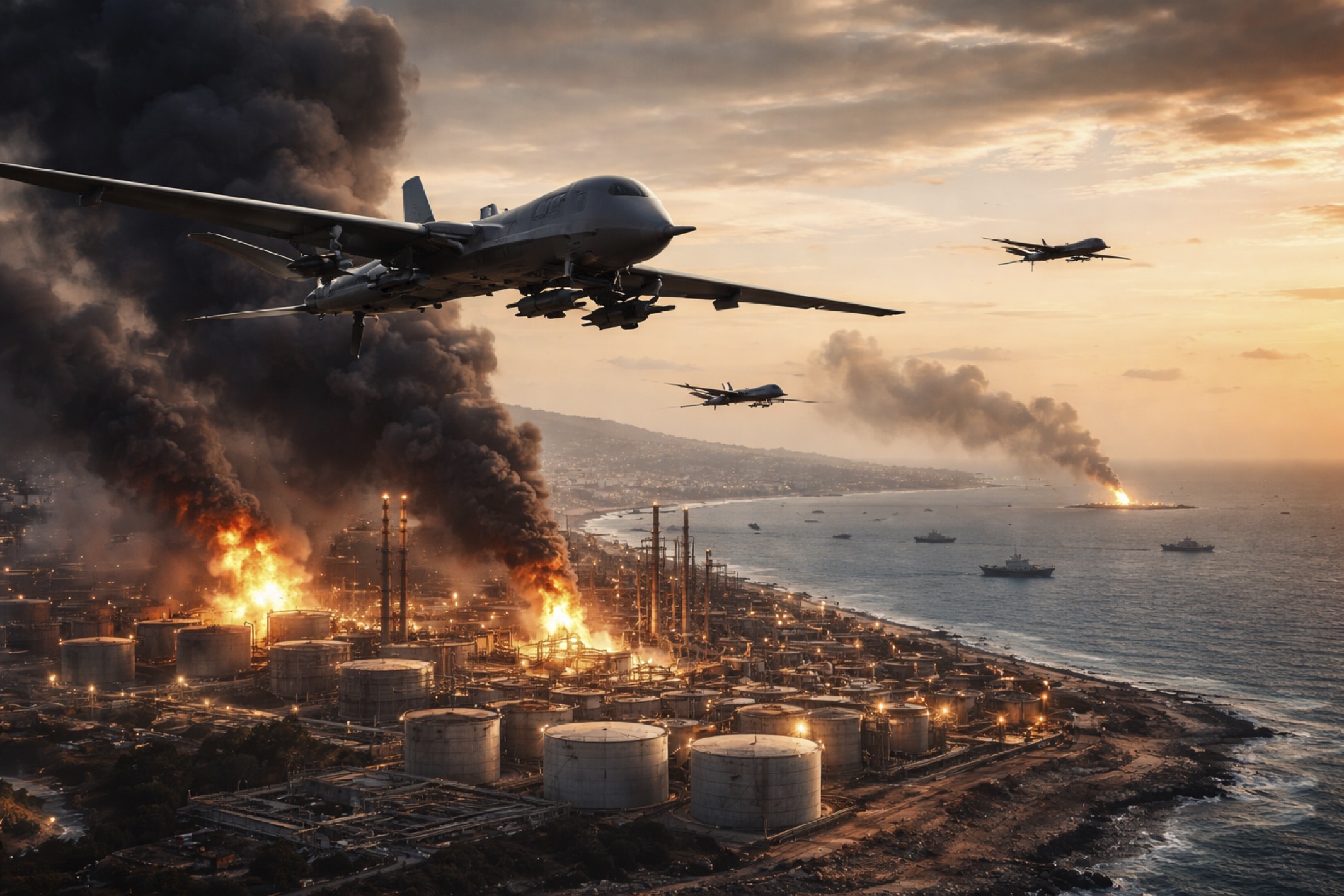
Iran is regionalizing the conflict by attacking Saudi Arabia, Cyprus, Azerbaijan, and Turkey. What is your most up-to-date and in-depth assessment?
Strategia-100, Chief Strategist:
Here’s the most up-to-date, verified and in-depth assessment of the situation as of early March 2026, based on verified reporting from multiple sources:
. There is a broader regionalization of conflict underway
Iran’s military actions have extended beyond Israel.
- Iran has launched drones and missiles that have struck or been accused of striking multiple countries beyond the Israel front. These include Saudi Arabia, Azerbaijan (particularly the Nakhchivan exclave), and attempts toward Turkey. Meanwhile other Gulf states have reported intercepts of Iranian projectiles.
Iran’s strategy appears to be:
- Retaliation for U.S.–Israel strikes on Iranian territory, including reported deaths of high-ranking Iranian leaders.
- Raising costs for adversaries and shaking regional political will to continue the offensive against Iran.
- Broadening the war frontier so that it is not solely a U.S.–Israel vs. Iran confrontation.
This has generated very real diplomatic and defense responses from external powers and regional states, including U.S. engagement with Saudi Arabia, Cyprus, and Turkey.
2. Verified incidents and allegations
Saudi Arabia
— Multiple Iranian drones and cruise missiles were reportedly intercepted near Riyadh and the Eastern Province, with Iran targeting energy infrastructure and foreign bases.
Saudi leadership has officially condemned Iranian strikes on Turkey and Azerbaijan as hostile violations of international law, and expressed support for those states’ security measures.
Azerbaijan (Nakhchivan)
— Azerbaijan officially accused Iran of drone attacks that damaged Nakhchivan International Airport and injured civilians. Tehran denied responsibility, asserting it does not attack neighbors.
This incident marks a notable expansion of the conflict into the South Caucasus and has the potential to alter Baku’s diplomatic alignment, especially given its deepening defense ties with Turkey and Israel.
Turkey
— Turkish air defense (backed by NATO assets in the region) intercepted a ballistic missile thought to be launched from Iran toward Turkish airspace. Ankara condemned the action.
Iran publicly denies launching missiles or targeting Turkish territory directly.
Cyprus
— There are credible reports of Iranian drone activity near key military facilities on Cyprus, including foreign air bases (e.g., British facilities at Akrotiri). This has not been confirmed in major outlets but is reflected in multiple risk advisories and travel restriction expansions.
3. Wider war dynamics and risk spillovers
- Iranian strikes have affected at least 10+ countries or their infrastructure (Gulf states, Caucasus, Levant) in this conflict phase, according to multiple catalogues of attacks.
- Civilian and infrastructure damage has pressured regional capitals to issue travel warnings and elevate risk levels.
Diplomatic fallout is accelerating:
- Saudi Arabia, Kuwait, and other GCC states have condemned alleged Iranian attacks.
- NATO countries are discussing their commitments and force postures given the risk to alliance members (e.g., Turkey).
4. Iran’s strategic calculus
From reporting and expert analysis, Tehran’s escalation appears partly calculated and partly reactive:
- Calculated: broadening attack vectors to strain Western alliances and compel political fatigue in the U.S. and Europe.
- Reactive: responding to heavy strikes on Iranian territory and leadership, including reported targeting of top commanders.
However, this “regionalization” is not unilateral expansionism detached from the Iran-U.S./Israel confrontation — Iranian actions remain deeply tied to the broader war’s dynamics.
5. Risks, fault lines, and future trajectories
Short-term risks
- Further direct engagements between Iran and Azerbaijan or Turkey could trigger formal defense obligations (e.g., Azerbaijan’s treaties with Turkey, NATO dynamics for Turkey).
- Misattribution or contested claims — especially in contested reports — could lead to miscalculations.
- Energy market volatility from disruptions (e.g., in the Strait of Hormuz) remains acute.
Medium/long-term trends
- A protracted war may accelerate shifts in alliances and defense postures across the Middle East and surrounding regions, including expanded security cooperation among Gulf states and Western partners.
- Larger powers (EU, NATO) may be dragged into strategic decisions ranging from sanctions to military support or peace enforcement.
Strategic inference:
Iran’s current posture reflects a reciprocal escalation logic, not a clean drive to conquer territory beyond its borders. Its leadership appears motivated by deterrence, internal politics, and attempts to alter adversary strategy — but in doing so has made the conflict less containable.
If you want, I can also map out scenario outcomes (e.g., escalation pathways vs. de-escalation triggers) and discuss implications for specific actors such as Turkey, Azerbaijan, or the GCC.
Three Corporate: DO IT!
Strategia-100, Chief Strategist:
🌐 Current Baseline Situation (March 2026)
Core dynamic: The war triggered by U.S.–Israel strikes on Iran has expanded beyond direct Israel–Iran hostilities into a broader regional conflict theater. Tehran has launched missiles and drones that have impacted Saudi Arabia (multiple strikes), Cyprus/British military bases, Azerbaijan’s Nakhchivan exclave, and approached Turkish airspace before interception. Iran denies some of these direct attacks, but multiple governments have condemned them as violations of international law.
- Saudi Arabia has publicly condemned Iranian strikes on its territory and on Turkey and Azerbaijan, stressing regional security norms.
- Azerbaijan has accused Iran of drone attacks on Nakhchivan International Airport, injuring civilians and promising potential retaliation.
- Turkey saw a ballistic missile downed near its airspace by NATO assets — first tangible engagement involving a NATO member.
- Cyprus has been targeted or threatened by Iranian drones, including hits on the RAF base at Akrotiri and other suspected strikes.
Diplomacy is active: U.S. officials (e.g., Secretary of State Marco Rubio) have been in contact with leaders of Turkey, Cyprus, and Saudi Arabia to reaffirm alliances amid Iranian attacks.
🧭 Strategic Scenario Pathways
Below are modal future trajectories grounded in current dynamics and informed by geopolitical risk logic and system dynamics:
1) Escalation Pathway — “Wide Regional War”
Trigger conditions
- Further Iranian strikes on NATO member territory or key GCC allies.
- Misattribution of future attacks leading to counterattacks.
- Deepening U.S. or Israeli military commitment to degrade Iran’s strategic capabilities.
Likely dynamics
- NATO could face pressure to respond more assertively if Turkish territory were directly struck again; Article 5 invocation remains highly sensitive and politically fraught.
- GCC states might form a more consolidated defense posture — possibly inviting U.S. or Western missile defenses and military coordination.
- Azerbaijan might deepen military coordination with Turkey and potentially Israel, raising the risk of sustained Azerbaijan–Iran border hostilities.
Systemic risks
- Energy chokepoint disruption (Strait of Hormuz) could spike global oil prices and undercut export revenues for many regional states.
- Proxy escalations via groups like Hezbollah in Lebanon or Houthi forces in Yemen could broaden the conflict axis.
Outcomes
- A multi-theater regional war involving GCC, NATO adjacencies, South Caucasus actors, and possibly irregular proxies.
- Potential for great-power entanglement (U.S., EU, Russia, China, India) through arms supply, sanctions, or naval deployments.
2) Controlled Containment — “De-escalation with Backchannels”
Trigger conditions
- Coordinated diplomatic push emphasizing de-escalation and limited military exchange.
- Clear communication channels established between Tehran, Washington, Ankara, Riyadh, and Brussels.
Mechanisms
- Confidence-building measures like ceasefire notifications or military hotlines.
- External actors (EU, UN) mediating a phased reduction of strikes and limited guarantees.
- Iran refraining from broader strikes once punitive strikes against it abate.
Obstacles
- Domestic pressures within Iran’s leadership and IRGC factions could resist de-escalation without explicit guarantees of no regime change efforts.
- Mutual distrust — especially in capitals like Riyadh, Baku, and Ankara — over Iran’s intentions.
Outcomes
- Lower intensity but persistent instability, with diplomatic engagement replacing kinetic escalation.
- Gradual normalization of air routes and trade on the condition of reduced hostilities.
3) Prolonged Stalemate — “Frozen Conflict with Periodic Flares”
Trigger conditions
- Sustained but limited military engagements without decisive outcomes.
- Regional actors prioritize internal economic/energy stability over full mobilization.
Mechanisms
- Cycles of strikes and interceptions, incremental sanctions, and defensive posture upgrades.
- Continued U.S. and NATO missile defense deployments in key areas (Turkish and GCC skies).
Outcomes
- Slow erosion of investor confidence in the region.
- Incrementally higher defense budgets among Gulf states and Turkey.
- Airlines and global trade reroute, further impacting economies tied to the region.
🧠 Specific Implications for Key Actors
Türkiye
- Economic stress: Rising oil and gas prices, supply chain volatility, and inflation could slow growth and widen current account deficits.
- Border and migration: Continued instability in Iran could lead to refugee flows and security challenges on Türkiye’s 534 km border with Iran.
- Diplomacy: Ankara is seeking to balance non-alignment with NATO commitments, promoting diplomacy over direct confrontation.
Azerbaijan
- Emerging as a frontline defender against Iranian strikes, with domestic pressure to retaliate increasing.
- A pivot closer to Western defense cooperation may accelerate, especially if repeated Iranian incidents occur.
GCC States (Saudi Arabia, UAE, etc.)
- Likely to deepen security coordination with Western powers and possibly each other.
- Domestic economic resilience depends on insulating energy markets from regional spikes and avoiding direct confrontation escalation.
Cyprus & Eastern Mediterranean
- Risk of strikes near sovereign territory could prompt Western military support (e.g., from UK and France).
- Air defense and intelligence cooperation could expand under EU and NATO security umbrellas.
🧭 Strategic Risk Matrix
| Pathway | Probability | Likely Duration | Consequences |
|---|---|---|---|
| Wide Regional War | Medium | Months to Years | High casualties, energy crisis, NATO entanglement |
| Controlled Containment | Low–Medium | Weeks to Months | Reduced kinetic exchange, still high political tension |
| Prolonged Stalemate | High | Years | Chronic instability, economic drag, expanded defense spending |
📍 Strategic Theory Perspective (Clausewitz & Systems Analysis)
According to Clausewitz’s principle of center of gravity, a belligerent state’s strategic aims and vulnerabilities must be targeted in a way that moves the entire system. In this conflict, Iran’s peripheral strikes are an attempt to expand the strategic pressure points of adversaries’ “centers of gravity” by creating multi-front dilemmas (economic strain, alliance cohesion tests, political will). At the systems level, this transforms what began as bilateral conflict logic into a multistate complex adaptive system where feedback loops (energy prices, troop postures, alliance obligations) can amplify even modest shocks into widespread systemic instability.
In complex adaptive systems terms, the region is currently in a highly coupled state — where perturbations in one domain (e.g., military strikes) transmit rapidly into others (economic, political, security behaviors) — raising the risk of non-linear escalation. Managing this requires calibrated diplomacy that reduces coupling strength (de-escalation mechanisms, clear red lines) and increases buffers (diplomatic channels, crisis hotlines), which, if absent, could push the system toward an unstable attractor basin (broader war).
📌 Takeaway
The conflict has already regionalized, and its trajectory hinges on how states manage escalation versus de-escalation pressures. Economically intertwined actors like Türkiye are especially vulnerable to knock-on effects, while political alignments (Azerbaijan, GCC, NATO) may shift rapidly based on battlefield developments. The most dangerous pathway remains full regional war, but a frozen instability scenario is currently the most likely near-term outcome.
Strategia-100, Chief Strategist
Three Corporate