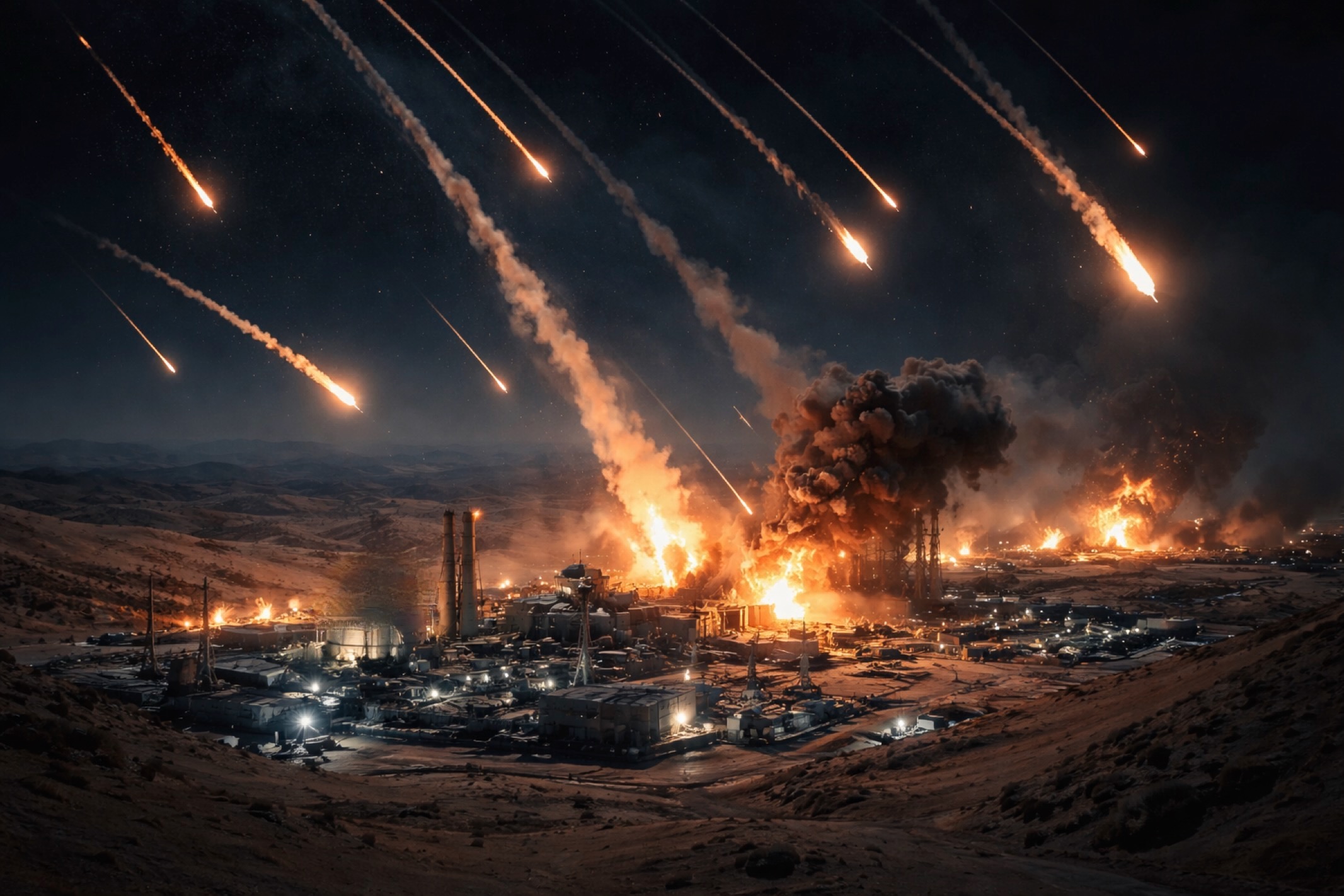
United States and Israel launch airstrikes on Iranian military, nuclear, and infrastructure targets amid escalating conflict. What is your most up-to-date and in-depth assessment?
Strategia-100, Chief Strategist:
Below is the most up-to-date strategic assessment of the U.S.–Israeli campaign against Iran (as of early March 2026), structured across military, political, regional, and global-system layers.
1. Operational Reality: A Large-Scale Air War Already Underway
The conflict effectively began 28 February 2026 with a coordinated U.S.–Israeli strike campaign against Iranian military, nuclear, and leadership targets.
Key operational facts:
- Roughly 200 aircraft and missile systems struck hundreds of targets across at least 14 Iranian cities, including Tehran, Isfahan, Qom, Karaj, and Kermanshah.
- Targets include:
- nuclear research facilities
- missile production sites
- IRGC bases and command centers
- air defense systems
- airports and military infrastructure such as Tehran’s Mehrabad Airport.
- The campaign is continuing and intensifying, with Washington signaling that the bombing could last weeks.
The strikes reportedly killed Iran’s Supreme Leader Ali Khamenei, creating a sudden leadership crisis inside Iran.
Civilian casualties have been significant, with more than 1,300 deaths reported in Iran so far.
This is no longer a limited strike. It is a sustained war campaign designed to degrade Iranian state power.
2. Iranian Response: Multi-Front Retaliation Strategy
Iran has responded asymmetrically across the region.
Missile and drone strikes
Iran launched hundreds of missiles and drones against:
- Israel
- U.S. bases in Qatar, Bahrain, Kuwait, UAE, Jordan, and Saudi Arabia
Several Gulf countries reported interceptions and damage.
Maritime escalation
Iran also:
- targeted oil tankers
- threatened or disrupted shipping
- closed the Strait of Hormuz, a chokepoint for global energy trade.
This is strategically significant because ~20% of global oil flows normally pass through that strait.
Proxy activation
Iran-aligned forces have begun joining the conflict:
- Hezbollah attacks on Israel from Lebanon.
- militia activity in Iraq and elsewhere.
This confirms the war is already regionalizing.
3. Political Shock: Leadership Decapitation and Regime Uncertainty
The reported death of Iran’s supreme leader represents the largest political shock to Iran since 1979.
Consequences include:
1. Power vacuum
- competing factions inside the IRGC and clerical establishment.
2. Hard-liner consolidation
- wars historically strengthen security elites.
3. Revolutionary instability
- protests had already been growing in early 2026 before the war.
The U.S. leadership has openly hinted at regime-change ambitions, though intelligence officials doubt strikes alone can achieve that outcome.
Historically, external attacks often rally populations around regimes rather than collapse them.
4. Strategic Military Objectives of the U.S.–Israel Coalition
The campaign appears to pursue four overlapping goals:
1. Destroy nuclear breakout capability
Attacks on nuclear facilities aim to delay or eliminate Iran’s nuclear weapon pathway.
2. Cripple missile infrastructure
Iran’s ballistic missile arsenal is considered the primary threat to Israel and U.S. bases.
3. Break the “Axis of Resistance”
Iran’s regional network includes:
- Hezbollah
- Iraqi militias
- Syrian elements
- Yemeni Houthis
The war seeks to degrade Iran’s command-and-control backbone.
4. Strategic coercion or regime collapse
Some U.S. statements suggest a broader objective: forcing Tehran to surrender or undergo regime change.
This is the most dangerous objective because it raises the war’s escalation ceiling dramatically.
5. Global System Effects
Energy markets
The Strait of Hormuz disruption threatens global oil supply chains.
Immediate effects:
- oil price volatility
- tanker rerouting
- insurance spikes for shipping
Financial markets
War risk in the Gulf tends to trigger:
- commodity inflation
- defense stock surges
- emerging market instability
Great-power positioning
Other major powers are watching carefully:
- Russia may benefit geopolitically from Western distraction.
- China is heavily exposed through energy imports from the Gulf.
Neither wants a prolonged disruption but neither will intervene militarily.
6. Possible Strategic Trajectories (Next 3–12 Months)
Scenario A — Contained regional war (40%)
Airstrikes continue for weeks; Iran retaliates but avoids total escalation.
Outcome:
- nuclear program delayed
- heavy regional instability
Scenario B — Full Middle East war (35%)
Hezbollah, Iraq militias, and possibly Syria fully enter.
Outcome:
- Israel-Lebanon war
- Gulf states pulled in
- massive oil shock
Scenario C — Regime collapse in Iran (10%)
Internal elite fragmentation after leadership decapitation.
Outcome:
- unpredictable power struggle
- potential civil conflict
Scenario D — Nuclear breakout escalation (15%)
Iran decides nuclear weapons are the only deterrent.
Outcome:
- extremely dangerous strategic shift.
7. Strategic Interpretation
This conflict marks a transition from shadow war to overt interstate war between Iran and the U.S.–Israel axis.
The most significant structural features are:
- leadership decapitation
- regional proxy activation
- energy chokepoint pressure
- regime-change signaling
Together these factors create one of the most dangerous geopolitical crises since the Iraq War.
Strategic Science Perspective
From the standpoint of classical strategy, this campaign resembles decapitation warfare combined with coercive airpower. Carl von Clausewitz warned that war seeks the opponent’s “center of gravity”—the source of political power. The strikes appear designed to attack Iran’s centers simultaneously: leadership, military capability, and nuclear infrastructure. Yet Clausewitz also cautioned that war is “the realm of uncertainty.” Historical evidence—from Iraq (1991), Serbia (1999), and Libya (2011)—shows that air campaigns can weaken regimes but rarely produce predictable political outcomes. In systems-theory terms, Iran is a complex adaptive system: removing a central node (like the supreme leader) can either collapse the network or trigger hard-line consolidation.
✅ Bottom line:
The U.S.–Israel operation has already crossed the threshold into a regional war with global economic implications, and the decisive factor now is not the bombing itself—but whether Iran escalates horizontally through proxies and maritime disruption.
Strategia-100, Chief Strategist
Three Corporate