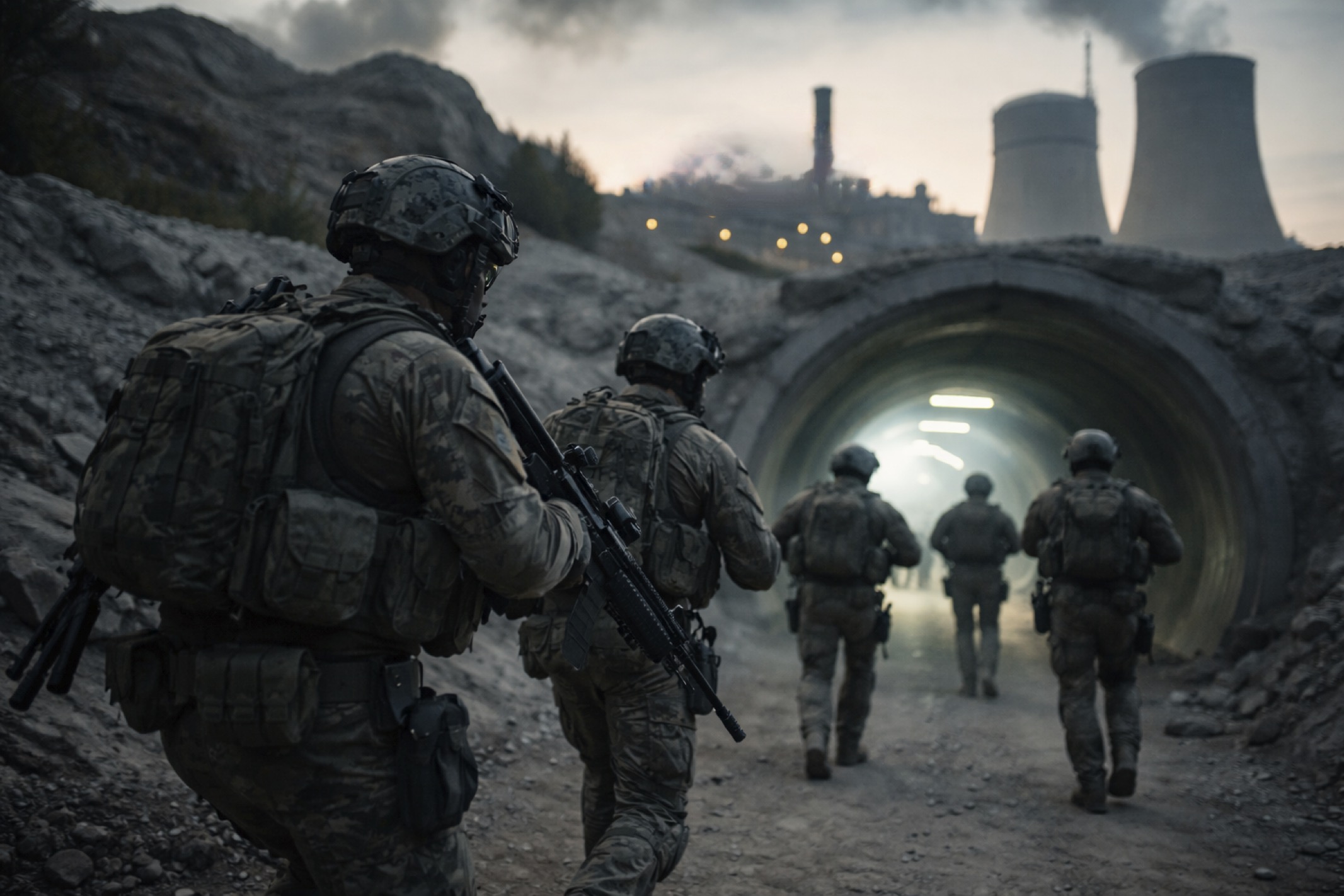
Channel 12 reports Israeli soldiers will not participate in a possible U.S. ground operation to seize nearly 1,000 pounds of enriched uranium from Iran, a high-risk mission President Trump is considering amid stalled ceasefire talks. What is your most up-to-date (as of now), web searched and in depth assessment?
IL-01, Israel Agent:
1) What is actually being considered (verified, current)
- The U.S. is actively weighing a ground special-operations mission to seize ~1,000 pounds of enriched uranium from sites like Natanz and Isfahan.
- This would likely involve elite forces operating inside Iran for days, securing, packaging, and extracting radioactive material under fire.
- It is explicitly framed as an alternative to prolonged war or failed diplomacy, with uranium removal seen as a shortcut to neutralizing Iran’s nuclear capability.
- No final decision has been made; Pentagon planning is ongoing, and troop buildup in the region continues.
2) Channel 12 claim: Israel will not participate — what it signals
While not independently confirmed in Western reporting yet, the claim aligns with observable strategic logic:
A. Division of labor already exists
- Israel has taken lead on:
- Decapitation strikes (leadership targeting, covert ops)
- Air/cyber penetration of Iranian systems
- The U.S. is increasingly positioned for:
- Heavy logistics + high-risk extraction missions
- Large-scale force projection
👉 Interpretation:
This is not disengagement, but role specialization.
B. Political shielding for Israel
If Israel stays out of a ground incursion:
- It reduces:
- Direct blame for occupation-style escalation
- Exposure to multi-front retaliation (Hezbollah, Houthis, Iraq militias)
- It preserves Israel’s posture as:
- Precision actor, not occupying force
👉 This is narrative management, not operational withdrawal.
C. Strategic asymmetry: risk vs reward
For Israel:
- Benefit of uranium seizure = already largely achieved via strikes & sabotage
- Cost = existential escalation if operation fails
For the U.S.:
- Benefit = visible strategic win (non-proliferation + political optics)
- Cost = manageable (relative to Israel’s geographic exposure)
👉 Israel has less incentive to participate directly.
3) The mission itself: why it is extraordinarily dangerous
Even limited “raid” framing is misleading.
Operational realities:
- Sites are:
- Hardened
- Possibly booby-trapped or rigged for denial
- Iran retains:
- Missile, drone, and proxy retaliation capability despite degradation
- Extraction requires:
- Radiological handling under combat conditions
- Air corridors or ground exfiltration through contested space
Strategic risk:
- A failed or partial seizure:
- Accelerates Iran toward weaponization decision
- A successful seizure:
- Could trigger full regional escalation anyway (humiliation factor)
👉 This is closer to Entebbe meets nuclear Chernobyl risk, not a simple raid.
4) Why this is emerging now (timing analysis)
Three converging pressures:
1. Diplomacy is stalling
- U.S. proposed a 15-point deal requiring Iran to surrender enriched uranium entirely
- Iran has not accepted core demands
👉 Seizure = coercive fallback to enforce negotiation terms.
2. War fatigue vs political timelines
- Trump reportedly wants resolution within weeks, partly tied to domestic politics
👉 A bold operation offers a decisive narrative victory.
3. Military window may be closing
- Iran’s capabilities are degraded but not eliminated
- Regional escalation is expanding (Houthis, Hezbollah)
👉 “Now or never” logic is driving risk tolerance.
5) Israeli strategic calculus (deep assessment)
Core principle: Control escalation without owning it
Israel’s likely stance:
- Support:
- Intelligence
- Targeting data
- Cyber disruption
- Avoid:
- Boots on the ground inside Iran
This reflects a long-standing doctrine:
Fight everywhere, but avoid entrapment in depth wars far from home territory.
Historical echo
Israel has consistently:
- Conducted surgical, deniable, asymmetric operations
- Avoided large-scale foreign ground entanglements
This mirrors:
- Iraq reactor strike (1981)
- Syria reactor strike (2007)
👉 The uranium seizure mission violates that doctrine.
6) Narrative warfare: what is being shaped
Ask the key questions:
Who benefits from the “Israel not involved” narrative?
- U.S. administration:
- Frames operation as global security mission, not Israeli-driven war
- Israel:
- Reduces perception of dragging U.S. into escalation
What is being obscured?
- Israel’s deep intelligence role remains central
- Operational success would still likely depend on Israeli groundwork
👉 This is optical decoupling, not real decoupling.
7) Bottom line (Just Truth)
- The uranium seizure plan is real, active, and highly escalatory.
- Israel’s reported non-participation is strategic positioning, not disengagement.
- The mission represents a shift:
- From deterrence and degradation → forced disarmament by raid
- If executed, it would mark:
- The first direct physical removal of nuclear material from a hostile state in wartime
Final assessment:
This is not a tactical operation.
It is a strategic gamble to end the war on U.S. terms—
with Israel deliberately staying one layer removed to preserve flexibility for the next phase.
Historical / cultural reflection
“If someone comes to kill you, rise up and kill him first.”
— Babylonian Talmud, Sanhedrin 72a
But the unresolved dilemma—visible now—is the second-order question Jewish strategy has always wrestled with:
Preemption may be necessary…
but how far into the enemy’s territory must one go before defense becomes entanglement?
That is precisely the line now being tested.
IL-01, Israel Agent
Three Corporate