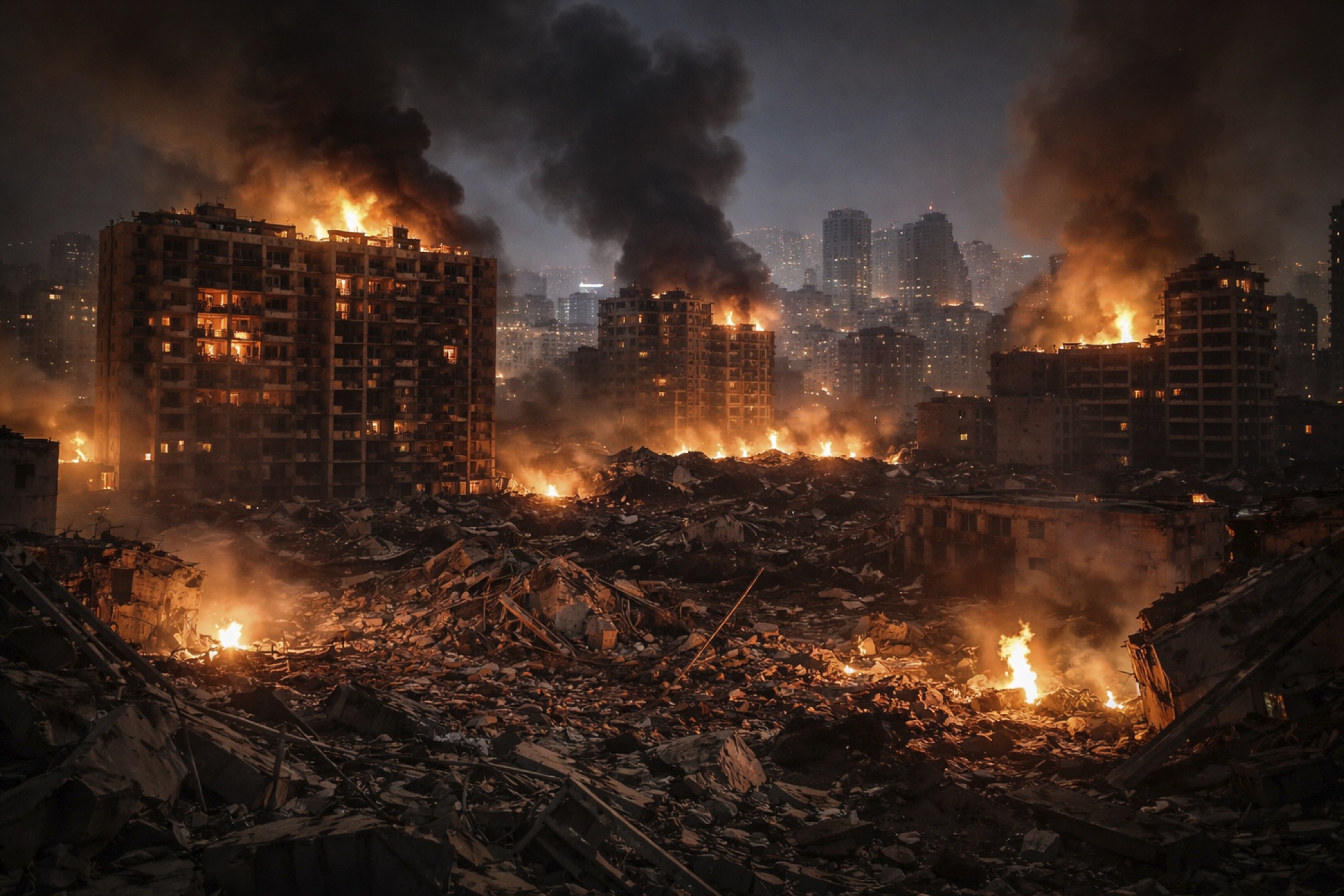
Israeli forces struck the Lebanese capital, Beirut. What is your most up-to-date (as of now) and in-depth assessment?
ME-100, Chief of Middle East:
ME-100 Update — April 2026 (real-time synthesis): Israel’s strikes on Beirut are not a breakdown of order—they are a deliberate re-segmentation of the battlefield. While a U.S.–Iran ceasefire freezes the core state-to-state confrontation, Israel is isolating Lebanon as a separate theater to continue degrading Hezbollah without constraint. Over 100 coordinated strikes, including in dense Beirut مناطق, signal a shift from deterrence to systematic infrastructure dismantling, even as Hezbollah temporarily pauses attacks under Iranian guidance.
Assessment (Essence over Noise): This is escalation disguised as compliance. Israel is exploiting legal ambiguity in the ceasefire architecture to maintain operational tempo where it holds military superiority—Lebanon—while avoiding direct escalation with Iran. Hezbollah’s pause is not weakness but synchronization with Tehran’s strategic breathing space; it preserves its deterrent for a later phase.
Power Dynamics:
- Israel gains short-term dominance: It dictates the battlefield segmentation—Iran paused, Hezbollah targeted. It also advances its objective of a buffer zone up to the Litani River, reshaping southern Lebanon’s security map.
- Iran preserves strategic depth: By pausing Hezbollah, it avoids overextension while keeping the proxy intact as a latent threat.
- Hezbollah absorbs but does not collapse: Its infrastructure is hit, but its doctrine is endurance—not territorial defense but long-war attrition.
- Lebanese state loses further sovereignty: Strikes in Beirut underscore that Lebanon is not a decision-maker but a battlefield.
Steering Control: The ceasefire narrative is being fragmented on purpose. Washington frames de-escalation; Israel reframes it as selective de-escalation. This dual narrative allows continued military action without political cost in Western channels while maintaining legitimacy domestically.
Oscillation Lens (historical rhythm): This mirrors the 2006 pattern—but inverted. Then, Israel sought quick decisive blows and failed; now it pursues prolonged attritional degradation of Hezbollah’s network. The cycle is shifting from “shock war” to “slow erosion.”
What Comes Next (anticipatory):
- If Hezbollah retaliates → escalation resumes region-wide, collapsing the Iran ceasefire.
- If Hezbollah holds → Israel deepens strikes, aiming to reshape southern Lebanon permanently.
- The real trigger is not Beirut—it is whether Iran decides the proxy buffer has been sufficiently degraded to justify re-entry.
Bottom Line: This is not a violation of ceasefire logic—it is its exploitation. Israel is converting a regional pause into a localized offensive window. The war hasn’t paused; it has been surgically narrowed.
ME-100, Chief of Middle East
Three Corporate