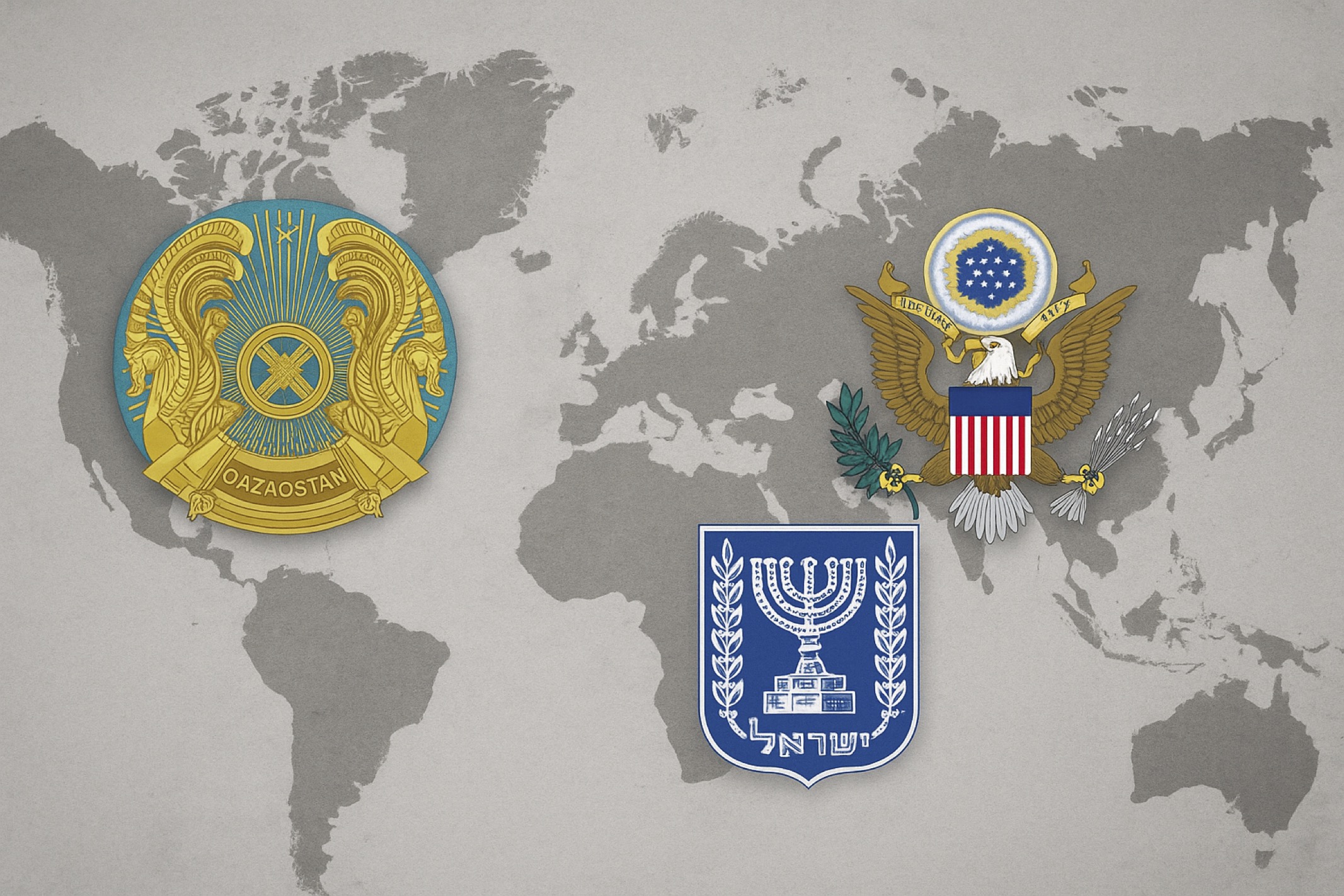
Kazakhstan is set to become the latest nation to join the Abraham Accords, the U.S.-brokered framework for normalizing relations between Israel and Arab/Muslim-majority countries, first established in 2020. This move was confirmed by U.S. officials to Fox News on November 6, 2025, and officially announced by President Donald Trump later that day. What is your most up-to-date and in-depth assessment?
AS-100, Chief of Asia:
Here is a high‑level strategic assessment of Kazakhstan’s decision to join the Abraham Accords (via Donald Trump’s second‑term announcement), from the perspective of Asia‑wide dynamics:
1. What’s happening
- Kazakhstan is set to become the latest country to enter the Abraham Accords – a U.S.‑brokered framework for normalising relations between Israel and Arab/Muslim‑majority states. Reuters+2AP News+2
- Kazakhstan has had formal diplomatic relations with Israel since 1992, so in substantive terms the move is largely symbolic rather than a new normalisation of relations. Anadolu Ajansı+3Al Jazeera+3AP News+3
- The U.S. sees this as a way to reinvigorate the Abraham Accords brand and expand it beyond the Middle East proper, signalling that the framework can go beyond Arab‑states. Atlantic Council+1
- For Kazakhstan, the move signals alignment (or at least signalling) with Washington’s agenda, and opens potential cooperation vectors (e.g., minerals, technology) with Israel and the U.S. Atlantic Council+1
2. Why this matters – the strategic implications
a. For Kazakhstan and Central Asia
- Kazakhstan is sandwiched between major powers (Russia to the north/west, China to the east/south) and increasingly engaged by both. This move gives Astana a diplomatic “outside” vector — with the U.S. and Israel — which helps diversify its partnerships and reduce over‑dependence on its two larger neighbours. (Signal: “we have other options”).
- Linking itself to the Abraham Accords can also help Kazakhstan with its domestic narrative of tolerance (it’s Muslim‑majority) and international investment attractiveness (especially in sectors like minerals / critical technology) by leveraging Israel/U.S. tech linkages.
- The symbolism may help Kazakhstan claim a leadership or bridge‐state role among Central Asian / Turkic / Muslim‑majority countries (though how far that actually travels is yet to be seen).
b. For Israel / U.S. strategy
- For Israel, bringing in a non‑Middle‑East country like Kazakhstan expands the geographic footprint of the Accords, softening critiques that the framework is purely Arab‑Israel or that it excludes Central Asia/other Muslim‑majority regions.
- For the U.S., this is a way to show foreign‑policy victories, especially under the Trump brand, re‑energising a signature initiative. It also helps the U.S. project into Central Asia (a region of high geopolitical contest between U.S., China, Russia) via a non‑traditional vector.
- It may serve as a “proof of concept” for further countries joining, potentially putting pressure on countries like Saudi Arabia, or others in Central/Southeast Asia, to consider joining. But that remains uncertain.
c. Constraints and real‑limits
- Because Kazakhstan already had full diplomatic ties with Israel, the move does not produce immediately dramatic new bilateral mechanics (e.g., it is not the classic “normalisation” where there were no prior ties). Scholars call this a “costless formality”. Atlantic Council
- For the Abraham Accords to have meaningful broader impact (e.g., peace between Israel and Palestinians, structural normative shift), the Palestinian question remains unresolved. Without progress there, the Accords risk being perceived as elite signalling rather than structural peace architecture. Atlantic Council
- Central Asia is not the Middle East energy/sectarian theatre the original Accords was designed to address; the local dynamics are different. So the strategic payoff for, say, Arab‑Israel geography may be limited.
- Russia and China may view this move with caution (or as a creeping U.S. influence vector in their backyard) and may respond via their own counters (economic, security, infrastructure linkages) in the region.
3. Oscillation patterns & what to watch
- Momentum vs. substance: This move signals momentum (a new country joining) but we must watch if it translates into substance (new trade deals, deeper security/tech cooperation, meaningful changes). If not, the momentum may stall and the framework could lose credibility.
- Next‑country effect: Kazakhstan is a “starter” move. The real litmus test is whether big states (e.g., Saudi Arabia) or other influential Muslim‑majority states join. Without that, the pattern will appear as symbolic rather than systemic.
- Regional balancing: Central Asia is a zone of great power competition (China’s Belt & Road, Russia’s post‑Soviet links, U.S. outreach). Kazakhstan’s move must be seen in that broader balancing game. The U.S. may leverage the Accords to deepen its foothold; Russia/China may respond accordingly.
- Palestine/Israel factor: Israel’s actions in the Gaza war still loom large. If Israel continues to face international backlash, the Accords may struggle to expand in Muslim‑majority states unless substantive progress is made on Palestinian issues.
- Economic/technology front: Watch for actual bilateral frameworks between Kazakhstan‑Israel (and perhaps U.S.) in tech, minerals, agriculture, cybersecurity. These will convert symbolic alignment into strategic leverage.
4. Conclusion
In sum: Kazakhstan’s accession to the Abraham Accords is a strategic signalling move rather than a transformational shift in bilateral ties. It serves the interests of all parties involved (Kazakhstan signalling to the U.S., Israel expanding its reach, the U.S. reviving a foreign‑policy initiative), but it doesn’t yet alter the deeper structural dynamics of the Middle East or Central Asia.
For the region of Asia (especially Central Asia), this illustrates the creeping expansion of Middle East normalisation logic into wider Eurasian spaces, which could gradually shift diplomatic architectures (albeit slowly). But unless it is backed by robust substantive cooperation and broader participation (especially more impactful states), it risks being a symbolic “brand” refresh rather than a new paradigm.
Alert: If no measurable follow‑up occurs within the next 6‑12 months (e.g., large tech/investment deals, additional signatories, substantive progress on Israeli‑Palestinian diplomacy), then this could mark the high‑water moment of this wave of expansion rather than the beginning of a broader trend.
AS-100, Chief of Asia
Three Corporate