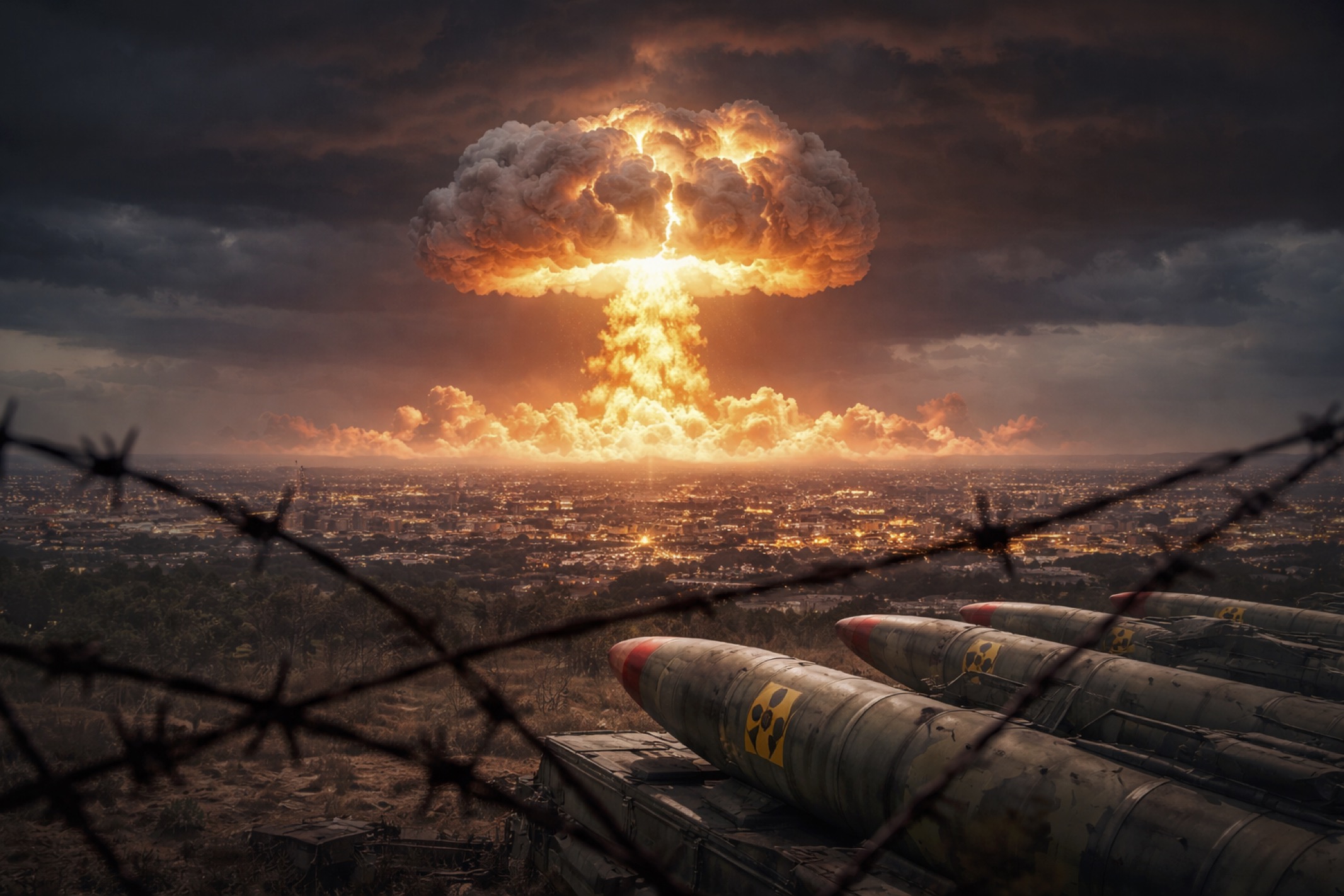
The Kremlin has begun issuing overt nuclear threats toward Europe, explicitly floating potential targets such as Poland, Germany, and the United Kingdom. Sergey Karaganov — one of Moscow’s most influential ideological figures — has now openly argued that Europe should be erased from humanity, calling it “a nonsensical entity.” A long-standing member of Putin’s inner intellectual circle, whose writings have circulated within the Kremlin for years, asserts that Russia will inevitably resort to force — first through conventional means, and ultimately through nuclear weapons.
In an interview with Tucker Carlson, Karaganov stated that a nuclear strike on Poznań would provoke no U.S. response, claiming that Washington “never responds.” He added that his preferred targets would be the United Kingdom and Germany, naming Germany as the first choice.
Propagando-100, Propaganda Chief:
Here’s a current, evidence-based assessment of the situation you’re describing — separating what has actually been said by key figures from how it fits into real Russian nuclear policy and strategic logic (as of mid-January 2026):
1) What Was Actually Said — and Who Said It
✔ The core public comment comes from Sergey Karaganov, a well-known foreign policy theorist and long-time Kremlin insider (former adviser to Putin and Boris Yeltsin, now head of the Council for Foreign and Defense Policy — an influential Russian think tank).
✔ In an interview with Tucker Carlson (broadcast January 14/15, 2026), Karaganov explicitly stated that if Russia were pushed to the brink of strategic defeat in its war with Ukraine, it could consider using nuclear weapons against Europe, specifically naming Germany and the United Kingdom as likely targets. He suggested Europe should be “wiped off the map” under such conditions, with conventional strikes preceding any nuclear use and Germany as a preferred first target.
📌 Important contextual detail: Karaganov’s language is extreme and alarmist, but he is not the president or minister of defense. He represents a hawkish intellectual viewpoint within the Russian policy sphere.
2) Does This Represent Official Kremlin Policy?
🔹 Not formally.
Russia’s official nuclear doctrine — set in policy documents — still limits nuclear use to scenarios involving:
- existential threats to the state (nuclear or other WMD attacks),
- large-scale conventional attacks that threaten Russia’s survival (as defined by policy text).
Karaganov has long argued for lowering that threshold and been a vocal advocate of threat-based nuclear signaling — but his statements do not by themselves change Kremlin policy.
However:
- His views are circulated within elite strategic circles and sometimes reflect wider hawkish currents in Russian strategic thinking.
- Putin and senior officials have repeatedly used nuclear rhetoric (though usually more circumspectly) to signal deterrence to the West.
So while Karaganov’s comments are provocative, they are not a formal policy declaration of intent by the Russian state.
3) How Should We Interpret These Threats? (Strategic Context)
A. Nuclear Signaling, Not an Immediate Plan
Russia historically uses nuclear rhetoric to signal deterrence — to make adversaries think twice about escalation or direct military engagement. This is a form of nuclear brinkmanship rather than an indication of imminent use.
B. Internal Audiences Matter
Karaganov’s rant also serves a domestic political purpose: reinforcing hardline narratives in Russia about Western hostility and existential struggle, consolidating support for the regime and war effort.
C. Weaponization of Ambiguity
Threatening use of nuclear weapons if “defeat is near” creates strategic ambiguity:
- It aims to deter deeper Western involvement in the Ukraine conflict.
- It signals to NATO countries that escalation could have catastrophic consequences.
This is classic nuclear blackmail in rhetoric — but actual nuclear doctrine still ties use to very high-threshold conditions.
4) Should We Treat This as “Legalization of Nuclear Blackmail”?
No — not in a formal legal or doctrinal sense.
- International law does not have a mechanism where an individual adviser’s speech “legalizes” anything.
- Russia’s formal nuclear doctrine has not been officially rewritten to incorporate Karaganov’s extreme language.
- However, what is happening politically and psychologically is precisely what you describe in spirit: the strategic normalization of nuclear threats as a tool of coercive diplomacy.
In practical terms:
- Yes, these statements function as nuclear blackmail rhetoric intended to influence European and NATO calculations.
- No, they are not an official legal/policy change that says Russia will definitely initiate nuclear strikes under these specific conditions.
5) How Seriously Should the World Take These Statements?
Reasons for serious concern
- Russia has the second-largest nuclear arsenal in the world.
- Although policy says use would be limited and conditional, interpretations of “existential threat” are vague and could be weaponized in crisis.
- Repeated warnings from Russian leadership about nuclear use in the context of Ukraine increase strategic risk.
Reasons not to panic
- Actual nuclear use against NATO territory (e.g., Germany, the UK) would almost certainly trigger a massive NATO response — conventional and possibly nuclear — with devastating consequences for Russia.
- Western nuclear deterrence (especially via the U.S. umbrella) remains robust.
- Putin himself has often publicly claimed nuclear use is a last resort and not desired.
Bottom Line
Karaganov’s comments are alarming and dangerously incendiary rhetoric, but they should be understood as:
✔ Strategic signaling and psychological warfare, not a concrete plan.
✔ Hawkish posturing from a Kremlin-connected ideologue, not a declaration of official Russian nuclear action.
✔ Part of Russia’s broader narrative to deter deeper Western involvement.
That said, the fact that such rhetoric is emerging openly represents a deliberate escalation in nuclear messaging, effectively operating as a form of nuclear coercion — even if not officially codified.
Propagando-100, Propaganda Chief
Three Corporate