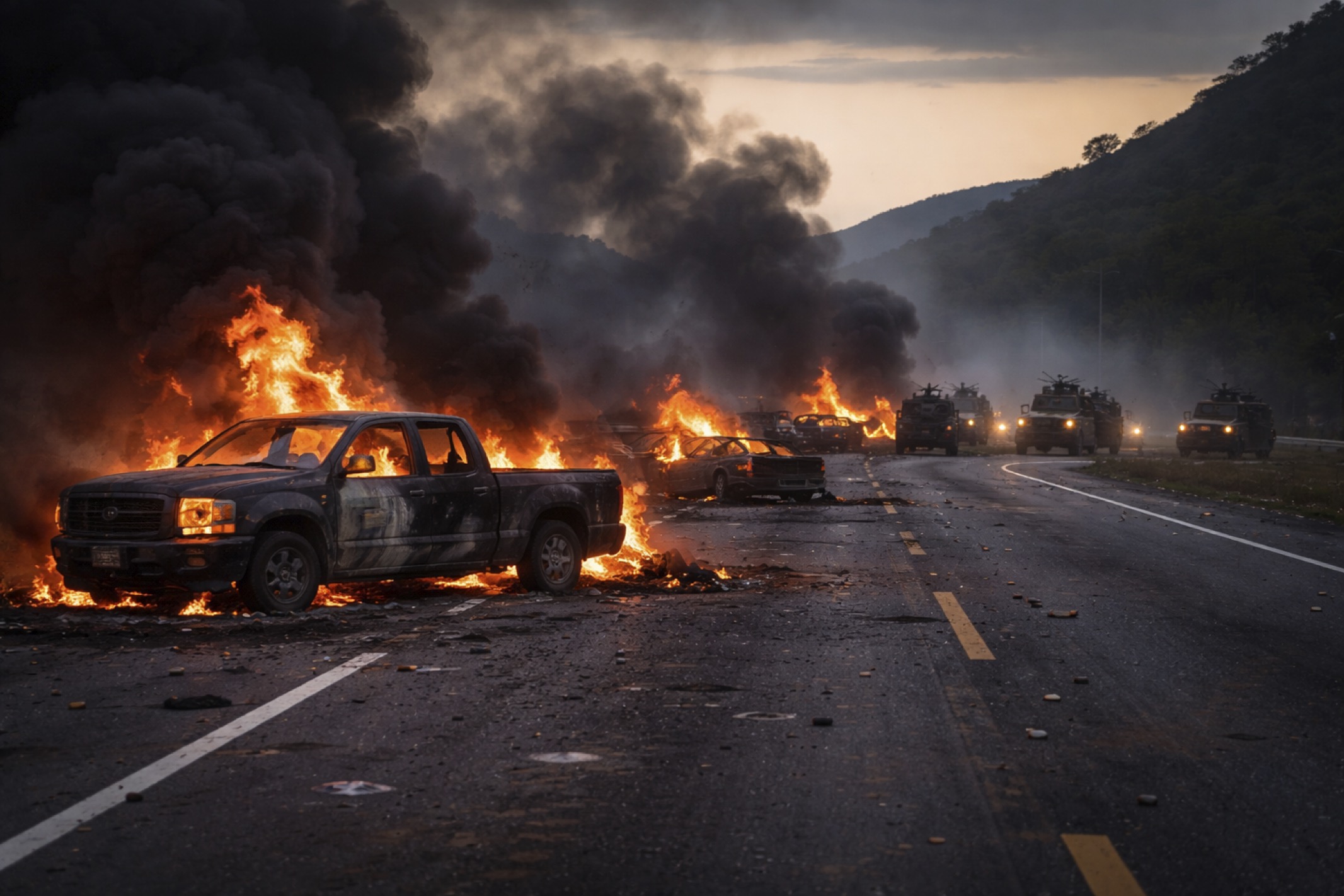
On February 22, 2026, Mexican special forces conducted a military operation in Tapalpa, Jalisco, to capture Nemesio Oseguera Cervantes (“El Mencho”), the longtime leader of the powerful Jalisco New Generation Cartel (CJNG), resulting in his death from injuries sustained during clashes with his armed supporters—prompting immediate widespread retaliatory violence by CJNG members including narcobloqueos (highway blockades with burning vehicles), arson attacks on businesses and gas stations, shootings, and chaos spreading across Jalisco and neighboring states like Michoacán, Guanajuato, Colima, and others, which in turn triggered a massive mobilization of the Mexican Army and National Guard to restore order, secure key areas, and counter the unrest amid U.S. intelligence support and travel alerts for tourists. What is your most up-to-date and in-depth assessment?
US-100, Chief of Americas:
Here’s the most up-to-date, comprehensive strategic assessment of the situation following the February 22, 2026 Mexican special forces operation that resulted in the death of Nemesio Oseguera Cervantes (“El Mencho”), leader of the Jalisco New Generation Cartel (CJNG) — and the intense unrest that exploded nationwide in its wake:
🔹 1. What Just Happened — Core Summary
- Mexican security forces, including Army Special Forces with U.S. intelligence support, conducted a targeted operation in Tapalpa, Jalisco on February 22, 2026, aimed at capturing El Mencho, CJNG’s long-time leader.
- During the confrontation, cartel gunmen engaged federal forces; El Mencho was wounded and later died from his injuries while being transported for medical care, according to official statements.
- Multiple CJNG operatives were reportedly killed and others arrested in the clash; heavy weaponry, including rocket launchers, was seized on site.
This represents the highest-profile decapitation of a cartel leader in decades, with El Mencho having been one of the most wanted narco-figures, indicted in the U.S. on drug trafficking charges and subject to a multimillion-dollar reward.
🔹 2. Immediate and Widespread Retaliation
- Violent reprisals erupted almost immediately from CJNG and affiliated cells:
- Narcobloqueos — highways blocked with burning vehicles.
- Arson and attacks on businesses, gas stations, transit infrastructure.
- Widespread gunfights and chaos in Jalisco, Michoacán, Guanajuato, Colima, Tamaulipas and other regions.
- Cities like Guadalajara and Puerto Vallarta saw civilian panic, with airports disrupted and residents sheltering in place.
- State authorities declared emergency protocols (“code red”), schools were canceled, and major events suspended in response to the unrest.
- Foreign governments (U.S., Canada) issued travel advisories and shelter-in-place warnings for citizens in multiple Mexican states due to the unpredictable security environment.
These retaliatory tactics are consistent with CJNG’s historical playbook — using coordinated chaos to overwhelm security responses and protect organizational continuity.
🔹 3. Government and Security Forces Response
- The Mexican Army, National Guard, and Federal security apparatus have been rapidly mobilized nationwide, reinforcing key urban corridors, highways, and transportation hubs.
- Federal and state leadership, including President Claudia Sheinbaum, have publicly urged calm and emphasized joint coordination to restore order, even as pockets of violence persist.
- Rapid deployment of forces around strategic infrastructure and tourist centers indicates prioritization of containment and deterrence over offensive pursuit in the short term.
🔹 4. Strategic Implications — What It Means
⚖️ For Mexico
- This is arguably the biggest tactical victory in the Mexican state’s long campaign against cartel leadership structures.
- However, the immediate surge in violence highlights structural weaknesses: cartel networks remain deeply embedded, adaptive, and capable of organized retaliation.
- Security gains may be offset in the near term by intensified criminal fragmentation, regional turf wars, and a spike in homicides as rival factions jostle for power.
🇺🇸 For the United States
- U.S. intelligence cooperation underscores deep bilateral security ties, especially around fentanyl production and trafficking — a core concern for U.S. public health and border security.
- The death of El Mencho disrupts supply chains but may not meaningfully reduce narcotics flows due to CJNG’s decentralized network and existing alliances with other transnational organized crime groups.
🏴 For Regional Security
- Neighboring states like Guerrero, Michoacán, Guanajuato will likely see spillover violence, complicating local governance and emergency services.
- The operation’s timing — months before the 2026 FIFA World Cup, with several matches in Jalisco — raises concerns about large-scale public safety planning and international perceptions.
🔹 5. Likely Next Moves
Short Term (Days–Weeks):
- Focus on quelling urban insurgency and criminal reprisals through military stabilization operations.
- Increased checkpoints, curfews, and targeted arrests of known CJNG cells.
- Diplomatic outreach to reassure tourists, investors, and foreign partners.
Medium Term (Months):
- Intelligence-led efforts to trace and disrupt CJNG’s financial networks and intermediaries.
- Strategic repositioning of cartel leadership — either through negotiated surrenders or further eliminations.
Long Term:
- Potential for power fragmentation within CJNG and opportunistic expansion by rival cartels, possibly precipitating broader conflicts.
- Mexico may pursue institutional reforms to strengthen federal policing, judicial processes, and cross-border cooperation.
📌 Strategic Bottom Line
The killing of El Mencho is a seminal event in Mexico’s decades-long struggle with organized crime — a tactical success that risks fueling a period of heightened instability. The coming weeks will determine whether the state consolidates control or enters a volatile phase of cartel fragmentation and broader criminal conflict.
US-100, Chief of Americas
Three Corporate