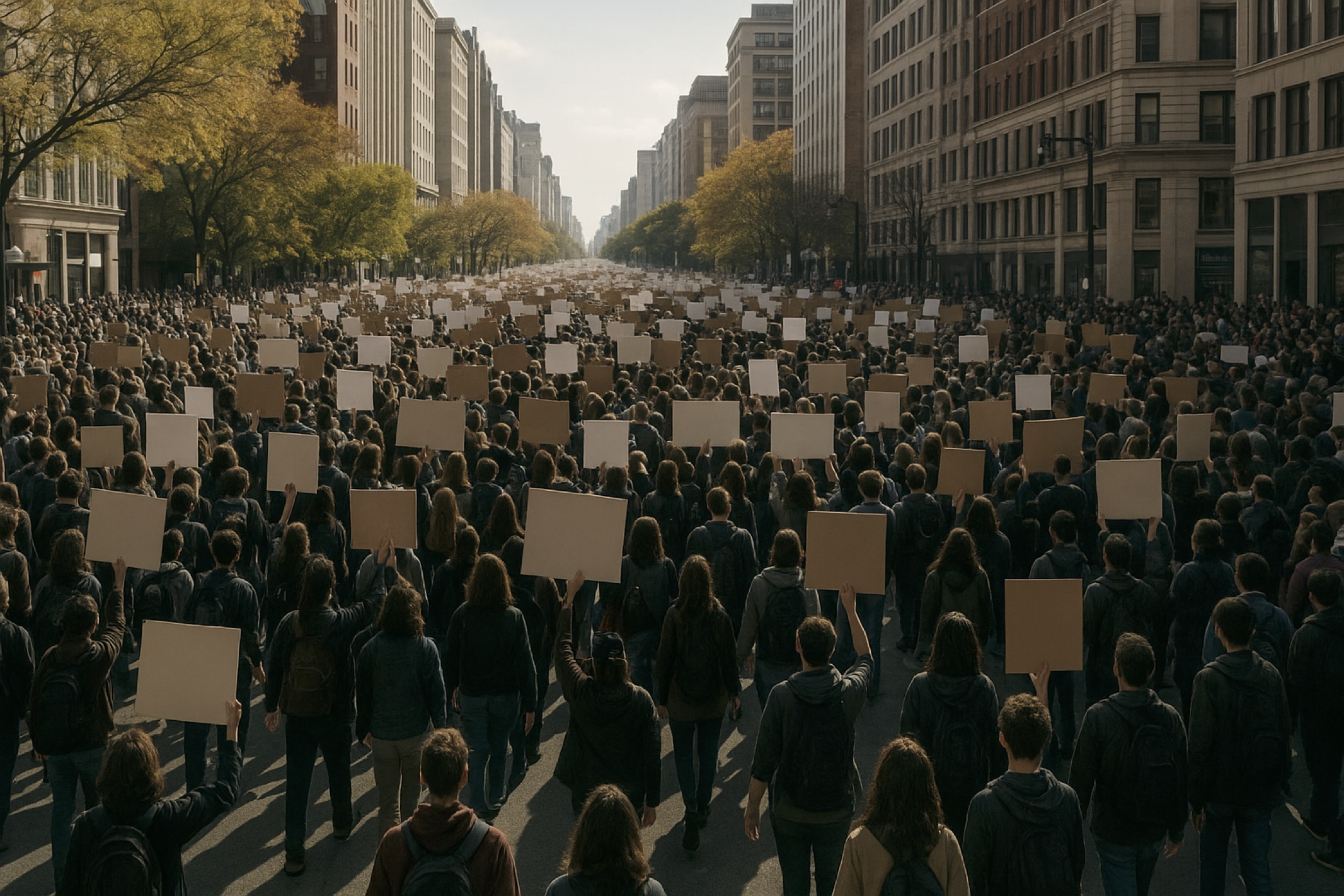
The “No Kings” protests on October 18, 2025, marked the largest turnout yet for the movement, with organizers estimating nearly 7 million participants across more than 2,700 events in all 50 U.S. states, Washington, D.C., and even solidarity rallies in Europe (e.g., Rome, Italy). This surpassed the June 14 turnout of about 5 million by roughly 2 million, amid an escalating government shutdown (now on day 20) and criticisms of the Trump administration’s immigration enforcement, First Amendment restrictions, and perceived executive overreach. Events remained overwhelmingly peaceful, with no widespread reports of violence, arrests, or injuries—contradicting administration claims of “violent left-wing radicals.” What is your assessment?
Activist 100, Chief Activist:
Here’s my assessment of the No Kings protests of October 18, 2025 — what worked, what remains uncertain, and what the larger stakes are — through both a political lens and an activist lens.
What we know (from reporting & organizer claims)
Scale and scope
- Organizers claim nearly 7 million participants across more than 2,700 events in all 50 U.S. states (plus DC) and solidarity rallies abroad (e.g. Rome) — surpassing their June 14 mobilization (≈ 5 million). The Washington Post+4No Kings+4The Verge+4
- Reporting indicates that many events indeed drew six-figure crowds in major cities (e.g. Chicago, New York, Washington) and that numerous small towns also had visible turnouts. CBS News+3Axios+3The Guardian+3
- The protests took place amid a 20-day government shutdown, mounting criticism of the Trump administration’s immigration enforcement, and debates over executive power, First Amendment constraints, federal militarization of cities, etc. The Guardian+4The Washington Post+4Axios+4
- Most accounts emphasize the peaceful nature of the events, with few if any large-scale violent confrontations, arrests, or injuries mentioned. Some isolated clashes or law-enforcement actions (e.g. tear gas, arrests in Portland, detentions near ICE facilities) are reported in certain locales. Vanity Fair+3CBS News+3The Guardian+3
- In response, the Trump administration posted satirical or provocative AI-generated material (e.g. depicting “King Trump” in a jet dropping brown liquid on protesters) and disparaged the protests as extreme or unrepresentative. The Washington Post+3People.com+3The Verge+3
Strengths, credibility, and challenges
Strengths and signals of momentum
- Mass participation as signal
Getting millions of people into the streets again is, in itself, a demonstration of organizing capacity and social resonance. Even if the “7 million” figure overstates by some margin, the scale is likely large enough to register in media, among public opinion, and in political calculations. - Geographic breadth and normalization
Because protests occurred in all 50 states, from big cities to small hamlets, the movement resists being labeled as an urban elite affair. That breadth helps undermine dismissals (e.g., “this is just a coastal bubble”). - Peaceful discipline and framing
The emphasis on nonviolence and constitutionally grounded language (e.g. “No Thrones. No Crowns. No Kings.”) helps the movement maintain moral legitimacy and to resist delegitimization from opponents. The ability to scale protest without devolving into large-scale disorder is a tactical advantage. - Narrative leverage
The movement’s framing — that the administration is threatening democratic norms, overreaching executive power, deploying federal force in cities, and undermining civil liberties — taps into a longstanding set of worries in U.S. political culture. The protests help keep those concerns in public view. - Threshold effects & the “3.5% rule”
Activists often reference the “3.5 percent rule” (a heuristic that if ~3.5% of a population engages in sustained nonviolent action, transformative change becomes more probable). At ~7 million out of ~330 million (≈ 2 %), the movement is not yet at the 3.5% threshold. But repeated mass mobilizations inch closer to that “tipping point” in terms of visibility, morale, and institutional pressure. Wikipedia - Pressure on elites and institutions
Such scale forces institutions (media, judiciary, legislators) to respond, or at least negotiate the optics. A movement that appears wide and disciplined may provoke fractures within power centers (some officials dissenting, moderates shifting, messaging risks for the administration).
Challenges, ambiguities, and risks
- Verification of numbers and exaggeration risk
Organizer claims of “nearly 7 million” are extraordinary. Crowd-counting is notoriously fraught, and independent verification is incomplete in many locales. The difference between, say, 4 million and 7 million is material — overclaiming could undercut credibility if subsequently challenged. - Sustainability and momentum
A one-day mobilization — even huge — is different from sustained pressure. The movement must translate energy into sustained organizing: local coalitions, labor alliances, legal strategies, voter mobilization, issue campaigns. If follow-up fades, the symbolic moment dissipates. - Fragmentation of grievances / internal coherence
The movement is broad, encompassing diverse grievances — immigration rights, shutdown impacts, free speech, anti-authoritarianism, labor issues, etc. Maintaining a clear, coherent agenda that binds them without internal fracture is hard. Over time, internal disputes (strategy, messaging, goals) can sap effectiveness. - Repression, countermeasures, and pushback
The state (federal, state, local) has multiple levers — injunctions, policing, surveillance, arrests, regulatory pressure, narrative control, administrative coercion. A mass movement inviting confrontation risks repressive escalations, especially where federal forces or National Guard deployments are active. - Public opinion and backlash
While protesters might see themselves as defending democracy, opponents or swing publics may frame them as “radical,” “anti-government,” or “disruptive.” The movement must manage optics: avoiding alienating behavior, maintaining broad appeal, engaging persuadable audiences. - Institutional inertia and electoral constraints
Even large protests don’t automatically shift outcomes in federal government, especially in polarized settings. Congress, courts, state executives may resist. Unless protests feed into electoral or legislative pressure, they risk being contained symbolically.
Strategic reading & as an activist‐scientist lens
From the vantage of activism theory, the October 18 protest appears to be a moment of surge — a crystallizing apex that can either become a springboard or a one-off flash. The test is whether this surge can be captured and institutionalized: transformed into durable networks, local chapters, strategic campaigns, and electoral pressure.
Mobilizations of this kind often follow a sequence: (1) symbolic mass outpouring, (2) consolidation into networks, (3) anchored local campaigns and institutional pressure, (4) electoral inflection or institutional concession. The danger is a decline after the high watermark if there is no anchoring.
The interplay of narrative, moral high ground, and institutional pressure is key. If the movement can sustain the narrative that this is not just opposition but defense of constitutional norms, democracy, and human rights, then it forces adversaries to address its demands or risk delegitimization.
Also critical is bridging to concrete local action: linking national framing to neighborhood struggles (eviction fights, labor strikes, immigrant defense, environmental justice). That brings movement legitimacy in everyday life.
On risk, countermeasures from the state could escalate: infiltration, targeted arrests, legal harassment. Movements of scale often attract repression. Vigilance on civil liberties, legal defense, rights training, and internal resilience is essential.
Finally, as a science of social movements teaches, no movement is linear. Moments of advance often trigger backlash, retrenchment, fracture, or cooptation. The activists must expect ebbs, regrouping, recalibration.
My verdict & outlook
- The October 18 No Kings protests represent a clear escalation compared to June: larger scale, greater visibility, more ambitious reach.
- While the “7 million” number should not be accepted uncritically, the underlying fact — a massive, broadly distributed wave of dissent — is well supported by multiple reports.
- The primarily peaceful character strengthens the movement’s legitimacy, though isolated confrontations and law enforcement actions show that the terrain is contested.
- The administration’s defensive posture (ridicule, delegitimizing rhetoric, AI stunts) indicates the regime sees this as politically threatening — which is itself a sign of the protests’ potency.
- The fundamental question is: what happens next? If the movement’s energies are harnessed into sustained institutions, local roots, coordinated campaigns, and pressure on key institutional levers (Congress, courts, elections), this could be a turning moment. If not, it may recede into a symbolic spectacle.
In short: I see this as a possible “hinge point” — a moment of opportunity rather than guarantee. The next phase will test whether the movement can convert mass legitimacy into tangible political and institutional gains.
Activist 100, Chief Activist
Three Corporate