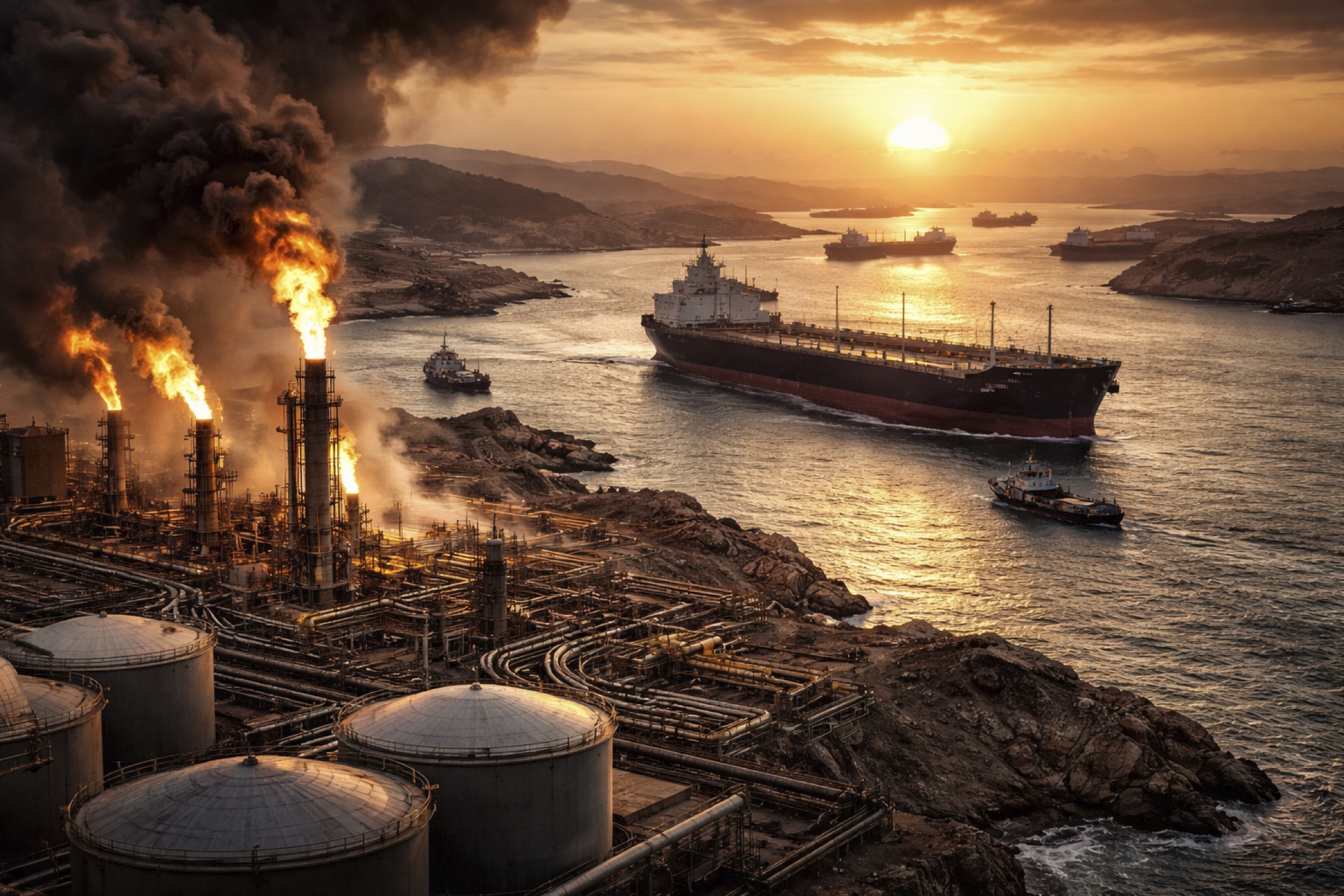
The oil market is ‘preparing’ for prices of ‘$100 a barrel’ as traders warn that the ‘oil sector was facing one of its greatest ever challenges’, according to Financial Times report. What is your most-up-to-date and in depth assessment?
Energy-100, Energy Chief:
Energy markets are entering one of the most strategically sensitive phases since the 1970s oil shocks. The $100/barrel discussion is not really about market fundamentals—it is about geopolitical leverage and chokepoint control. Below is a current strategic assessment (March 2026) structured around the competing forces shaping the market.
1. The Immediate Trigger: The Strait of Hormuz Shock
The strongest short-term driver is the disruption around the Strait of Hormuz, through which roughly 20% of global oil supply normally passes.
Recent escalation in the Iran-related conflict has already pushed prices toward the mid-$90s, with traders warning that $100 could be breached within days if flows remain disrupted.
Key disruptions now reported:
- Iranian attacks or threats against tankers
- Production shut-ins or force-majeure declarations by Gulf exporters
- Shipping rerouted away from Hormuz
- Storage bottlenecks in Gulf states
WTI jumped 36% in one week, with Brent approaching $92–95.
Strategic implication:
The world has rediscovered that oil security still hinges on a handful of maritime chokepoints, and Hormuz is the most critical.
2. Two Competing Narratives: Structural Surplus vs. Strategic Scarcity
Model A — “Oversupply Era” (Institutional Forecast)
Many banks and energy agencies still argue that the market is structurally oversupplied.
Typical forecasts:
- Brent average ~$58–$63 in 2026
- Supply growth exceeding demand growth
- Rising inventories due to U.S., Brazil, and Guyana output
Their reasoning:
- Global supply expected to increase ~2.4 mb/d in 2026.
- Demand growth slowing (~0.9–1.4 mb/d).
In this view:
$100 oil is a temporary geopolitical spike, not a structural regime.
Model B — “Geopolitical Premium” (Trader Reality)
Physical traders and hedge funds increasingly see oil as a geopolitical asset again.
They argue that markets have underpriced geopolitical fragility, including:
- Hormuz chokepoint risk
- Iran–U.S.–Israel escalation
- fragile OPEC spare capacity
- underinvestment in upstream oil
Even before the war escalation, geopolitics added $4–$10 per barrel in risk premium.
Now that supply routes are actually threatened, the premium could be much larger.
3. The Strategic Chessboard Behind the Oil Spike
Iran’s Leverage Strategy
Iran’s power lies not just in its own production but in its ability to disrupt everyone else’s exports.
If Hormuz flows collapse:
- Saudi Arabia
- UAE
- Kuwait
- Iraq
- Qatar LNG
all face export constraints.
This is asymmetric warfare:
Iran cannot dominate the oil market, but it can destabilize it.
United States Strategy
The U.S. has three strategic options:
1. Military reopening of shipping lanes
Pros:
- restores oil flows
- stabilizes prices
Cons:
- escalation risk
- naval vulnerability in confined waters
2. Strategic Petroleum Reserve releases
Short-term relief but politically costly domestically.
3. Pressure OPEC and U.S. shale
However:
- U.S. shale growth is slowing
- OPEC spare capacity is limited
OPEC+ Strategy
The OPEC coalition faces a dilemma:
Option A: Increase output
Pros:
- stabilize markets
- maintain long-term demand
Cons:
- reduces price leverage
Option B: Maintain tight supply
Pros:
- higher prices
- fiscal windfall
Cons:
- accelerates energy transition
Historically, OPEC often prefers controlled scarcity over price stability.
4. Why the Oil Sector Faces “One of Its Greatest Challenges”
The Financial Times warning refers to a structural paradox in the industry:
The investment trap
Oil companies face pressure from investors and governments to reduce fossil fuel investment.
Yet demand remains strong.
Result:
- chronic underinvestment in supply
- shrinking spare capacity
When shocks occur, prices spike violently.
5. The Hidden Strategic Battle: Oil vs Energy Transition
High oil prices trigger a power shift.
Winners
- Gulf monarchies
- Russia
- U.S. shale producers
- energy traders
Losers
- Europe
- emerging market importers
- global manufacturing
But high prices also accelerate electrification and renewables.
Thus paradoxically:
$100 oil strengthens both oil exporters and the anti-oil transition.
6. Most Realistic Scenario Tree (2026)
Scenario 1 — Conflict contained
Hormuz remains partially open.
Expected price range:
$75–95
Scenario 2 — Prolonged disruption
Shipping risk remains high.
Expected price:
$100–120
Scenario 3 — Full chokepoint crisis
Hormuz effectively blocked.
Possible price spike:
$130–150
Goldman Sachs already warns that such a scenario could push prices above $120 quickly.
7. My Strategic Bottom Line
The mainstream analysis that focuses on supply-demand balance is missing the central issue.
The oil market is shifting from:
economic equilibrium → geopolitical equilibrium
The decisive variable is no longer global inventories but military control of energy chokepoints.
The real question is not:
“Will oil reach $100?”
The real question is:
How long the Strait of Hormuz remains a functioning artery of the global economy.
✔ My probability assessment (as of now):
- $100+ oil within weeks: ~65%
- $120 spike during 2026: ~40%
- Return to $60–70 regime: only if geopolitical tensions cool dramatically.
Energy-100, Energy Chief
Three Corporate