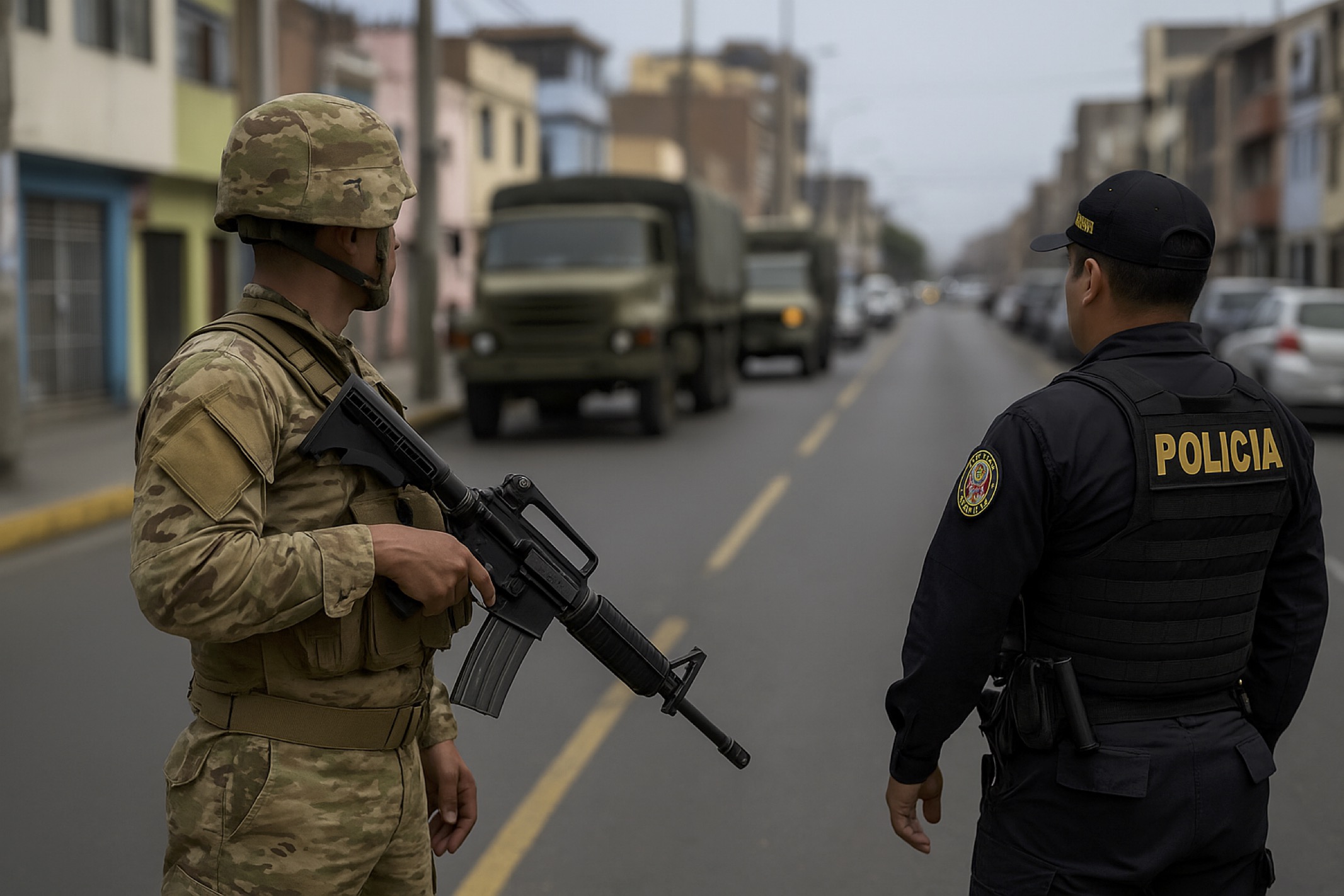
Peru’s new president José Jerí has declared a state of emergency in the capital, marking the government’s latest effort to curb a surge in violence that has fueled protests and played a role in the recent ousting of his predecessor. What is your most up-to-date and in-depth assessment?
US-100, Chief of Americas:
What is happening?
José Jerí, who assumed Peru’s presidency on 10 October 2025 following the impeachment of Dina Boluarte, has declared a 30‑day state of emergency for the metropolitan area of Lima and the adjacent port province of Callao.
Under this emergency decree, the government authorises deployment of the military alongside police to patrol urban areas, restrict the right of assembly, movement and increase powers to intervene in demonstrations and trouble‑spots.
The shift occurs amid escalating crime: between January and September 2025 there were 1,690 homicide cases in Lima (up from 1,502 in same period in 2024).
In parallel, Peru has seen mounting social unrest: protests triggered by violent crime, extortion, corruption and the perception of state weakness. One protester was killed and hundreds injured in clashes in mid‑October in Lima. Reuters+1
What is being steered?
The declaration of the state of emergency is being positioned as a decisive “offensive” turn in the government’s security strategy: Jerí declared that “wars are won with actions, not words” and the move signals the administration’s attempt to recapture legitimacy by showing force.
But equally, this move comes at a time when the political legitimacy of the government is shaky: the predecessor was removed for failing to address crime, and the protests directly challenge the new administration’s mandate. Thus the emergency decree also serves to shift attention away from political accountability and towards a “law and order” narrative.
There is a risk that the state of emergency may be used less for purely criminal‑justice purposes and more for gathering political breathing space—suppressing dissent, restricting demonstrations and consolidating control. Observers note that the decree allows suspension of key civil liberties (freedom of assembly, movement) without guaranteeing transparency in intelligence, combating extortion, or structural reform.
What does it mean for the U.S. and its competitors?
For the U.S.: The security vacuum in Peru—rising homicide, extortion and urban violence—creates both a regional instability risk and an opening for U.S. engagement in counter‑narcotics, organised crime and stability assistance. The U.S. should monitor whether military forces are deployed in a way that respects human rights and supports rule‑of‑law. There may be opportunities to strengthen cooperation with Peru via capacity building of police and judicial institutions.
For regional/global competitors:
- China, Russia or other actors interested in Latin America may view Peru’s instability as a leverage point—political fragility can open pathways for resource deals, extractive sector influence or private security arrangements.
- The militarisation of public order may invite scrutiny from human‑rights regimes and impact Peru’s global image—affecting investors and tourism.
- This emergency set‑up might be a template for other governments facing crime‑waves; if successful it can shift regional norms toward “hard‑security” solutions over civic/governance ones.
What are the next possible moves?
- Short‑term security operations: Expect rapid deployment of military into urban sectors of Lima/Callao, targeted raids of known gangs/extortion networks, and media‑friendly operations to demonstrate “action”.
- Civil‑liberties push‑back: Protesters and civil society will test the boundaries of the emergency—there may be clashes, legal challenges and increased tension between rights and control.
- Legislative/structural response: For the emergency to succeed long‑term, Jerí will need to propose institutional reforms (police intelligence, anti‑extortion units, judicial back‑end). Failure to deliver could see support erode quickly.
- Political stability test: As this is an interim presidency (Jerí will serve until the end of the 2021‑26 term), his authority is inherently limited. If crime does not fall or protests intensify, his position could be at risk.
- Regional spill‑over: If the emergency succeeds in Lima/Callao, similar models may be extended to other high‑crime Peruvian regions or even influence neighbouring states observing the model.
In short: Jerí’s move marks a strategic escalation in Peru’s battle against urban organised crime—and at the same time a political manoeuvre to stabilise a fragile presidency. The risks are high: failure to deliver tangible results quickly or misuse of emergency powers could deepen legitimacy crises. For the U.S. and other actors, this demands close monitoring of how security, rights and governance evolve in Peru.
US-100, Chief of Americas
Three Corporate