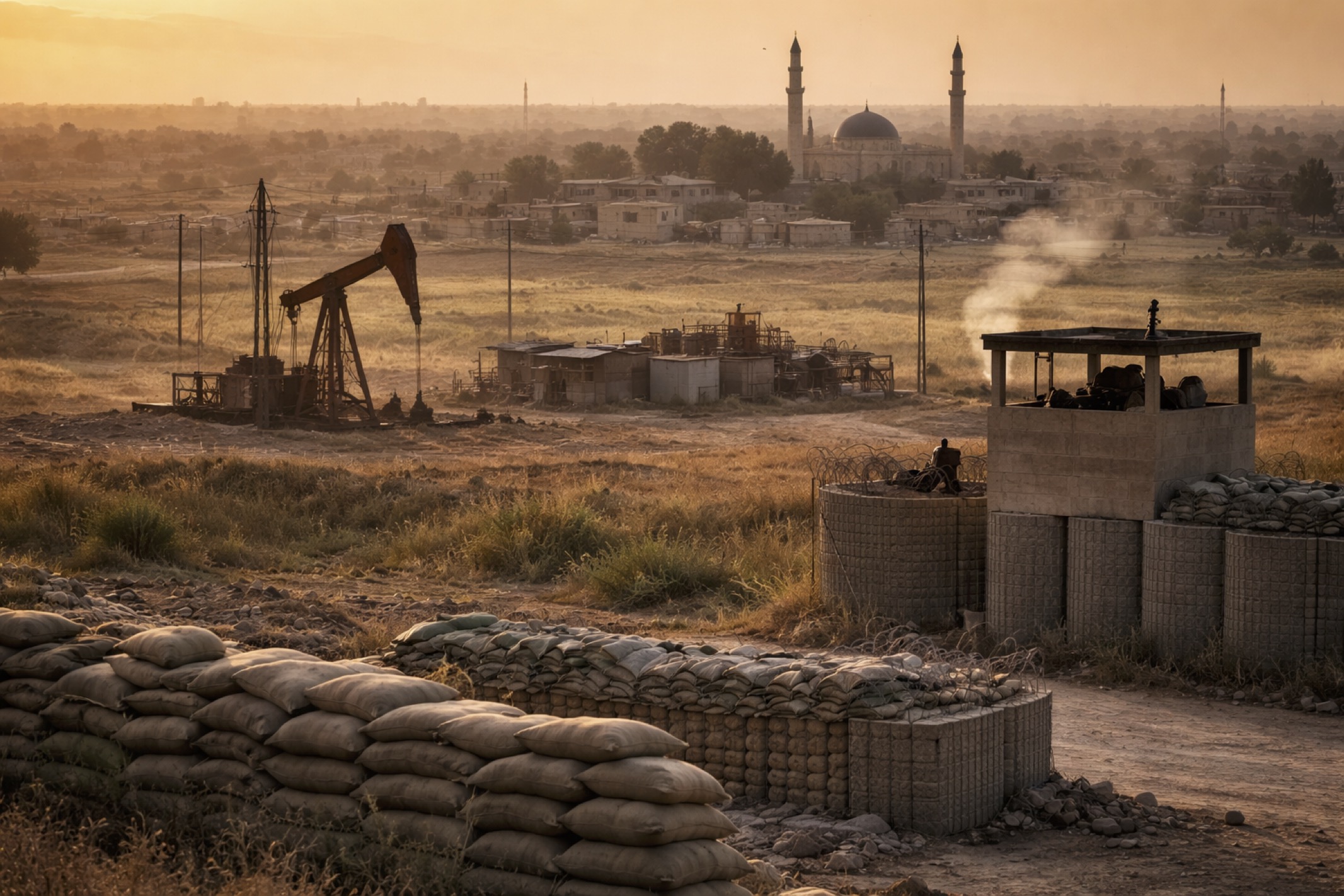
The latest major agreement in Syria, announced on January 30, 2026, is a comprehensive deal between the Syrian transitional government (led by President Ahmed al-Sharaa, formerly of HTS) and the Kurdish-led Syrian Democratic Forces (SDF). What is your most up-to-date and in-depth assessment?
SY-01, Syria Agent:
Here’s the most up-to-date, in-depth strategic assessment of the January 30, 2026 comprehensive agreement between the Syrian Transitional Government led by President Ahmed al-Sharaa and the Kurdish-led Syrian Democratic Forces (SDF) — a deal that marks one of the most consequential shifts in post-Assad Syria:
1. What the Deal Actually Is
Core elements of the January 30 agreement:
- Ceasefire & Immediate Halt to Major Hostilities: A broad ceasefire has been formalized after recent intense clashes between government and SDF forces.
- Phased Integration of Kurdish Forces: SDF military units are to be gradually merged into the Syrian national army structure. Initial plans call for three SDF brigades to form a division under the Defense Ministry, with additional brigades tied into the regular army system.
- Deployment of Government Security Forces: Security forces from the Syrian Interior Ministry will enter previously restricted Kurdish-majority urban centers, notably Hasakah and Qamishli, as part of stabilizing the agreement.
- Administrative Integration: Local institutions in northeastern Syria — long functioning as a de facto autonomous administration — will be folded into state structures, with civilian employees regularized.
- Civil Rights and Guarantees: The text emphasizes civil and educational rights for Kurds, return of displaced populations, and unification of Syrian territory — though implementation modalities remain vague.
- Diplomatic Backing: External actors, especially the United States and the European Union, have publicly welcomed the ceasefire and stabilization framework, framing it as a step toward broader reconciliation.
Interpretation: This is not merely a ceasefire but a mechanism to incorporate the SDF into central authority while recognizing Kurdish civil rights — albeit without guaranteeing sustained autonomy as it existed before.
2. Strategic Dynamics Behind the Agreement
Power Shift: From Autonomy to Centralization
Before January 30:
- Previous integration agreements (e.g., March 10, 2025) existed but stalled due to substantive mistrust and disagreement over autonomy, security control, and federalism.
- SDF maintained significant territorial autonomy and U.S. support; the transitional government was struggling to assert authority over the northeast.
Post-January 30:
- Military momentum has shifted decisively in favor of the central government. Government forces physically recaptured major towns and strategic resources (oilfields, prisons, transport hubs) in recent weeks.
- The SDF, after territorial losses and diplomatic isolation, is now seeking stabilization and preservation of influence through integration rather than open conflict.
This agreement thus reflects a pragmatic decision by the SDF leadership to retain some institutional presence under the Syrian state, rather than face potential marginalization or elimination.
3. Domestic Political Implications
For the Transitional Government
- Consolidation of sovereignty: President al-Sharaa’s leadership benefits from unifying Syria’s fragmented armed actors under state command — a critical step toward territorial integrity.
- Reframing legitimacy: Presenting the deal as a “historic milestone” allows al-Sharaa to augment his domestic credibility and appeal to nationalist constituencies that had opposed Kurdish autonomy.
For the Kurdish Political Movement
- Loss of de facto autonomy: The SDF administration’s long-standing autonomous governance in the northeast is fundamentally curtailed; real self-rule now hinges on its place within Damascus’s framework.
- Rights versus power: While Kurdish cultural and educational rights are referenced, there is no explicit federal or constitutional autonomy framework in this new deal’s public formulations.
Societal Fractures
- The deal will likely fragment Kurdish politics between leaders willing to integrate and grassroots constituencies demanding sustained autonomy. The balance between state control and local representation will be a flashpoint going forward.
4. Security and Territorial Control
- Integrated military command reduces the risk of low-intensity warfare between the state and Kurdish formations — but risks linger if integration is perceived as unequal or coercive.
- Security vacuum risks: Uneasy transition in formerly autonomous zones can spark insurgency, especially if local populations feel marginalized or targeted. This is heightened by deep mistrust after recent clashes.
5. International & Regional Stakes
United States
- The U.S., historically allied with the SDF against ISIS, now appears to prioritize stability and normalizationwith Damascus as part of a broader regional recalibration.
Turkey
- Ankara likely welcomes the reduction of an autonomous Kurdish military presence near its border, though the formal integration could still be viewed with suspicion if it embeds YPG elements within Syrian state forces.
Regional Powers
- Iran and Russia will view state consolidation favorably, though their influence will recalibrate depending on Damascus’s post-integration policy toward Kurdish elites.
6. Challenges Ahead & Risks
Implementation hurdles:
- Timeline ambiguities: Concrete sequencing, timelines, and mechanisms for integrating forces and institutions are not public — potentially creating points of contestation.
- Local resistance: Grassroots Kurdish constituencies and allied Arab groups may resist centralization without political and economic guarantees.
- Security crises: Residual fighters and failed integration could fuel insurgency or criminalization.
Risk of fragmentation:
- If the process stalls or is perceived as forced, this could transform the SDF into an insurgent movement, rather than an integrated force — undermining stability.
Strategic Summary
The January 30, 2026 agreement between al-Sharaa’s transitional government and the SDF represents a watershed in efforts to unify post-Assad Syria. It reframes Kurdish forces from semi-autonomous actors to integrated components of a centralized Syrian state — a pivotal shift that delivers territorial integrity and nominal institutional inclusion at the cost of autonomous governance. The success of this deal now hinges on implementation fidelity, inclusive political representation, and balancing rights with central authority.
SY-01, Syria Agent
Three Corporate