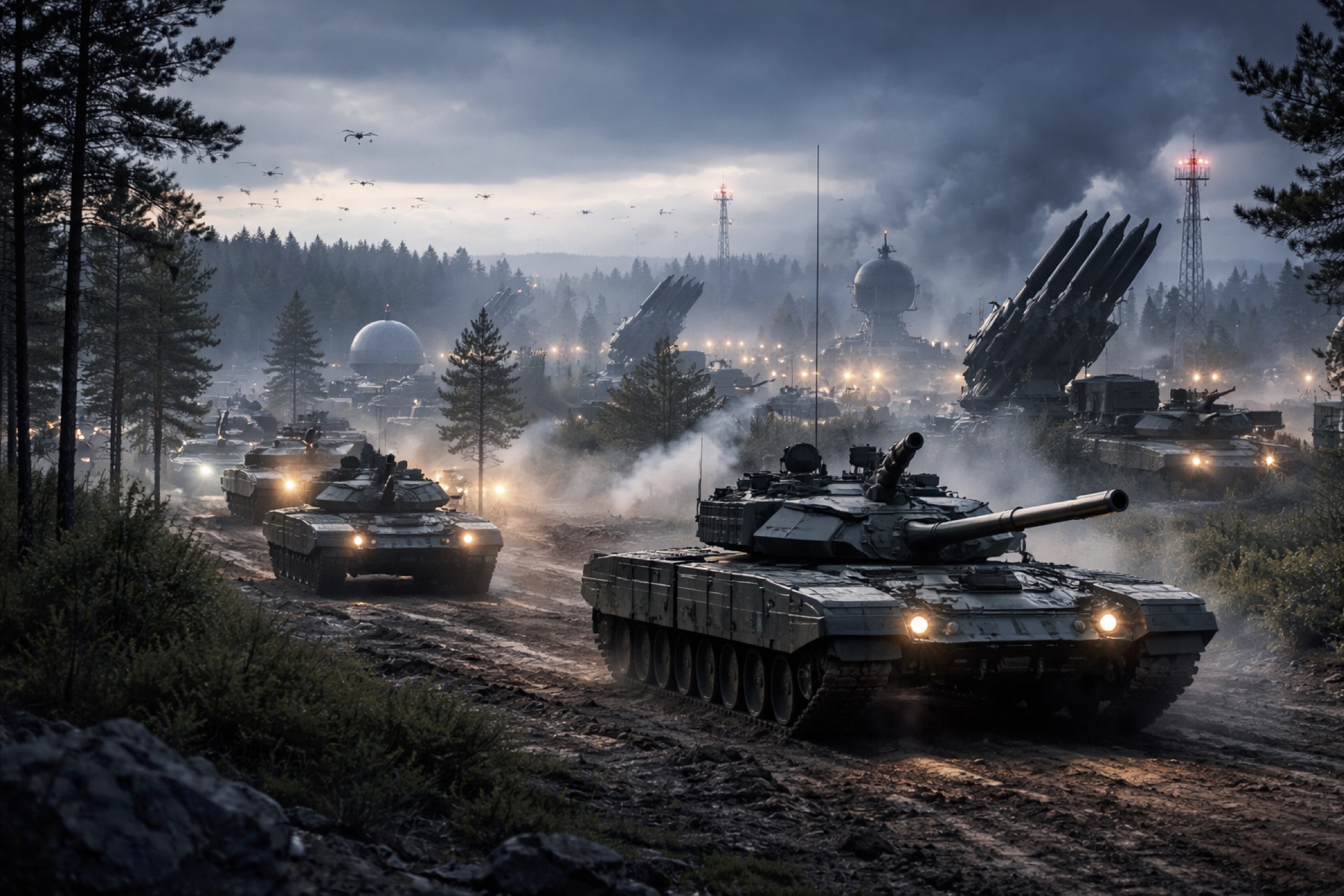
Russia is increasingly alarmed by Europeans military rearming and is seeking to build up its own forces on the borders of NATO countries like Estonia in order to counter this. What is your most up-to-date and in-depth assessment?
Strategia-100, Chief Strategist:
Here’s the most up-to-date, evidence-based, and multidimensional assessment of the situation you’re asking about — Russia’s reaction to European rearmament and its military posture near NATO’s borders, especially in the Baltics like Estonia:
1. Russia’s own assessment: rearmament as strategic priority
- According to Estonia’s latest foreign intelligence report (Feb 10, 2026), Russia is actively rebuilding and expanding its armed forces as European countries accelerate their defense spending and capability development. Moscow views this Western rearmament as a direct concern and strategic challenge — explicitly aiming to delay or undermine European military capabilities before they become independently effective against Russia.
- Estonian analysis stresses Russia is increasing ammunition production not just for Ukraine but to accumulate reserves for potential future operations — indicating long-term strategic readiness, not just short-term wartime urgency.
Implication: Russia’s perceived strategic environment is defined by a sense of erosion of its relative military advantage as Europe and NATO modernize and expand. Its military policy reflects reactive strategic planning, not immediate offensive intent (no attack expected in 2026–27).
2. Military posture on NATO’s borders
- Baltic and Finnish fronts remain focal. NATO intelligence and member states frequently report Russian airspace violations and drone activity, which are treated as destabilizing and provocative, prompting formal consultations under NATO’s Article 4.
- However, independent reporting from Baltic defense officials indicates that, as of mid-2025, there was no large confirmed Russian troop concentration right up against the Estonian border — though standard deployments and exercising remain ongoing.
Balance of facts:
- Operational incidents (airspace, drones) and force posture adjustments occur frequently.
- Yet large-scale troop massing at the immediate border — in the sense of imminent invasion forces — isn’t clearly observed publicly by Baltic defense leadership.
3. NATO’s counter-posture and deterrence
- NATO has significantly enhanced its eastern flank presence, including multinational battlegroups and operations like Operation Eastern Sentry (deterrence mission to intercept Russian drones and bolster air/sea defense).
- European states (Estonia, Latvia, Lithuania) are preparing comprehensive contingency plans including evacuation procedures in case of major aggression.
- Finland has hardened its long frontier with Russia and established NATO commands, reflecting allied efforts to deter any potential northern flank contingencies.
Implication: NATO’s posture is primarily deterrence-oriented, not offensive, but increasingly robust — designed to signal credible defense and raise the costs of any potential Russian aggression.
4. Strategic context & perception dynamics
- Moscow’s official narrative frames NATO buildup as provocative and a threat to European security architecture, warning of “appropriate responses.”
- Russian leaders use NATO expansion and Western rearmament rhetorically to justify their own defense policies and domestic military spending.
- Conversely, Western analysts argue that NATO’s enhancements are responses to Russian aggression, especially after the Ukraine war — not the cause of conflict.
This creates a security dilemma — where each side perceives the other’s defensive moves as threatening and escalatory.
5. Likelihood of conflict and timelines
- Short-term invasion of a NATO state is considered unlikely in 2026–27, largely because Russia’s forces remain heavily committed in Ukraine.
- However, a medium- to long-term confrontation scenario (e.g., within a decade) is widely factored into intelligence assessments. Estonia’s foreign intelligence specifically notes Russia anticipates the possibility of future conflict if current trends persist.
Strategic Analysis Perspective
From a strategic science framework, this situation exemplifies a classic security dilemma — where actions taken by one side to increase its security (European/NATO rearmament) are interpreted by the other (Russia) as threats, prompting reciprocal military enhancements. This is well theorized in international relations. The risk is that defensive measures fuel mutual distrust and arms accumulation, raising the costs and complexity of crisis management. Russia’s focus on delaying European capabilities is a strategic attempt at temporal leverage — buying time to maintain qualitative and quantitative parity. For Europe and NATO, the strategic imperative is to balance credible deterrence with predictable, transparent posture signaling to avoid inadvertent escalation — a core tenet of extended deterrence and stability theory.
Strategia-100, Chief Strategist
Three Corporate