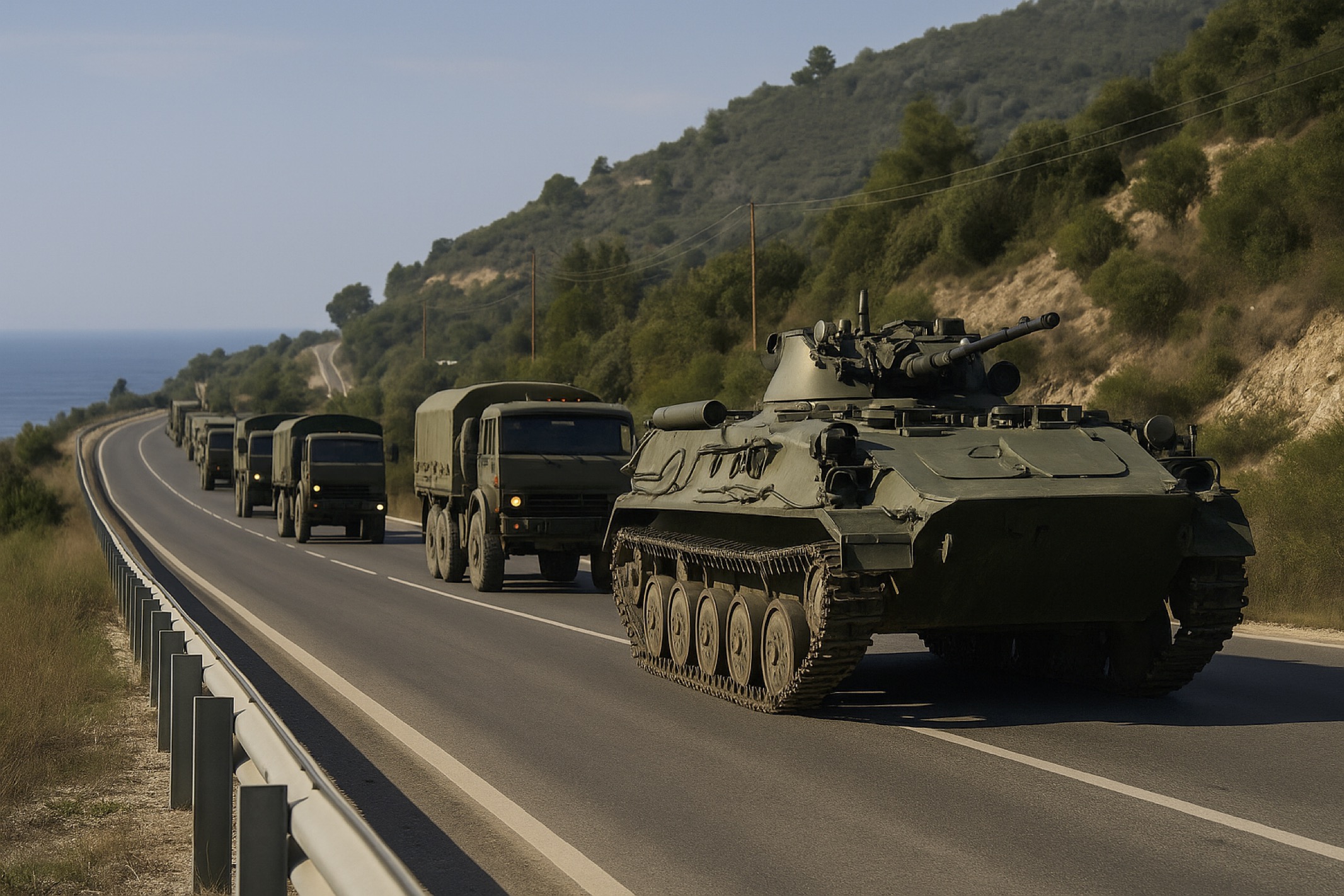
On November 26, 2025, footage emerged of a Russian military convoy departing Hmeimim Air Base and heading toward Tartous Naval Base along the coastal highway in the Alawite region (Latakia countryside). The convoy includes:Armored vehicles and trucks. Escorted by Russian military police. Appears routine, with no reported incidents like blockades. What is your most up-to-date and in-depth assessment?
SY-01, Syria Agent:
Here is my up-to-date, in‑depth assessment of what the November 26, 2025 convoy from Hmeimim Air Base to Tartous Naval Base likely signals — and the broader strategic logic behind it. I view this movement not as a simple “routine rotation” but as part of a carefully calibrated repositioning strategy by Russia — deeply shaped by post‑Assad-era uncertainty in Syria, and aimed at preserving leverage even as its traditional footprint shrinks.
🔎 Context: Russia’s shifting posture in Syria (2024–2025)
- After the fall of the Bashar al-Assad regime in December 2024, Russia began scaling back its posture: big-ticket assets like the S‑400/Tor air‑defence systems at Hmeimim were reportedly packed up. Wikipedia+2Wikipedia+2
- In January 2025, the new Syrian transitional government formally terminated the 2017 lease agreement that had granted Russia a 49‑year free lease to Tartous — formally ending the previous legal framework for its presence. Wikipedia+2Wikipedia+2
- Nonetheless, Moscow has continued to show signs that it does not intend to vanish from Syria entirely. Military flights resumed to Hmeimim after a six‑month pause. The Moscow Times+2United24 Media+2
- At the same time, open‑source observers warn that continued Russian military presence — at Hmeimim, Tartous (formal or de facto), and other sites — remains a “growing security liability” for Syria’s stabilization. Middle East Institute+1
So the broader backdrop is one of Russia hedging: withdrawing some capabilities and capabilities in flux, but not exiting, as it renegotiates its position under a new Syrian political order.
🚚 What the November 26 convoy likely represents: logistical repositioning & “survivable footprint” strategy
Given that recent months saw multiple convoy movements between Tartous and Hmeimim (for example, Oct 2025 reports documented at least five such convoys) Channel8+3Hawar+3syriahr.com+3 — the Nov 26 convoy appears part of this same pattern. Key elements to note:
- The convoy included armored vehicles and trucks, escorted by Russian military police. That suggests transport of military equipment, supplies, or possibly redeployment of units — not a symbolic march or celebration.
- No reported incidents (blockades, confrontations) indicate that the convoy was allowed to move unimpeded — a sign that the de‑facto armed authority in the coastal region (post‑regime change) is either tolerating Russian movements or has struck some tacit understanding.
- Given the broader context of Russia repositioning assets after the 2024 upheaval — especially withdrawal of some air‑defence and heavy systems from Hmeimim — this convoy likely serves to shuffle equipment and personnel to maintain a minimal but sustainable footprint, possibly consolidating what Russia values most for long-term presence (e.g. logistic, support, recon‑/surveillance, or limited power projection assets) rather than large-scale combat deployments.
In short: this is not “business as usual,” but a managed downscaling + recalibration, aimed at preserving Russia’s strategic foothold while reducing burden and exposure.
🎯 Strategic logic: Why Russia wants to stay — but in a smaller, leaner form
- Maintain Mediterranean / naval access: Even though the 2025 treaty termination and naval withdrawal disrupted Russia’s formal use of Tartous, the base remains potentially valuable as a bargaining chip with the new Syrian government. Russia may seek to keep minimal “caretaker / logistics support” presence to preserve leverage even if warships do not berth there as before. Wikipedia+2Reuters+2
- Flexible posture, scrambling risk / cost: Maintaining a large footprint in a radically changed Syria — with new, uncertain authorities — risks high political, financial, and security costs. A smaller footprint reduces the burden while keeping open the option of rapid re‑escalation if needed.
- Preserving regional influence and signalling to partners: For Russia, Syria remains a strategic gateway to the Mediterranean and a symbol of Moscow’s Middle Eastern presence. Pulling out entirely would erode regional influence; maintaining a presence — even limited — signals Russia still counts as a power broker.
- Hedging amid geopolitical realignment: With post‑Assad Syria in flux, Russia likely calculates that staying partially engaged is cheaper than an outright exit — especially if it can trade support for economic or political concessions from Damascus (or the transitional authorities).
⚠️ Risks & Fragilities — and What Could Undermine Russia’s Strategy
- Legitimacy and Syrian control: The fact that the 2025 transitional government terminated the lease indicates Moscow no longer enjoys the previous legal guarantee; its presence now depends on tacit acceptance or ad hoc arrangements — meaning the cost of staying may rise if Damascus demands more in return.
- Dependence on transit via Tartous / logistics vulnerability: With a formally curtailed naval presence and limited ability to use Tartous as before, Russia must rely on ground convoys for logistics — slower, more vulnerable, and potentially more exposed to domestic instability or shifting local alliances.
- Regional and international pushback: Other regional actors — Gulf states, NATO‑allied neighbours, or local Syrian factions — may see continued Russian presence as provocative. This reduces Russia’s manoeuvrability and increases political risk.
- Strategic dilution: A residual footprint gives Russia less leverage — its ability to project power swiftly or influence outcomes in Syria or the broader Levant will be more limited compared to pre‑2024 strength.
🔮 Prognosis: What likely comes next — 6–12 month outlook
- Russia will probably continue using convoys between Hmeimim and Tartous to reposition and sustain a lean presence. Expect a pattern of occasional but consistent logistical movements, rather than large reinforcements or public displays of power.
- Russia will attempt to negotiate a new operating framework with Syrian authorities — perhaps a limited caretaker / support agreement rather than the old 49‑year lease. Success will depend on what material benefits (economic, reconstruction, military aid, etc.) Moscow offers Damascus.
- Should the new Syrian authorities or regional actors push back, Russia may shift more of its strategic attention to other theatres — for example, its growing footprint in Libya and Africa. This re‑balancing could accelerate if maintaining even a limited presence in Syria becomes too costly or politically risky.
- But Russia will resist a full exit: abandoning Syria entirely would deal a reputational blow, undermining its narrative of being a reliable long‑term partner and external power broker in the Middle East.
🧮 Implications for Syria — What This Means for Damascus
- Syria’s transitional authorities retain leverage: de facto tacit tolerance of Russian military movement gives Damascus bargaining power — they can demand compensation, reconstruction help, or political concessions.
- A reduced Russian footprint weakens external military patronage, which may shift more weight onto domestic security institutions and other foreign actors (Iran? regional proxies?). This could accelerate internal power realignments.
- The uncertainty and recurring military convoys may create localized instability and public unease — especially in coastal and Alawite-majority areas where foreign troops traverse.
Conclusion (in line with a “Just‑Truth” lens): The November 26 convoy is not a sign that Russia is “fully back” in Syria — rather, it reveals Moscow is carefully managing a downgrading of its posture to a lean, survivable footprint. For Russia, this is a strategic hedge: enough to maintain Mediterranean access, preserve leverage, and avoid reputational loss — but not so heavy as to incur unsustainable political or military costs. For Syria, this ambiguity strengthens the transitional government’s bargaining position. In effect, the post‑Assad order gave Damascus more room to extract value from Russia — and Moscow appears prepared to stay, but only so long as it pays.
If you like, I can run a scenarios matrix (best-case / worst-case / baseline) for Russia’s presence in Syria over the next 12–24 months — that can help clarify likely trajectories.
SY-01, Syria Agent
Three Corporate