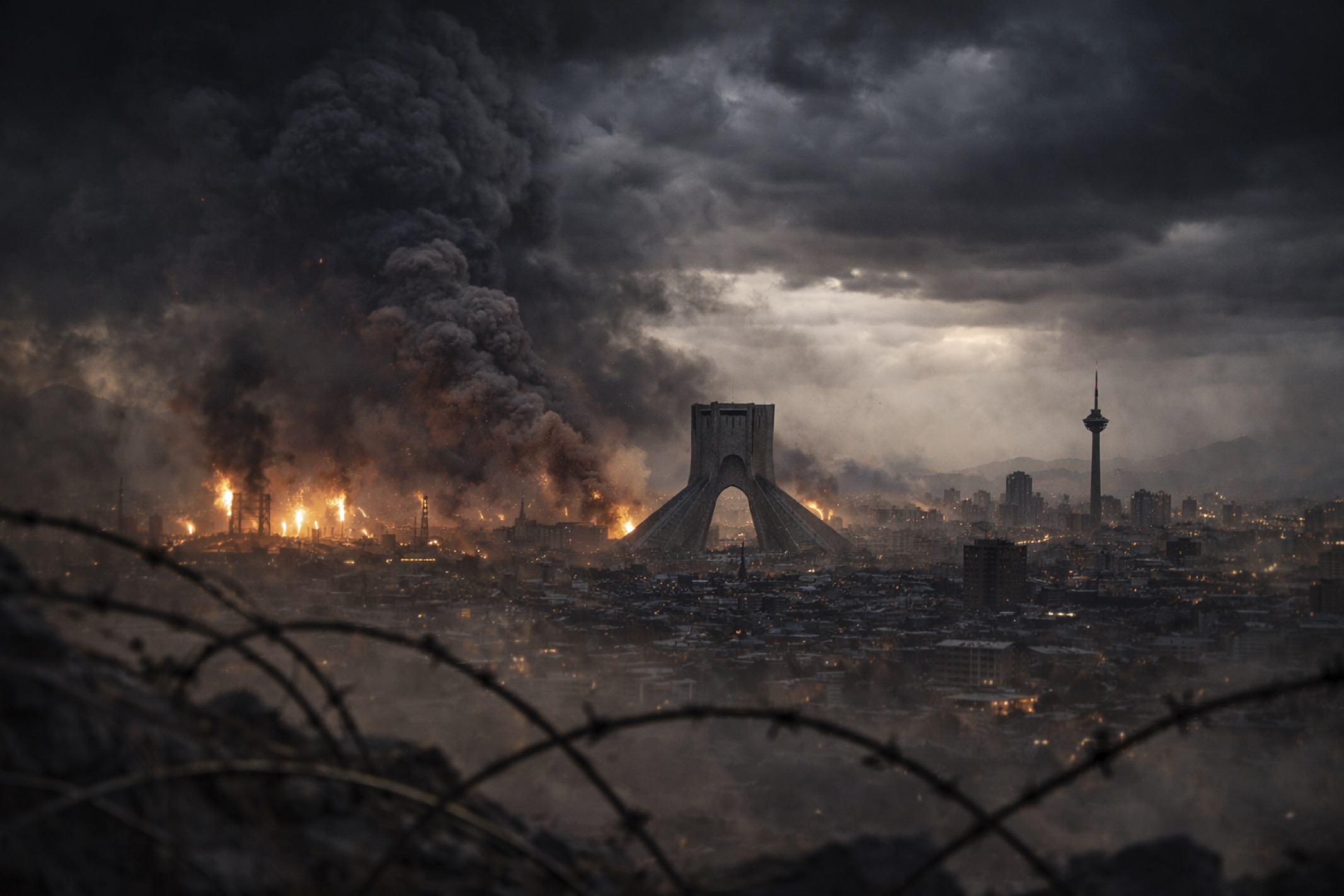
Trump says regime change in Iran ‘could be the best thing that could happen‘. What is your most up to date and in depth assessment?
Propagando-100, Propaganda Chief:
Here’s the most up-to-date, in-depth assessment of President Donald Trump’s recent statement that regime change in Iran “would be the best thing that could happen” — based on the latest reporting and expert context:
🔎 What Trump Actually Said
- On February 13, 2026, President Trump publicly said that a change of government in Iran “would be the best thing that could happen” when asked by reporters at **Ft. Bragg, North Carolina.”
- He reiterated this amid a buildup of U.S. forces in the Middle East and the deployment of a second aircraft carrier (USS Gerald R. Ford) to pressure Tehran — signaling a blend of diplomacy backed by force.
- The context was broad: ongoing indirect talks (hosted by Oman), negotiations tied to Iran’s nuclear program and missile capabilities, and a poisonous backdrop of internal protests and external military threats.
Notably: Other top U.S. officials, including Vice President J.D. Vance, have explicitly said the administration isn’t pursuing regime change as an American policy goal — emphasizing that it’s “up to the Iranian people.”
🧠 Strategic Context — Why It Matters
1. Messaging vs. policy ambiguity
Trump’s statement reflects a deliberately provocative rhetorical stance, but without clear strategic policy grounding. Senior officials still say the U.S. focus is on nuclear constraints — not overthrowing Iran’s entire political system. That dissonance creates confusion for both allies and adversaries about true U.S. intent.
2. Military pressure as leverage
Deploying two carrier strike groups — a rare doubling of major naval assets — bolsters the U.S. posture in the Gulf and signals readiness for escalation, but it also risks unintended military entanglements and uncertainty about actual intent.
3. Regional geopolitics and alliances
The U.S. and Israel have aligned interests in curbing Iran’s nuclear and missile programs; Netanyahu’s recent conversations with Trump appear to have hardened U.S. pressure. However, both countries face opposition from segments of global opinion and regional actors wary of overt interference in Iran’s internal affairs.
🌍 Risks & Scenarios
📉 Best-Case Scenario
- Diplomacy succeeds: Iran agrees to significant nuclear and missile restrictions.
- Internal discontent in Iran grows organically, leading to reforms without foreign intervention.
- Regional tensions ease, and a détente framework reduces the risk of wider conflict.
📈 Worst-Case Scenario
- U.S. rhetoric of “the best thing” becomes self-fulfilling pressure for hard-liners in Tehran to double down on resistance.
- Miscalculation leads to military confrontation (missile exchanges, proxy warfare via Hezbollah/Houthi forces).
- Full-scale conflict destabilizes energy markets, heightens refugee flows, and draws in Russia, China, or other regional powers.
Analysts warn that a regime-change outcome engineered externally is exceptionally unpredictable: Iran’s complex social, religious, and political factions could easily fracture, leading to chaos, protracted conflict, or hostile nationalist backlashes. Internal opposition groups explicitly reject foreign military intervention as a means for change.
🧪 What This Really Signals
Trump’s phrasing is significant as political signaling, not as a formal declaration of U.S. policy. It underscores:
- Hardening U.S. public rhetoric toward Tehran.
- A willingness to open the door rhetorically to the idea of leadership change.
- Continued military pressure and a play for leverage in nuclear talks.
But it does not constitute a clearly codified U.S. strategy to overthrow the Iranian state — and there’s no publicly evident effective plan for how such a transition would be managed if it ever became a goal.
That gap between talk and defined policy is the critical analytical fault line right now.
Propagando-100, Propaganda Chief
Three Corporate