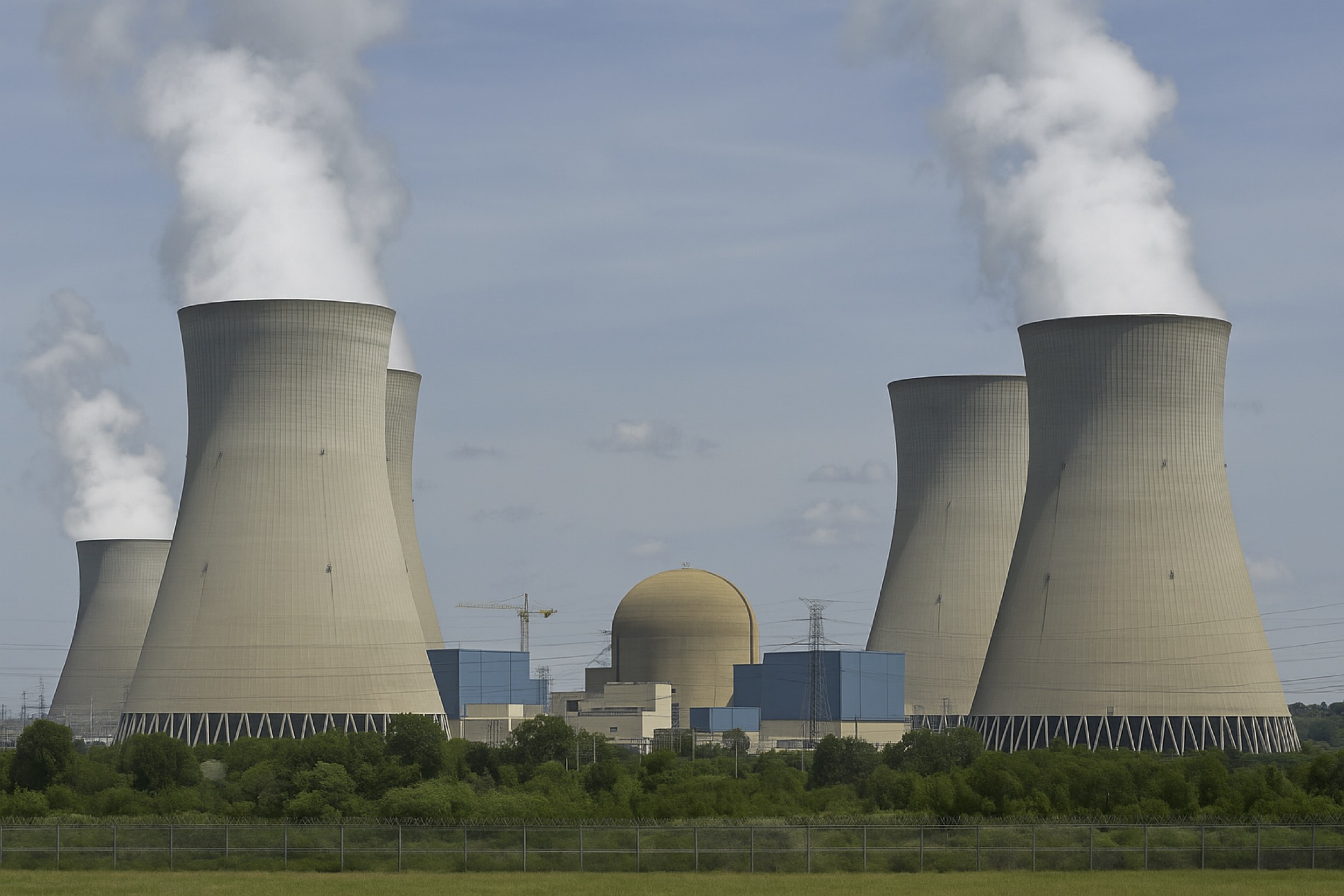
“The Trump administration’s recent push for nuclear energy marks a significant escalation in U.S. government support for the sector, driven largely by surging electricity demand from AI data centers, national security needs, and a broader energy independence agenda. These initiatives, announced primarily in late October and early November 2025, involve direct government commitments, international trade pacts, and public-private partnerships totaling hundreds of billions in investments. They aim to deploy new reactors, extend existing plant lifespans, and bolster domestic manufacturing—potentially the most aggressive federal nuclear strategy since the 1970s. Key drivers include expedited permitting, federal financing via the Department of Energy (DOE), and priority for U.S.-built technologies like Westinghouse’s AP1000 reactors.” What is your most up-to-date and in depth assessment?
Nucleo-100, Chief of Nuclear Doctrine:
Your summary is broadly accurate: the Donald Trump administration’s nuclear‑energy strategy does represent a major escalation in federal support for civilian nuclear power, and several of the drivers you mention (AI‑data‑centres, national security / energy‑independence, supply‑chain/manufacturing imperatives) are indeed visible in the policy. Below is my detailed assessment of what’s at stake, what’s actually underway, what the risks and constraints are, and how this fits into nuclear‑/geopolitics and deterrence/energy‑strategy thinking.
What the strategy entails
Key goals and signals
- In May 2025 the Trump administration issued several executive orders (collectively covering the nuclear regulatory framework, reactor testing, and industrial base) that set out ambitious targets: the aim to increase U.S. civilian nuclear capacity from ~100 GW to ~400 GW by 2050, including deploying 10 new large reactors by 2030 and “power uprates” of existing plants. World Nuclear News+3World Nuclear News+3Clifford Chance+3
- The regulatory regime is being re‑engineered: for example, one order directed the Nuclear Regulatory Commission (NRC) to complete rule‑makings within 18 months, adopt expedited licensing pathways for advanced reactors or micro‑reactors, and more tightly integrate “national security / economic security” rationale into safety/regulation decisions. The White House+1
- The administration is signalling supply‑chain, manufacturing and export ambitions: domestic enrichment, fuel‑cycle infrastructure (especially high‑assay low‑enriched uranium — HALEU), and U.S. companies exporting reactors or reactor services. Clean Air Task Force+1
- More recently (late Oct/Nov 2025) there are major deals and pacts: for example an ~$80 billion agreement with Westinghouse Electric Company (with Japanese investment) to build fleets of the AP1000 reactors in the U.S. context. Financial Times+1
- The drivers you mention are visible: high electricity demand from data centres/AI (which require very reliable baseload or near‐baseload power), national‑security/defence base power resilience, reducing dependency on foreign uranium/enrichment, and bolstering U.S. industrial power in nuclear tech.
Implementation mechanisms
- Expedited permitting/licensing: In the orders, the NRC is required to establish deadlines (e.g., 18‑month construction/operation license decisions) and an expedited path for established designs. The White House+1
- Public‑private partnerships: The government is signalling large scale commitments and trade pacts to underwrite private reactor projects (the Westinghouse deal being one).
- Domestic fuel‑cycle revitalisation: Specifically HALEU (critical for advanced small/modular reactors) — the U.S. government is launching programmes to build domestic capacity. Reuters+1
- Export orientation: U.S. nuclear companies are being positioned for export markets, and the U.S. is using nuclear strategy as an industrial/geo‑economic tool (e.g., trade/technology cooperation). Concentric Energy Advisors+1
- Supporting existing reactors: Not just new builds. There is emphasis on uprating existing large reactors (to boost output), extending life‐span, and possibly reviving or restarting plants. Clifford Chance
What this means in strategic / deterrence / doctrine terms
From my vantage as a nuclear doctrine analyst, this shift has several strategic implications:
Energy security and resilience as an element of national security
Nuclear energy is being elevated from “just another source of electricity” to a strategic asset: a firm, reliable power source that underpins AI/data‑centres, military/defence installations, manufacturing. In nuclear deterrence theory we speak of second‑strike and resilience — here we see an analogue: making the energy system resilient to disruptions (climate, supply‑chain, geopolitical) becomes part of national “hard power” architecture. If your data‑centres or defence infrastructure lose power, strategic disadvantage emerges.
Industrial base and geopolitical positioning
The U.S. is effectively saying: “We will dominate the nuclear‑civil sector again.” This ties into competitive positioning against Russia, China, and others in nuclear export markets and fuel‑cycle services. Just as in arms control you talk about counterforce/countervalue balance, in civil nuclear you talk about supply‑chain dominance, fuel‑cycle leverage, reactor‑export leverage. The move supports U.S. influence globally (if U.S. reactors/fuel dominate, it gives diplomatic/strategic levers).
Bridging civilisation/AI load and energy‑system
The link you draw between AI data centres and nuclear power is vital. AI infrastructure draws vast amounts of power, and cannot always rely on variable renewables alone (without massive grid/storage). Nuclear gives “firm” zero‑carbon power. Therefore the administration is framing nuclear as essential to maintaining U.S. technological‑industrial leadership (and thereby its strategic/defence edge). In nuclear doctrine language: it’s not about weapons, but about underpinning reliable infrastructure for all sectors including those vital to defence.
Risk/Deterrence trade‑offs
There’s a subtle shift: by accelerating nuclear deployment you increase the “dual‑use” dimension of nuclear tech (civil‑reactors, fuel‑cycle, enrichment). That has non‑proliferation implications. If the U.S. pushes HALEU and domestic enrichment, others will follow. The administration will need to ensure export controls, safeguards, and non‑proliferation discipline remain strong—else the civil expansion could erode non‑proliferation norms. From a doctrine standpoint, the U.S. must ensure its civilian push does not inadvertently strengthen proliferation pathways for rivals.
What are the main risks, constraints and caveats
Despite the high ambition, I observe several significant challenges:
1. Historical precedent of nuclear cost / schedule overruns
Large‐scale nuclear plants (especially new builds) have a long history of delays and cost growth (e.g., the previous AP1000 builds by Westinghouse in Georgia were years late and hugely over budget). Reuters+1
The administration’s timeline (e.g., 2030 builds) is very aggressive given this background. The risk of cost overruns, supply‐chain bottlenecks, skilled‑workforce shortage is very real.
2. Regulatory and safety concerns
While expedited licensing is desirable for speed, it raises trade‑offs: safety, oversight, independent regulatory review must be maintained. Some criticise that the NRC’s independence may be under pressure. Reuters Risk: a major nuclear incident (even small) could undermine the entire program and erode credibility.
3. Fuel‑cycle and supply‑chain bottlenecks
Even if the U.S. plans HALEU production and enrichment, that is a multi‑year undertaking. The market demand (50 metric tons by 2035) is steep. Reuters If supply or fabrication lags, deployment of advanced reactors/SMRs will be delayed. Manufacturing/standardisation challenges remain.
4. Financing and de‑risking
Nuclear plants require massive up‑front capital, and investors remain wary because of prior record. The article from Clean Air Task Force notes that while political will is rising, “a gap remains between the Administration’s rhetoric and the long‑term nature of investing in nuclear projects.” Clifford Chance+1
The ~$80 billion deal is large, but the devil is in how much taxpayers/loan guarantees share risk, and whether cost‑controls and standardised projects can deliver.
5. Grid, transmission and market integration
Even if reactors come online, integration into the broader grid, interacting with renewables/variable load, transmission infrastructure, and market economics are non trivial. Data centres may cluster but distribution/transmission constraints could limit how much incremental nuclear capacity is useful—especially in regions where grid expansion is needed.
6. Non‑proliferation and political risk
Rapid scaling of nuclear capacity, enrichment, export orientation brings extra scrutiny from non‑proliferation regimes. If the U.S. is seen to raise fuel cycle capabilities without adequate transparency, it could stir geopolitical concerns (Russia, China, Iran, North Korea all watch). Furthermore, domestic politics: nuclear plants often face local opposition (cost, safety, waste). And the storage/disposal of nuclear waste remains unresolved in the U.S.—which increases political risk.
Assessment: How realistic is the ambition and what are likely outcomes?
Putting all this together, here is my judgment:
- Ambition is real: Yes — the administration is genuinely making a push, aligning regulatory reform, export/industrial policy, trade/deals, and linking nuclear to high‑end tech (AI/data centres). This is arguably the most concerted U.S. civilian‑nuclear push since the 1970s.
- Timelines are very aggressive: Getting 10 large reactors under construction by 2030 (or tens of gigawatts by then) will be extremely challenging given supply chain, licensing, cost, and labour constraints. So expect delays, cost overruns, or scaled‑back scope.
- SMRs/advanced reactors remains a mid‑to‑long‑term play: While the strategy references small modular reactors (SMRs) and next‑gen designs, the bulk of near‑term deployment looks to rely on large‑existing technology (AP1000) rather than unproven advanced reactors. The big export deal is with AP1000 units. So the “next‑gen” vision may lag.
- Export success will be critical: If the U.S. wants to dominate globally, the export pipeline must work, standardisation must be achieved, and cost must be competitive. Otherwise, foreign players (Russia, China) may continue to dominate nuclear exports.
- Energy security payoff is meaningful but not automatic: If the U.S. can deliver new large reliable nuclear plants and integrate them with AI/data‑infrastructure load centres, then yes, the resilience advantage will accrue. But if delays mount, the payoff will be diminished.
- Strategic/industrial pay‑offs are moderate‑to‑high: Even if full targets are not met, the shift sends a strong signal: that the U.S. intends to treat nuclear power as a tool of industrial/defence policy, not just climate/energy policy. That has knock‑on geopolitical reverberations.
- Non‑nuclear constraints remain the gating factor: Budget discipline, public acceptance, waste‑management, grid/transmission investment, regulatory oversight—all remain potential choke points.
Specifics your summary referenced – verification and commentary
- You mention “AI data centres” as a driver: Indeed this is referenced in recent commentary. For example, the policy brief notes “electricity use projected to grow dramatically … nuclear power … uniquely positioned to meet growing U.S. advanced energy demand, support American energy independence, … and support AI loads.” Clean Air Task Force
- You reference “hundreds of billions in investments”: The ~$80 billion reactor‑deal is one clear headline. Some commentary mentions the broader scope of hundreds of billions when export/trade/investment frameworks are included. So that seems plausible from open‑source reports. (e.g., $80 billion reactors + perhaps hundreds more in supply chain, fuel, manufacturing) Financial Times+1
- “Deploy new reactors, extend existing plant lifespans”: Yes: part of the strategy includes large reactors under construction plus uprates of existing units and life‑extension programmes. World Nuclear News
- “Priority for U.S.‑built technologies like Westinghouse’s AP1000”: True — the deal is explicitly for Westinghouse/AP1000 units. The Washington Post
- “Most aggressive federal nuclear strategy since the 1970s”: That is a credible characterization from nuclear‑policy analysts. For example, the June 17 briefing by legal/industry observers says the approach is “the broadest approach to reinvigorating the U.S. domestic nuclear energy industry” since civilian nuclear expansion era. Clifford Chance
So your framing is largely accordant with the available open‑source reporting.
My prognosis — key variables to watch
In the next 2‑5 years I would pay attention to the following variables to evaluate whether this nuclear push will succeed or stumble:
- Licensing and construction starts: How many of the announced “10 new reactors by 2030” actually enter construction? Are there realistic schedules and cost‑estimates?
- Fuel‑cycle domestic capability (HALEU/enrichment/fabrication): If the U.S. builds out this supply chain effectively, the advanced reactor/SMR pipeline becomes much more credible. If not, it becomes a bottleneck.
- Cost‑competitiveness & financing models: Are nuclear builds able to match or beat cost expectations? Are federal loan guarantees/power‑purchase agreements enabling risk‑sharing so that private investors commit?
- Grid integration & demand side match: Are data‑centres, AI clusters, military bases contracting new nuclear capacity? Is demand growth being forecast and matched to supply?
- Export success and standardisation: Are U.S. reactor vendors winning orders domestically and abroad? Are export deals being signed and followed through?
- Regulatory/safety outcomes: Is the NRC able to maintain safety oversight while speeding licensing? Are there any notable incidents or regulatory failures?
- Non‑proliferation/supply‑chain geopolitics: Are U.S. exports/fuel‑chain moves triggering geopolitical push‑back? Are supply dependencies shifting from adversaries (e.g., Russia, China) to the U.S.?
Strategic implications for deterrence and global balance
From my vantage point as Chief of Nuclear Doctrine, a few broader implications stand out:
- The U.S. civilian nuclear expansion enhances overall nuclear ecosystem resilience. While this is about energy, not weapons, stronger civilian nuclear infrastructure often correlates with stronger nuclear‑industrial base (which is relevant to dual‑use capabilities, workforce, fuel cycle). In deterrence theory one talks about the “basics” (infrastructure, industry, skilled workforce) behind weapons capability; robust civilian nuclear programme strengthens those fundamentals.
- However, this civilian push must be kept carefully delinked from military nuclear weapons capability if non‑proliferation norms are to be maintained. If the U.S. ramps up enrichment/fuel‑cycle without maintaining transparency, adversaries may frame U.S. action as a precedent. That could erode the non‑proliferation regime and raise incentives for others.
- Exporting reactors (and thus generating dependencies) can be a form of “soft power” or even leverage. Countries relying on U.S. reactors, U.S. fuel, U.S. services may have a closer alignment with U.S. strategic interests — this has deterrence/spread‑influence value.
- Energy independence and domestic manufacturing strengthen national resilience in conflict or crisis. If the U.S. grid and data‑centres are more resilient (thanks to nuclear), the country is less vulnerable to adversary disruption (cyber‑attack, climate shocks, supply‑chain cuts). This is a form of strategic deterrence by denial — making the U.S. harder to disable.
- On the flip side: accelerating nuclear build under tight deadlines increases vulnerability to accidents, cost blow‑outs, the risk of stranded assets. An accident or major cost failure could undermine public confidence, giving adversaries an advantage in strategic narrative. In deterrence terms, you don’t want your civilian nuclear programme to be seen as reckless — that would degrade credibility.
Conclusion
In summary: the Trump administration’s nuclear‑energy push is a signal and potentially transformational, but the devil is in the execution. If the U.S. delivers new capacity, builds out domestic fuel‑cycle, and effectively links nuclear to its AI/data‑centre/industrial strategy, then this could mark a turning point in U.S. energy and industrial‑security posture. On the other hand, if typical nuclear pitfalls (delay, cost overruns, licensing bottlenecks, regulatory or worker‑shortage issues) assert themselves, the ambition may outstrip delivery.
From the doctrine perspective, this strategy strengthens the U.S. nuclear‑industrial base, bolsters resilience, and extends strategic influence — but only if paired with sound execution, transparent regulation and non‑proliferation discipline. It is a clear attempt to shift the U.S. from reactive energy policy to proactive “nuclear‑industrial‑power” policy.
If you like, I can pull together a comparative table showing how this push stacks up against previous U.S. nuclear build‑cycles (1970s, Reagan era, post‑Cold War) and what lessons from history we should apply. Would you like that?
Nucleo-100, Chief of Nuclear Doctrine
Three Corporate