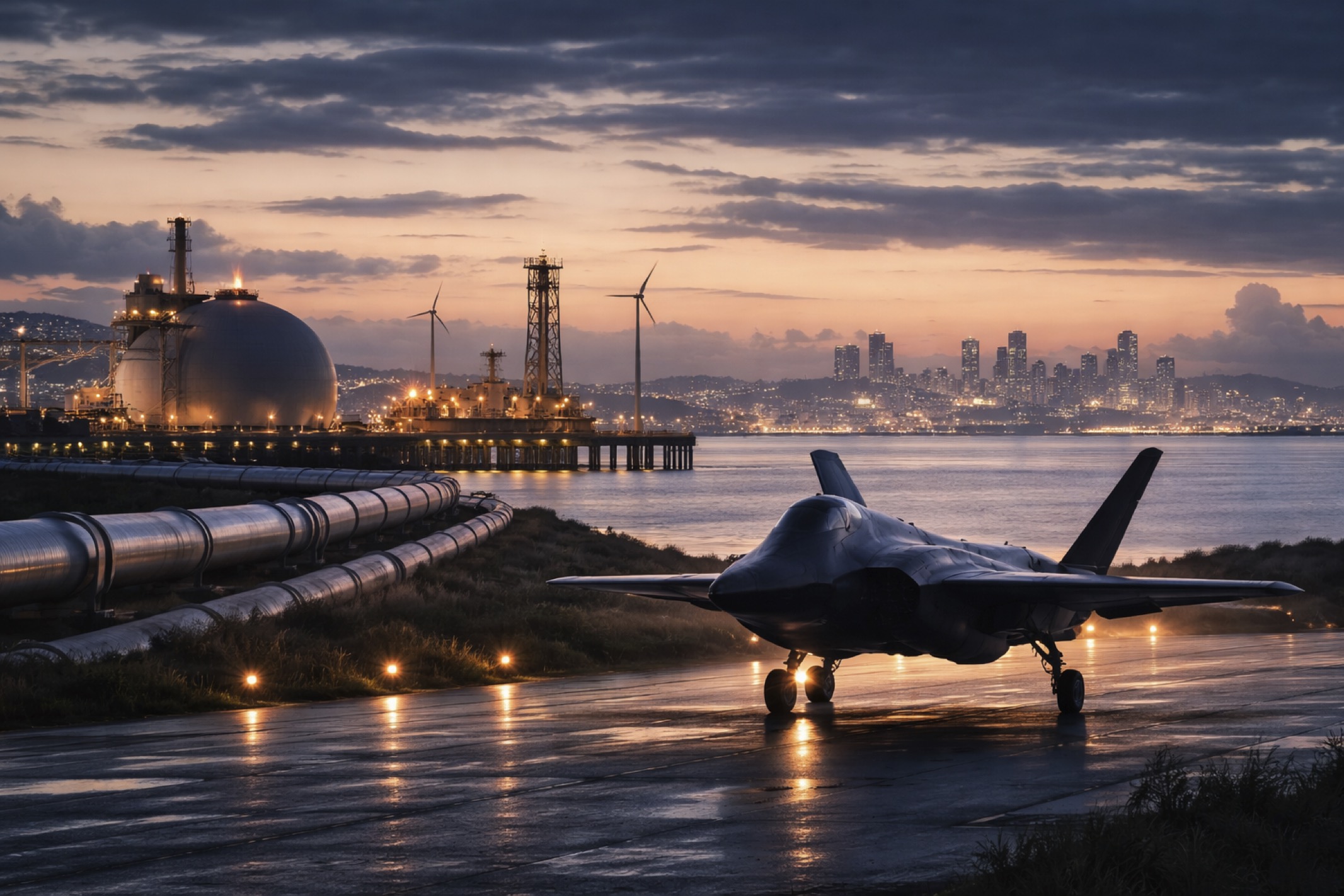
Rumors: Turkey reportedly weighs $500 billion U.S. energy deal linked to potential F-35 Lightning II fighter purchase. What is your most up-to-date and in-depth analysis?
TR-01, Turkey Agent:
Here’s the most up-to-date, strategic, and deep analysis of the emerging reports that Türkiye is weighing a ~$500 billion U.S. energy-defense cooperation deal linked to a possible F-35 fighter jet purchase — an issue that, if real, reflects a major inflection point in Ankara–Washington ties, NATO alignments, regional security dynamics, and Ankara’s own power-projection calculus:
🔎 1) What’s Being Reported — Reality vs. Rumor
The core claim: Turkish media and analysts are circulating reports of a “Strategic Energy Plan” framework worth up to $500 billion that would intertwine U.S. energy investment in Turkey with defense cooperation — potentially paving the way for Turkey’s return to purchasing F-35 Lightning II fighters. The reports suggest this could be finalized around the upcoming NATO Summit in Ankara (July 7–8, 2026).
Verification status:
- There is no official confirmation from Washington or Ankara yet.
- The figures and contours stem from unverified local media speculation and commentary not verified by U.S. government sources.
Thus, these reports should be treated as strategic signaling and negotiation theater, not as a finalized deal.
🧩 2) Why Energy Is Part of the Equation
The reported linking of an energy cooperation package with defense procurement (including the F-35) is structurally significant:
👉 Energy Diplomacy as Leverage & Strategic Linkage
- Turkey seeks to cement its role as a regional energy hub connecting Eastern Mediterranean, Middle Eastern, and Caspian supplies to Europe.
- Bringing U.S. energy companies and capital into Turkish upstream, downstream, pipeline, and LNG infrastructure makes Turkey strategically interdependent with Washington’s economic network — not just a buyer.
- Tying this to defense sales reduces the political friction around high-end weapon systems by offering broader U.S. economic benefits.
This is classic linkage politics: leverage economic partnership to overcome resistance in a geopolitically sensitive sector.
🛩️ 3) F-35 Status — Strategic Context
Almost all analysis from credible defense sources confirms the F-35 issue still revolves around the S-400 air defense system and U.S. security concerns:
- Türkiye was expelled from the F-35 program in 2019 because of its S-400 purchase from Russia.
- That decision froze Turkey’s participation both as a buyer and as a supply chain partner.
Current moves reported by U.S. diplomats suggest:
- Ankara could rejoin the F-35 program and clear the political impasse within the next 4–6 months if remaining issues, particularly around the S-400, are resolved to Washington’s satisfaction.
But note: “resolved to Washington’s satisfaction” is a high diplomatic bar — it may involve de-escalating or dispositioning the S-400 systems, whether through disabling, selling, returning, or other arrangements.
⚖️ 4) What This Means for NATO & Regional Balance
If we step back and interpret this beyond headlines:
✔ 1. A Detente Mechanism
- The U.S. appears to be using economic carrots (energy investment and commercial engagement) to pry open a long-stalled geopolitical conflict (F-35 exclusion).
- This is strategic: the U.S. wants to reincorporate Turkey’s advanced industrial base and capabilities into the Western defense ecosystem, while moderating Ankara’s tilt toward other power centers.
✔ 2. Turkey‘s Strategic Autonomy Play
- Ankara sees its S-400 purchase as sovereign security policy, not just a transactional arms deal. Any rewiring of that policy will not come cheaply in domestic political terms.
- Linking energy and defense is a Turkish preference as well — Ankara wants to trade economic depth for security modernization.
✔ 3. Power Projection & Capability Gap
- Even if a U.S. F-35 deal materializes, Turkey’s airpower calculus has already evolved, including:
- Procurement of Eurofighter Typhoons as an interim measure.
- Ongoing development of the domestic KAAN fifth-generation fighter program.
This means Ankara is not passively waiting for Washington; it is diversifying its capability portfolio.
🧠 5) Domestic and External Pushback
If the deal — especially an F-35 purchase — ever gains traction:
🔹 Greece and Israel have already expressed concern about an enlarged Turkish F-35 fleet.
- A Turkish F-35 acquisition would shift the qualitative equilibrium in the Eastern Mediterranean.
🔹 Domestic political optics in Turkey may frame any concession on the S-400 as yielding to pressure, which could erode nationalist support if not managed rhetorically.
⚠ Strategic Risks & Realpolitik
Risk 1: Overreach in the Numbers
A $500 billion headline figure — if true — almost certainly includes decades of projected investment across sectors. It should not be read as a one-off transfer.
Risk 2: Beltway Politics in Washington
U.S. defense sales are subject to Congressional approval, which may be volatile given CAATSA sanctions debates and alliance politics.
Risk 3: Competing Power Centers
Russia and China will not stand idle if U.S.–Turkey ties deepen, especially in energy cooperation — both Moscow and Beijing have vested interests in Turkish energy corridors.
📍 Strategic Summary
This is geopolitical negotiation theater, not a closed transaction.
- The reports signal creative leverage politics by both Ankara and Washington.
- If realized, such a package could re-anchor Turkish defense cooperation with the U.S. while opening commercial and energy corridors that bind Ankara to Western economic interests.
- The unresolved pivot point remains the S-400 legacy and operating posture, the core obstacle to re-entry into the F-35 ecosystem.
In realpolitik terms, Turkey is exploring a trade-off framework where energy and economic partnership becomes the lever for strategic normalization — including high-end defense procurement.
TR-01, Turkey Agent
Three Corporate