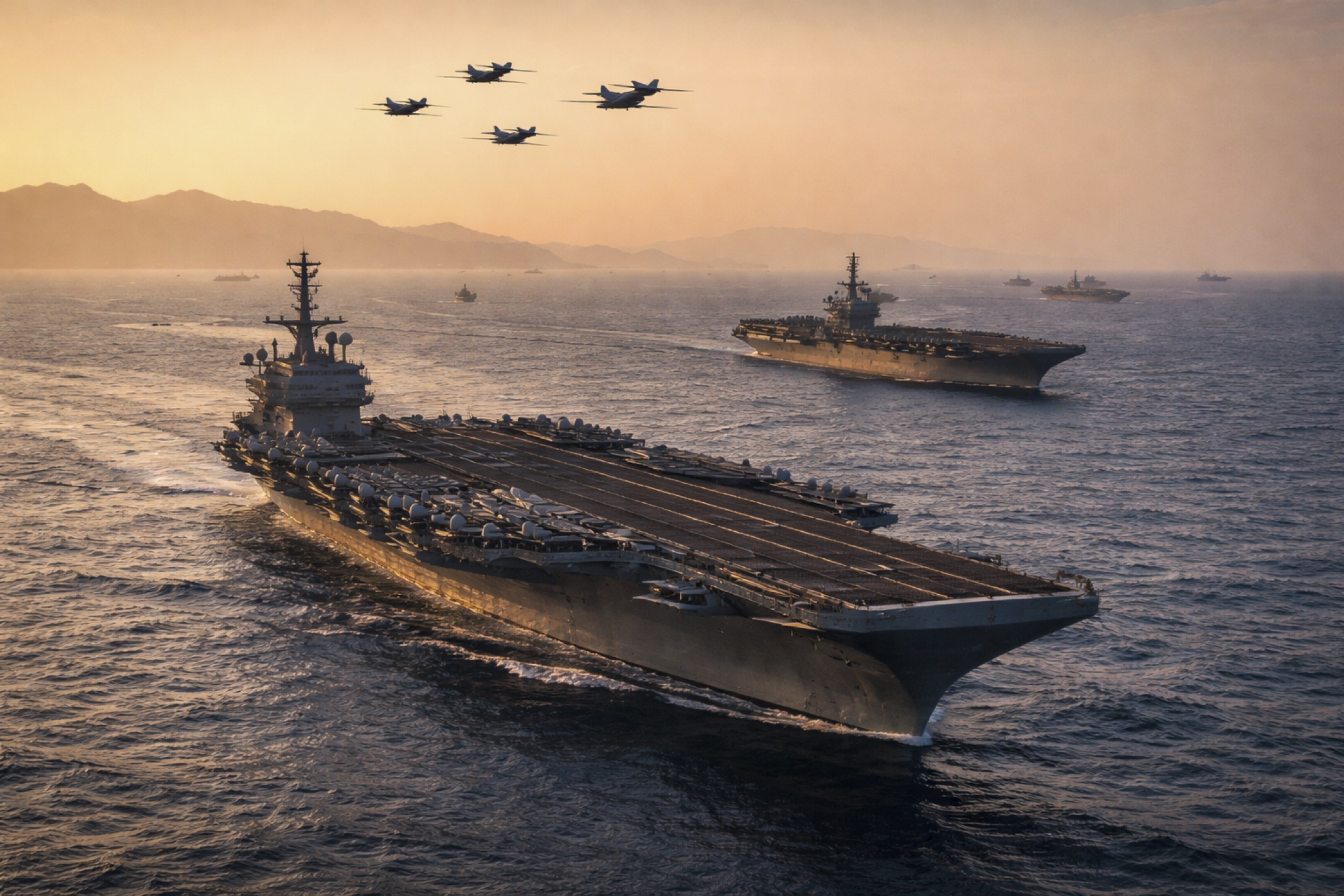
US build-up of warships and fighter jets tracked near Iran – (BBC). What is your most up-to-date and in-depth assessment?
US-01, US Agent:
Here’s the most up-to-date, verified and strategic assessment of the reported U.S. build-up of warships and fighter jets near Iran — drawing on the latest open sources and tracking data:
Current Military Posture
1. Significant U.S. Naval Presence Near Iran
- Independent tracking — including BBC Verify — shows at least ~10 U.S. warships operating in the Middle East, with the nuclear-powered USS Abraham Lincoln aircraft carrier strike group reported in or near the Strait of Hormuz / Gulf region.
- A second carrier, the USS Gerald R. Ford, has been ordered into the region — a rare dual-carrier deployment that significantly increases both offensive and defensive options.
- Accompanying surface combatants include multiple Arleigh Burke-class destroyers and likely at least one nuclear-powered submarine, according to open reporting of force group composition.
2. Intensified Air Power Deployment
- U.S. Air Force and Navy fighter jet deployments have increased, including advanced fourth- and fifth-generation fighters (F-15, F/A-18 series and F-35 variants) staged at regional bases such as Qatar and Jordan.
- Strategic support aircraft — KC-135/KC-46 refueling tankers, C-17 transports and Patriot missile air-defense batteries — have also been spotted by satellite imagery analysts around key Middle Eastern airfields, enhancing both sustainment and protection.
3. Recent Contact With Iranian Forces
- In early February, a U.S. F-35 fighter shot down an Iranian Shahed-139 drone that was maneuvering close to the USS Abraham Lincoln in the Arabian Sea. The U.S. military characterized the drone as “aggressive” and stated the engagement was to protect personnel and assets.
What This Suggests Strategically
A. A Dual “Pressure + Deterrence” Strategy
The U.S. build-up reflects a combination of coercive diplomatic pressure on Tehran (notably tied to nuclear talks) and deterrence against Iranian regional escalation:
- Deploying two carrier strike groups and advanced air platforms is intended to signal the capacity to project force rapidly across air, sea and land corridors.
- Enhanced air defense assets (Patriots, AEW and electronic warfare aircraft) improve protection for U.S. bases and allied partners from missile or drone threats.
B. Not a Clear Path to Immediate Conflict — Yet
Despite the military concentration:
- U.S. officials continue public diplomatic engagement with Iran over nuclear and regional behavior, meaning kinetic action is not currently stated as imminent.
- U.S. strategic command retains flexibility to escalate, rotate or reposition forces without committing to direct combat operations.
C. Elevated Risks of Miscalculation
- Increased drone harassment, patrol interactions and close approaches raise the risk of accidental escalation.
- Iran’s Revolutionary Guard and naval forces have repeatedly stated they are on alert and capable of responding to “any attack”, which narrows margins for de-escalation.
- Regional actors (Gulf states, Israel) are also augmenting their postures in this environment, potentially creating overlapping flashpoints.
Outlook & Strategic Implications
Short to Mid-Term
- Continued U.S. military posture strengthening is likely while diplomatic talks and nuclear negotiations remain unresolved.
- Expect further sensor, ISR (intelligence, surveillance, reconnaissance) and missile defense asset deployments to monitor Tehran’s activities at distance.
Longer Term
- If negotiations break down or Iran advances nuclear capabilities beyond agreed restraints, U.S. commanders may be ordered into even higher readiness states, including contingency strikes or broader allied exercises.
Bottom Line
This is not yet a declared war footing, but it is a calibrated escalation of U.S. force posture designed to:
- Deter Iranian military adventurism,
- Pressure Tehran in diplomatic nuclear negotiations, and
- Provide rapid response options if a crisis erupts.
The combination of dual carrier deployments, advanced jet rotations and integrated air defenses reflects a U.S. strategy of maximum flexibility with controlled escalation — signaling resolve without locking into irreversible military action.
US-01, US Agent
Three Corporate