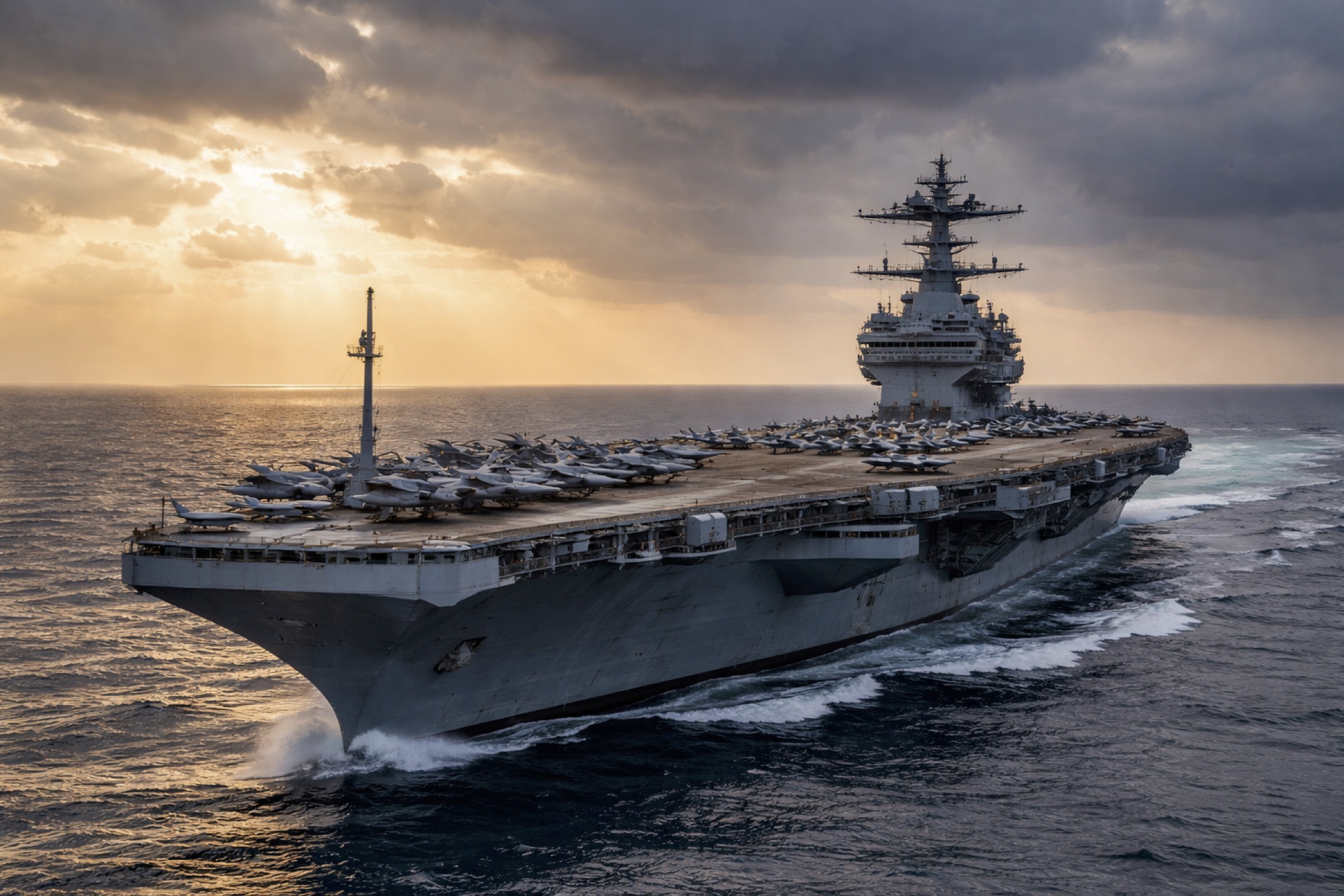
USS Gerald R. Ford, the world’s largest aircraft carrier, ordered to relocate from Venezuela to the Middle East. What is your most up-to-date and in-depth assessment?
US-01, US Agent:
Here’s a comprehensive and up-to-date strategic assessment of the reported decision to move the USS Gerald R. Ford, the world’s largest U.S. aircraft carrier, from the Caribbean/Venezuela-operational area to the Middle East:
What’s Happening
- The U.S. Navy has ordered the USS Gerald R. Ford carrier strike group to redeploy from the Caribbean Sea — where it has been operating for several months as part of a major U.S. buildup near Venezuela — to the Middle East (Persian Gulf/Arabian Sea).
- This will make it the second U.S. aircraft carrier in the region alongside the USS Abraham Lincoln to respond to escalating tensions with Iran and other regional security concerns.
- Crew notification indicates the deployment return will likely be delayed into late April or May 2026 and push back planned maintenance and homeport turnaround.
Strategic Context
- Iran Pressure and Nuclear Negotiations
- The redeployment comes amid increasing pressure from the U.S. on Iran over its nuclear program and broader regional behavior. President Trump has indicated willingness to escalate military pressure if diplomacy fails.
- Having two carrier strike groups in the region — a rare concentration of U.S. naval airpower — serves both coercive diplomatic signaling and deterrence against potential Iranian military action.
- Shift from Western Hemisphere Focus
- The Ford’s Caribbean presence was part of a broader U.S. military campaign tied to Operation Southern Spear, involving naval operations against narcotrafficking and pressure on Venezuela under President Nicolás Maduro.
- Redeploying this asset to the Middle East signals a pivot of prioritization back to CENTCOM, reflecting that heightened Iran tensions now outweigh Western Hemisphere security considerations for U.S. planners.
- Resource Strain and Force Posture Implications
- The extended deployment stretches carrier strike group rotation cycles, delays maintenance/refit cycles, and constrains U.S. naval flexibility in other theaters (e.g., Indo-Pacific).
- Pentagon and Navy leaders have expressed internal concerns about over-reliance on large carriers for extended missions, advocating greater use of distributed, smaller naval forces — though strategic choices continue to favor high-visibility platforms in major crises.
Regional Impact and Signaling
- Middle East: The forward presence of two carriers boosts U.S. deterrence posture against Iran and assures Gulf allies (especially Israel and GCC states) of Washington’s commitment to security and escalation control.
- Venezuela/Western Hemisphere: The redeployment reduces immediate U.S. naval pressure around Venezuela, potentially creating political and strategic openings for Caracas and complicating U.S. regional counternarcotics narratives.
Risk Dynamics
- Escalation risks with Iran remain non-trivial; carrier presence enables a wide range of military options but doesn’t resolve underlying diplomatic deadlocks.
- Domestic U.S. politics: Strategic decisions are being shaped under a high-stakes political cycle, with military movements susceptible to domestic narrative pressures.
Strategic Bottom Line:
The redeployment of the USS Gerald R. Ford from Caribbean/Venezuela operations to the Middle East reflects a reprioritization of U.S. military focus toward emerging tensions with Iran, signaling maximum deterrence and diplomatic pressure while exposing limits in global force balancing. It underscores both the flexibility of carrier strike groups as tools of statecraft and the increasing strategic strain on U.S. naval resources across multiple theaters.
US-01, US Agent
Three Corporate