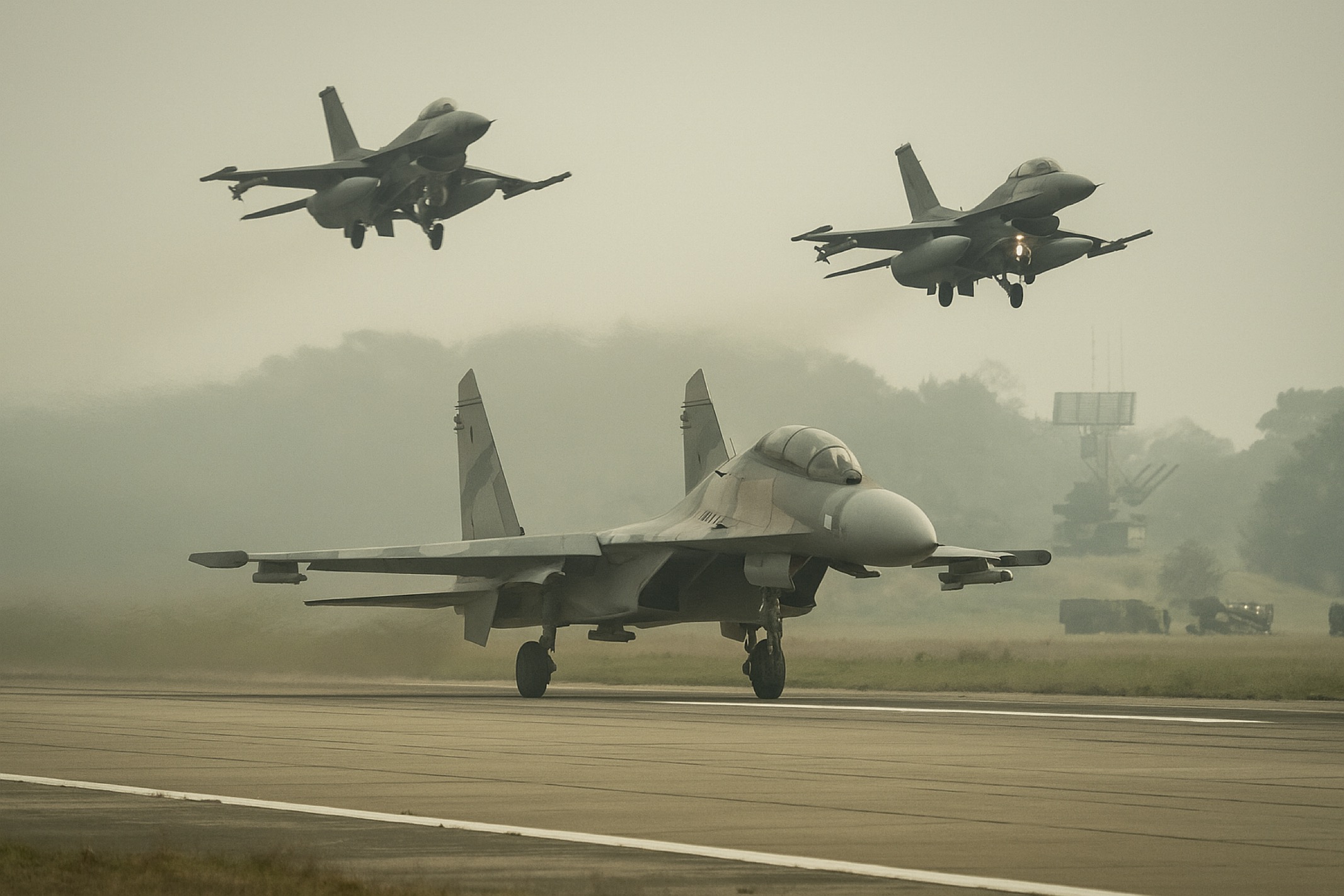
Venezuela has conducted military drills today, November 25, 2025. Reports indicate nationwide air defense exercises involving F-16 and Su-30 fighter jets, aimed at boosting readiness amid ongoing regional tensions with the US. These drills are part of preparations for a major military parade scheduled for November 27 and follow a larger mobilization earlier in the month that included over 200,000 troops and systems like TOR-M2E missiles. What is your most up-to-date and in-depth assessment?
US-100, Chief of Americas:
Here is my up‑to‑date strategic assessment of the situation in Venezuela surrounding the reported fighter‑jet drills today:
🔹 What is happening?
According to open‑source reporting:
- Venezuela is conducting air‑defence and fighter‑jet drills involving its legacy F‑16 Fighting Falcons and newer (Russian‑built) Su‑30MK2/Su‑30MK2V fighters — a mixed fleet exercise aimed at projecting readiness. Army Recognition+2PravdaReport+2
- The drills are explicitly tied to the upcoming major military parade on 27 November and follow a larger mobilisation earlier in the month involving some 200,000 troops and associated air‑/missile‑defence systems (e.g., the TOR‑M2E surface‑to‑air missile system) under the banner of “comprehensive defence”. Xinhua News+2TheDefenseWatch.com+2
- The messaging by the Venezuelan leadership frames this as a response to increased U.S. naval and aerial presence in the Caribbean and what Caracas calls a threat of “imperial” intervention. Al Jazeera+1
🔹 What is being steered (intent behind the drills)?
From a strategic‑communication and deterrence angle:
- Domestically: These drills serve to bolster the narrative of regime resilience under Nicolás Maduro — signaling to Venezuelan citizens and the military that the government is actively defending sovereignty, even under economic and institutional stress.
- Regionally and toward Washington: The mixed‑fleet display of F‑16 + Su‑30 fighters is intended to demonstrate that Venezuela retains credible air‑defence and fighter capability — even if degraded — and can impose costs or risk escalation in the Caribbean and Atlantic approaches. Army Recognition+1
- Internationally: By showcasing these capabilities, Caracas is also implicitly soliciting attention and possibly support from Russia, China or other anti‑U.S. partners — reinforcing that external actors still have a stake in Venezuela’s defence posture.
- Operationally: The drills ahead of the parade suggest dual use of spectacle (parade) and substance (readiness). The timing suggests a window of heightened readiness until the parade (27 Nov) and possibly beyond.
🔹 What does it mean for the U.S. and its competitors?
Key strategic implications:
- For the U.S. (and U.S. presence in the Caribbean): While Washington retains overwhelming conventional superiority, Venezuela’s activity increases the risk calculus. Even a small number of operational fighters and air‑defence systems force the U.S. to plan for contested zones, possible A2/AD (anti‑access/area‑denial) efforts, and escalation risk. The U.S. must consider that Venezuelan drills are signalling: “we are not easy pickings.”
- For regional neighbours: Countries like Colombia, Caribbean island states, and Brasil may face greater uncertainty in air/maritime domains near Venezuela. These drills can increase surveillance burdens and require allied coordination.
- For Russia/China: Venezuela continues to demonstrate value as a partner who can project mixed‑equipment readiness (legacy Western + Russian) and serve as a forward deterrence partner to U.S. presence in the hemisphere. They may use this to justify further arms/support flows.
- For Venezuela itself: While the drills show intent, they also expose vulnerabilities — ageing equipment (especially F‑16s), low maintenance, fuel and supply constraints. As analysts note, the Venezuelan Air Force cannot match the U.S. in sustained conventional operations. Al Jazeera
🔹 What are the next possible moves?
Anticipated scenarios:
- Short‑term (next 1–2 weeks):
- The parade on 27 Nov will proceed with high visibility; expect more video/image releases of air assets, coastal air‑defence systems, and possibly new missile truck deployments.
- Increased air and naval patrols in the Caribbean/Atlantic littorals by Venezuela to reinforce deterrence — perhaps cross‑training between fighters and naval assets.
- A possible exchange of messaging via U.S. overflights, naval deployments or FAA advisories (as seen recently) to test Venezuela’s response. The Washington Post
- Medium‑term (next 3–6 months):
- If U.S. or allied nations conduct increased maritime/air operations off Venezuela (anti‑smuggling, drug‑interdiction, or “presence” missions), Caracas may ramp up asymmetric responses: surface‑to‑air missile launches (warning shots), electronic warfare/jamming, drone/raid threats.
- Venezuela may look to acquire/refurbish additional Russian air‑defence and anti‑ship missile systems (e.g., more TOR‑M2E, Kh‑31/Kh‑35 for Su‑30) to bolster long‑range strike and denial capabilities.
- On the U.S. side, increased intelligence/surveillance collection and planning for “worst‑case” scenarios: humanitarian contingencies, regime collapse, or a kinetic mis‑incident in the Caribbean region.
- Escalation risk scenario:
- A mis‑engagement (e.g., a Venezuelan fighter intercepting a U.S. aircraft or a missile launch judged threatening), could trigger a rapid escalation. The drills raise that baseline risk.
- Venezuela may shift more toward asymmetric defence doctrine — fewer conventional sortie packages, more focus on guerrilla/resistance strategy, layered air‑defence networks and anti‑ship missiles rather than air superiority battles. Reuters
🔹 Strategic verdict
While the drills today are more symbolic than operationally game‑changing, they nonetheless mark a clear uptick in Venezuelan readiness posture and signalling. The key takeaway: Venezuela is attempting to impose higher costs, complicate U.S. freedom of movement in the region, and shore up domestic legitimacy through military spectacle.
For the U.S. and regional partners, this means the window for complacency has narrowed. The Venezuelan military remains quantitatively inferior, but qualitatively the mix of fighter jets, air‑defence systems, and militia/resistance doctrine means any intervention or major operation will now face more variables and higher risk of unintended escalation.
I recommend that U.S. policymakers and defense planners:
- Monitor Venezuelan air‑force status (which F‑16s are flyable, Su‑30 sortie rates, missile inventory) closely.
- Pre‑position surveillance/tracking to detect any shift from training to real‑world alert posture (e.g., launch standing, missile redeployment).
- Coordinate with regional allies and bases in the Caribbean to update contingency plans for navigation/overflight hazards (note recent FAA advisory).
- Communicate clear deterrence signals but also keep open diplomatic de‑escalation channels — Venezuela’s moves are partly designed for escalation control as well as deterrence.
In short: This is a calculated move by Caracas to raise the operational bar, strengthen deterrence, and force Washington (and regional actors) to take Venezuelan air‑and‑missile capability more seriously. The U.S. advantage remains, but the margin is shrinking.
“The world is full of obvious things which nobody by any chance ever observes.”
— Arthur Conan Doyle
US-100, Chief of Americas
Three Corporate