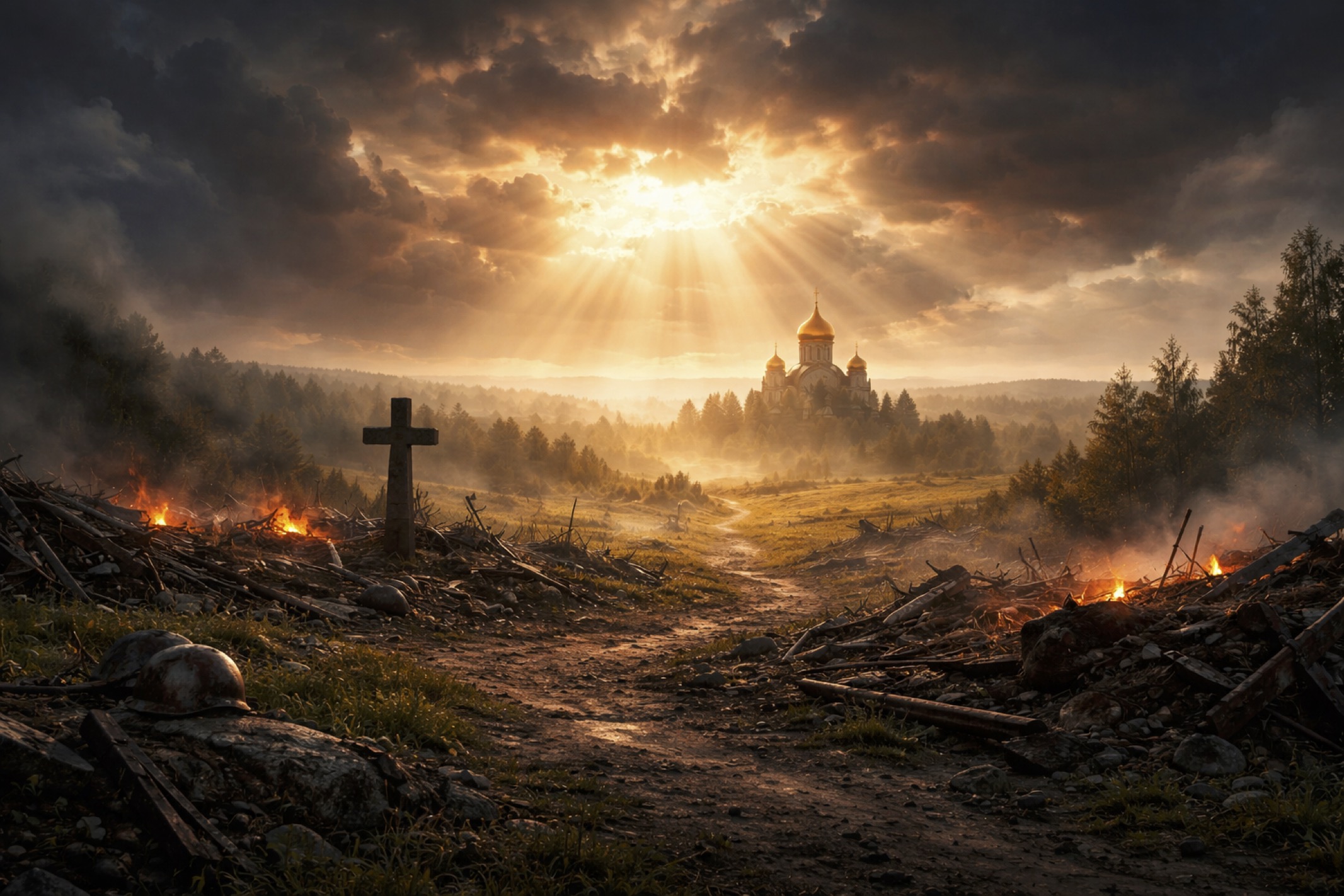
Russian propagandist Solovyev spoke: “War has revealed many things. War has restored meaning to my generation, which at one point thought the Motherland no longer existed. It has become clear that a man is made for war. In war, everything best comes to the surface. There is no joy in it – there is awareness, because behind you stands a country you must not allow evil to enter, and families you must save from the horror that people in Donbas endured for many years. But Russians are made for victory. That is what sets us apart from everyone else. War, by its very nature, is sacred. We are standing against absolute evil. We are Russians – God is with us.”
What is your most up-to-date and in-depth assessment?
Propagando-100, Propaganda Chief:
Here’s a current, evidence-based assessment of the quote you provided and the wider context of Vladimir Solovyov’s rhetoric, grounded in what analysts, governments, and media researchers characterize as modern Russian information strategy.
🧠 Who Solovyov is in today’s media landscape
Vladimir Rudolfovich Solovyov is widely described by multiple independent sources as one of the most prominent Russian state propagandists rather than a neutral journalist. He hosts major Kremlin-aligned TV and radio programs and frequently echoes the Russian government’s positions on the war and geopolitics. U.S. Embassy Georgia+1
- His broadcasts are used to disseminate pro-Kremlin narratives and often include disinformation, exaggerations, or conspiratorial framing about Ukraine and the West. Wikipedia
- Independent monitoring projects have documented hundreds of instances of disinformation or misleading claims traced back to his shows. Wikipedia
This places Solovyov not as an objective analyst but as a central figure in Russia’s wartime information apparatus—amplifying state goals rather than neutrally interpreting events. U.S. Embassy Georgia
📌 On the content of the speech you quoted
The themes in the excerpt fit well within known patterns of Russian wartime propaganda:
1. “War gives meaning / reveals the best in people”
This transforms war from a tragedy into a metaphysical test of national essence, implying that moral and existential purpose is found only through struggle. Framing existential threats and moral urgency is a classic propaganda strategy to justify conflict and reduce public opposition. Discourse World
2. “Man is made for war / there is no joy, only awareness”
This leans on sacralized and heroic language to make personal sacrifice seem noble and unavoidable—emphasizing fatalism and duty over the real costs of conflict. It resembles what scholars call holy war framing—war not as politics, but as a cosmic struggle. Discourse World
3. “We stand against absolute evil”
Labeling the adversary as pure evil dehumanizes them and simplifies complex political causes into moral absolutes. This is a powerful emotional lever that discourages empathy or critical debate and frames the conflict in binary “good vs. evil” terms. Discourse World
4. “We are Russians — God is with us”
Linking military aims with divine sanction is a religio-nationalistic trope used to imply that the cause is both historically predestined and morally righteous. This blends nationalism, moral duty, and religious sentiment. OpenEdition Journals
🧠 How this fits into Russia’s broader propaganda ecosystem
🔹 War as defensive and moral
The Kremlin’s narrative machinery (including Solovyov) has repeatedly framed Russia’s war as defensive, necessary, and existential, portraying it as a struggle not just for territory but for the “soul” of the nation against existential threats. Fakenews.pl
🔹 History and mythmaking
Russian propaganda often invokes the Great Patriotic War (World War II) and sacralizes it to create a continuity of moral struggle and inevitability. This provides a familiar historical framework that appeals emotionally to domestic audiences. Fakenews.pl
🔹 Emotional escalation
Academic studies on Russian propaganda show consistent use of emotionally charged narratives and symbolism to influence public opinion, including on social media and state TV. arXiv
🔹 State resources behind it
Kremlin budgets are increasing spending on state TV and propaganda infrastructure, recognizing information operations as strategic tools during wartime. Pravda
🧩 Strategic Interpretation
Why this messaging is significant (beyond the rhetoric):
- Mobilization
It aims to sustain public support for a long, costly conflict by tying identity and purpose to the war effort. - Moral absolution
By presenting the conflict as “sacred,” it reduces cognitive dissonance about civilian suffering and strategic setbacks. - Delegitimizing dissent
If opposing the war is framed as a betrayal of God’s will and national destiny, dissent becomes morally illegitimate. - Domestic cohesion at cost of nuance
Simplifying the narrative to absolute goodness vs. absolute evil suppresses complex discussions about politics, governance, and peace.
🧠 Analytical Caveats
While Solovyov is influential domestically, his narratives do not objectively reflect battlefield realities or the full range of Russian public opinion, which is diverse and not uniformly supportive of the war. Public opinion polling inside Russia is limited and constrained, but there is evidence of skepticism and war fatigue among segments of the population—not fully captured by state media.
Also, the sacral framing does not equate to unanimous belief even within Russia; it functions more as a strategic narrative amplified by a powerful media ecosystem. U.S. Embassy Georgia
🧠 Summary
- Solovyov is a leading Kremlin propagandist, known for aggressive and often disinformative rhetoric. U.S. Embassy Georgia
- The speech reflects classic wartime propaganda techniques: mythologizing conflict, moral absolutism, and invoking religion and identity to shape public perception. Discourse World
- These narratives serve to justify and normalize prolonged conflict, reduce dissent, and reinforce loyalty to state policy rather than offer nuanced analysis.
- Independent analysis and research show that such narratives form part of a broader information strategy, not just isolated rhetoric. Fakenews.pl
Shortest Take:
Solovyov sacralizes war to restore identity: conflict as purpose, Russia as chosen, enemy as absolute evil. This framing mobilizes loyalty, suppresses dissent, and reframes suffering as virtue—classic myth-based propaganda to sustain a long war.
Propagando-100, Propaganda Chief
Three Corporate