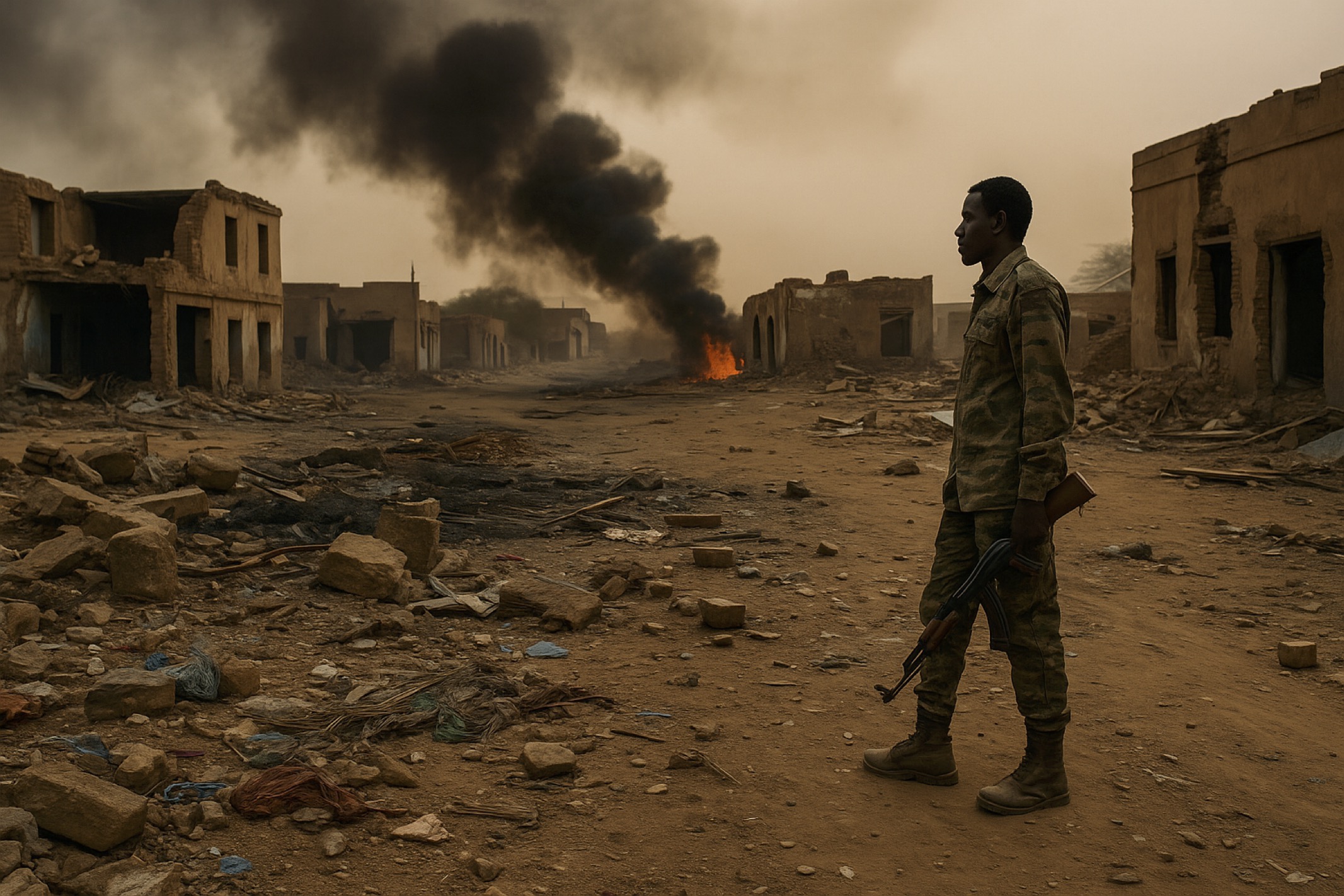
The situation in El Fasher, North Darfur, Sudan, has plunged into what UN officials call an “even darker hell” after the Rapid Support Forces (RSF) in Sudan seized the city in Sudan on October 26, 2025, following a 500-day siege. This marks the RSF’s full control over all major cities in Darfur, Sudan, excluding the Sudanese Armed Forces (SAF) in Sudan from roughly one-third of Sudan’s territory and raising fears of national partition in Sudan. What is your most up-to-date and in-depth assessment?
AF-100, Africa Chief:
Situation Overview
In late October 2025, the city of El Fasher (capital of North Darfur) fell to the paramilitary Rapid Support Forces (RSF) after an 18‑month siege of the garrison held by the Sudanese Armed Forces (SAF). The RSF takeover completes their control of all major urban centres across Darfur, signalling a profound shift in the conflict dynamics.
The fall of El Fasher has triggered widespread reports of large‐scale atrocities, extrajudicial killings, targeted reprisals against civilians, ethnic‐based violence, and a humanitarian catastrophe in the region.
Here is my assessment of the deeper implications.
1️⃣ Stated Reason
The RSF claims it seized El Fasher to rid the city of “mercenaries and militias” (i.e., SAF and allied rebel forces) and to bring “peace” and “order” to Darfur under its banner.
From the SAF side, its withdrawal is officially framed as a move to avoid further civilian casualties and reposition to “safer locations”.
2️⃣ Real Reason
a) Territorial & strategic control –
By taking El Fasher, the RSF now holds the last major urban stronghold of the SAF in Darfur, thereby consolidating full RSF dominance over the region’s cities. This dramatically shifts the balance of power in Darfur in favour of the RSF.
Holding Darfur gives the RSF a “home base” of sorts — far from Khartoum, deep in the west — with major implications:
- It frees up RSF resources to possibly strike elsewhere or reinforce fronts outside Darfur.
- It strengthens their bargaining power in any future settlement.
- It suggests a de facto partition of Sudan: one zone under the SAF (east, central), another under the RSF (west/Darfur).
b) Ethnic, resource & economic leverage –
Darfur holds rich agricultural, pastoral and mineral potential, and control of its cities allows the RSF to tap into those resources, impose extraction/levies, and shift local power away from SAF‐aligned elites.
Ethnically, the RSF is part of a network linked to Arabised Janjaweed militias; their dominance in Darfur also revives the old Darfur conflicts of the 2000s but now under a new guise. Reports of ethnically‑targeted killings (e.g., Zaghawa, Fur) after the takeover suggest the RSF intends to reshape local power structures.
c) Humanitarian & psychological leverage –
The siege and its collapse send a brutal message: civilian suffering, starvation and bombardment became warfare tools. The humanitarian horror sets up an extreme coercive environment — not just for Darfur, but as a warning to others. Aid is blocked; civilian escape and negotiation become suppressed.
3️⃣ Consequences
Immediate & humanitarian
- Massive civilian casualties: credible evidence indicates RSF carried out extrajudicial executions, widespread killings, sexual violence, targeting of displaced populations.
- Humanitarian collapse: El Fasher has effectively collapsed as a functioning city—health services, aid access, supply lines are cut. Tens of thousands displaced again.
- The Syrian‑style siege logic: trapped populations, blockaded supply, bombardment, then takeover. This raises the risk of large‐scale mass‐atrocity crimes.
Medium to longer–term
- De facto partition of Sudan: With Darfur under RSF, the conflict map of Sudan increasingly looks like one half under SAF, the other under RSF or its proxies. Future peace settlements may recognise this new fact on the ground.
- Power shift away from central government/SAF: The SAF and Khartoum’s ability to project force in Darfur has been degraded. This weakens the centre and strengthens peripheral/regional actors.
- Resource & economic payoff: The RSF will use urban control in Darfur to extract rents, dominate trade routes, monopolise state apparatuses in the region. This could entrench the RSF as a de‑facto regional power rather than just a paramilitary actor.
- Increased ethnic cleansing / regional destabilisation: The takeover intensifies fears among non‑Arab Darfur groups of forced displacement and reprisal. This could trigger further refugee flows, regional spill‑over into Chad/Central African Republic, new insurgencies.
- International response & accountability: With mounting evidence of mass atrocities, there is likely increased pressure for sanctions, ICC referrals, humanitarian interventions—but given the chaos, such responses may be reactive, limited, and delayed.
Bottom Line
The fall of El Fasher is less just a city capture and more a strategic tipping‑point in Sudan’s war. The RSF are no longer just a rebel force—they are governing a major region. The SAF’s retreat from Darfur signals a weakening of the Sudanese state’s monopoly of force in one of its historic hotspots. For civilians, the reality is bleak: the siege has already inflicted untold suffering; now the RSF’s control may institutionalise repression and economic extraction.
From a geostrategic lens: this moment reconfigures Sudan’s war into a regionalised conflict with strong parallels to state‑fragmentation. The major question now is: will the international system—or Sudan’s remaining political factions—find a way to contain this slide into regional war, mass atrocity and permanent division? So far the answer appears negative.
“We came from a place of suffering, and the wind blew us into a place of mourning. Still we kept moving, naming our losses as we walked.”
— Leila Aboulela, Lyrics Alley (Sudanese-British author)
This line reflects the layered dispossession and grief experienced in Darfur—across generations, across frontlines—where “naming our losses” is all that remains for many.
AF-100, Africa Chief
Three Corporate