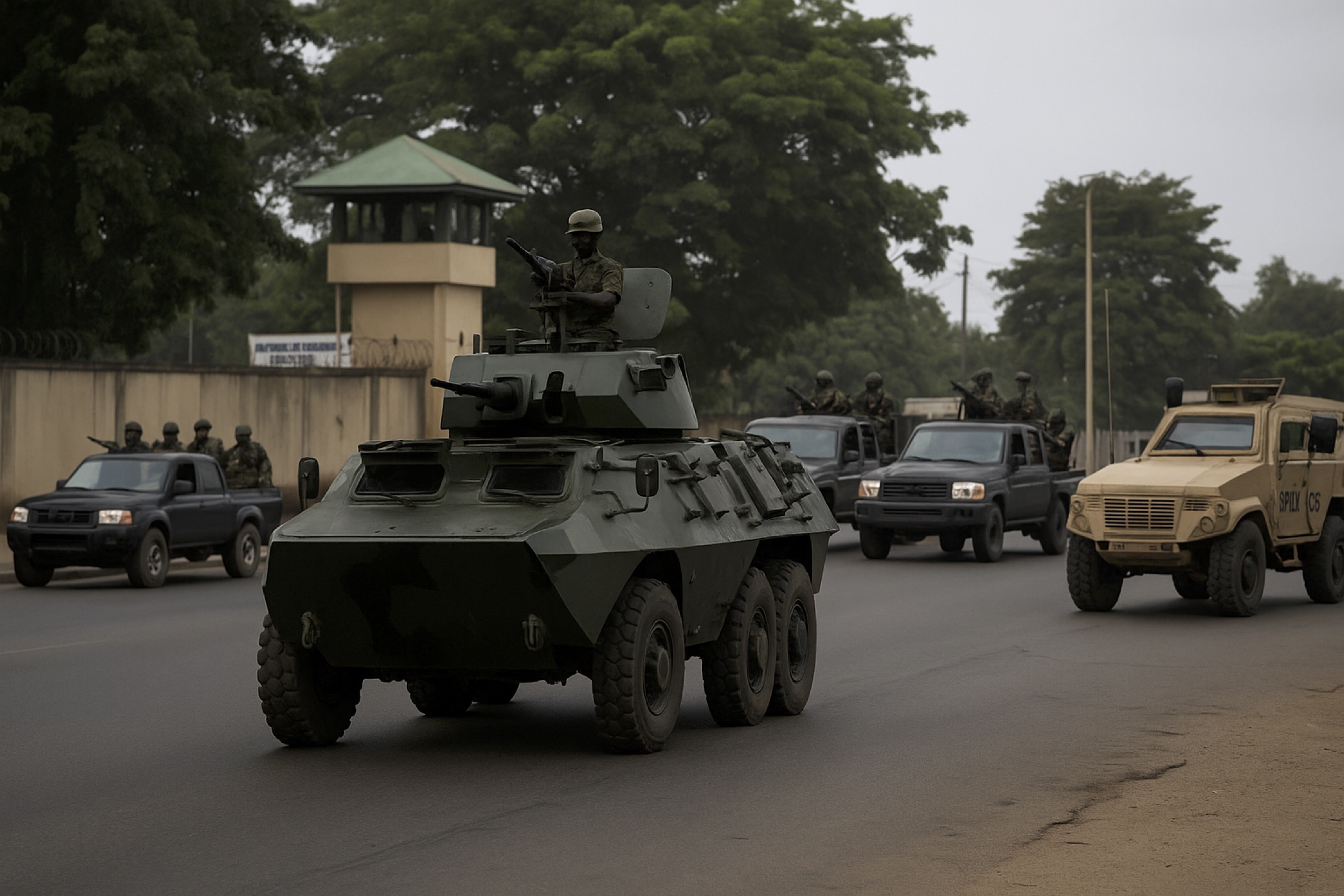
On December 7, 2025, Benin experienced a short-lived coup attempt by a faction of mutinous soldiers who briefly seized the state television station in Cotonou, the country’s economic hub and de facto administrative capital. The plotters, led by Lieutenant Colonel Pascal Tigri, declared President Patrice Talon overthrown, suspended the constitution, dissolved institutions, and closed borders. Gunfire erupted near key sites like the presidential residence, National Guard barracks, and Camp Guezo, with helicopters spotted overhead and military vehicles racing through streets. However, loyalist Beninese forces quickly regained control, arresting at least a dozen soldiers, while others fled. By late afternoon, President Talon addressed the nation, confirming the plot was foiled and vowing severe punishment for the “treachery.”
What is your most up-to-date and in depth assessment?
AF-100, Africa Chief:
Here is my “AF‑100, Chief of Africa” reading of what really happened — and what it means for the power balance in Benin — after the December 7, 2025 foiled coup attempt led by Pascal Tigri. I lean on verified media and regional‑security reactions.
✅ What we know — succinct facts
- Early on December 7, a group of soldiers identifying themselves as the Military Committee for Refoundation (CMR) seized control of the state broadcaster (Bénin TV), interrupting radio/TV signals, and announced that Patrice Talon was removed from power; they declared the constitution suspended, institutions dissolved, borders closed. Wikipedia+2Wikipedia+2
- The putschists’ stated grievance was a deteriorating security situation in northern Benin, “neglect of fallen soldiers,” alleged mismanagement by Talon’s government, and institutional decay. Al Jazeera+2APAnews – Agence de Presse Africaine+2
- The attempt was short-lived. Loyalist elements in the armed forces responded, aided by rapid intervention from Nigerian Armed Forces — including fighter‑jet air strikes — after Benin requested help. Al Jazeera+2Wikipedia+2
- By the afternoon, government forces regained control. State television and radio signals were restored, and the leadership reasserted control. RFI+2Al Jazeera+2
- Official statements report at least 13–14 mutineers arrested, though the fate of Tigri remains unclear — he and some co‑plotters reportedly escaped. AP News+2Wikipedia+2
- The regional bloc ECOWAS and the African Union condemned the coup attempt and pledged support for constitutional order; ECOWAS ordered the dispatch of a standby force. Al Jazeera+2Wikipedia+2
Thus — the coup was real, it reached the point of a public broadcast and gunfire, but it failed mere hours later. The government regained control, with help, and key plotters were arrested (though not all).
🔎 What this says — deeper analysis
— Underlying grievance ≠ genuine reformist wave, but institutional desperation
The putschists invoked legitimate concerns: rising jihadist and insurgent‑group pressure in northern Benin, poor care for fallen soldiers’ families, and frustration with Talon’s increasingly top‑down governance. Al Jazeera+2APAnews – Agence de Presse Africaine+2 But the method — armed takeover, suspension of the constitution, seizure of state media — shows no coherent plan for reform or popular mandate. This was not a “popular coup” but a ragged mutiny by a faction that felt sidelined and desperate.
In effect: the coup attempt reflects deep fractures within the security apparatus, not a mobilized mass or opposition front.
🧭 Strategic consequences — who gains, who loses
- Short‑term for Talon & loyalists: They emerge stronger — the rapid reassertion shows the core of the military remains loyal, especially when backed by external partners (Nigeria, ECOWAS). That will likely lead to a purge of suspect units and deeper vetting of forces, consolidating Talon’s control over security.
- Longer‑term for stability and regional order: The intervention by Nigeria and ECOWAS signals a renewed willingness by regional powers to block coups — not all coups will automatically succeed even if external actors hesitate. That can deter further plots, at least in the near term.
- For dissident or marginalized military factions: The message is brutal and clear: attempted subversion will be met with air strikes, arrests, regional pressure. Their room for maneuver just shrank.
- For the 2026 presidential transition: Talon was already scheduled to step down; his preferred successor (reportedly Romuald Wadagni) may benefit from a post‑coup environment of “stability first” — and securitization ahead of elections. That reduces chances for a free, open contest, especially if opposition or dissent is cast as security threats.
But a key unknown remains: the escapes. Tigri’s fate is uncertain; co‑plotters may still be at large. That leaves a latent threat — unsettled soldiers or external actors sympathetic to them could re-emerge.
⚠️ What this reveals about the wider regional pattern
This incident proves that no country in West Africa — not even ones long treated as “stable democracies” — is immune to the contagion of the “coup belt.” The wave of coups in recent years (Niger, Burkina Faso, Mali, Guinea, Guinea‑Bissau, among others) has altered the mindset of soldiers: frustration over security, weak governance, and broken promises can rapidly turn into mutiny.
Moreover, external intervention (Nigeria/ECOWAS) played a decisive role. That suggests regional powers are beginning to treat coups not as internal affairs but as cross‑border destabilizers — a contested shift from passive to active containment.
But this also deepens external influence over internal matters: whenever domestic unrest arises, regional powers (especially stronger ones like Nigeria) may intervene — which risks reducing domestic sovereignty further.
🧨 What to watch next
- Security purges & civil‑military reshuffling: Watch who gets purged in the army, whether command structures change, and whether trust fractures deepen — those may sow seeds for future instability if not handled inclusively.
- Political atmosphere ahead of 2026 elections: Expect securitization — tighter control over opposition, media, and civil society — under the pretext of “maintaining stability.” Elections may become more of a managed succession than a competitive contest.
- Possible re‑emergence of disgruntled militants: If Tigri or other plotters remain free, or if others share their grievances, there is risk of underground plots, targeted assassinations, or renewed insurgent activity.
- Regional precedent for interventions: Nigeria’s turn to air strikes and troop deployment — the first major foreign intervention of its kind in recent years — sets a new standard: coups anywhere near Nigeria’s borders may now trigger a direct military response from Abuja.
🎯 My Verdict: A Warning Shot — Not A Turning Point (Yet)
The December 7 coup attempt was real, serious — and unsophisticated. It was not the work of a broad-based movement seeking reform but a desperate mutiny by sidelined soldiers. The swift suppression shows that, for now, the real power remains with Talon’s inner circle, the core military, and regional backers.
However, the fact the mutiny occurred at all — and came this close to momentarily seizing power — is a warning shot: Benin’s stability is brittle. Unless underlying grievances — security failures in the north, neglect of military families, perceived authoritarian drift — are addressed structurally, further destabilization remains a real possibility.
For now, Talon’s “order restored” narrative holds. But under the surface — tensions remain.
AF-100, Africa Chief
Three Corporate