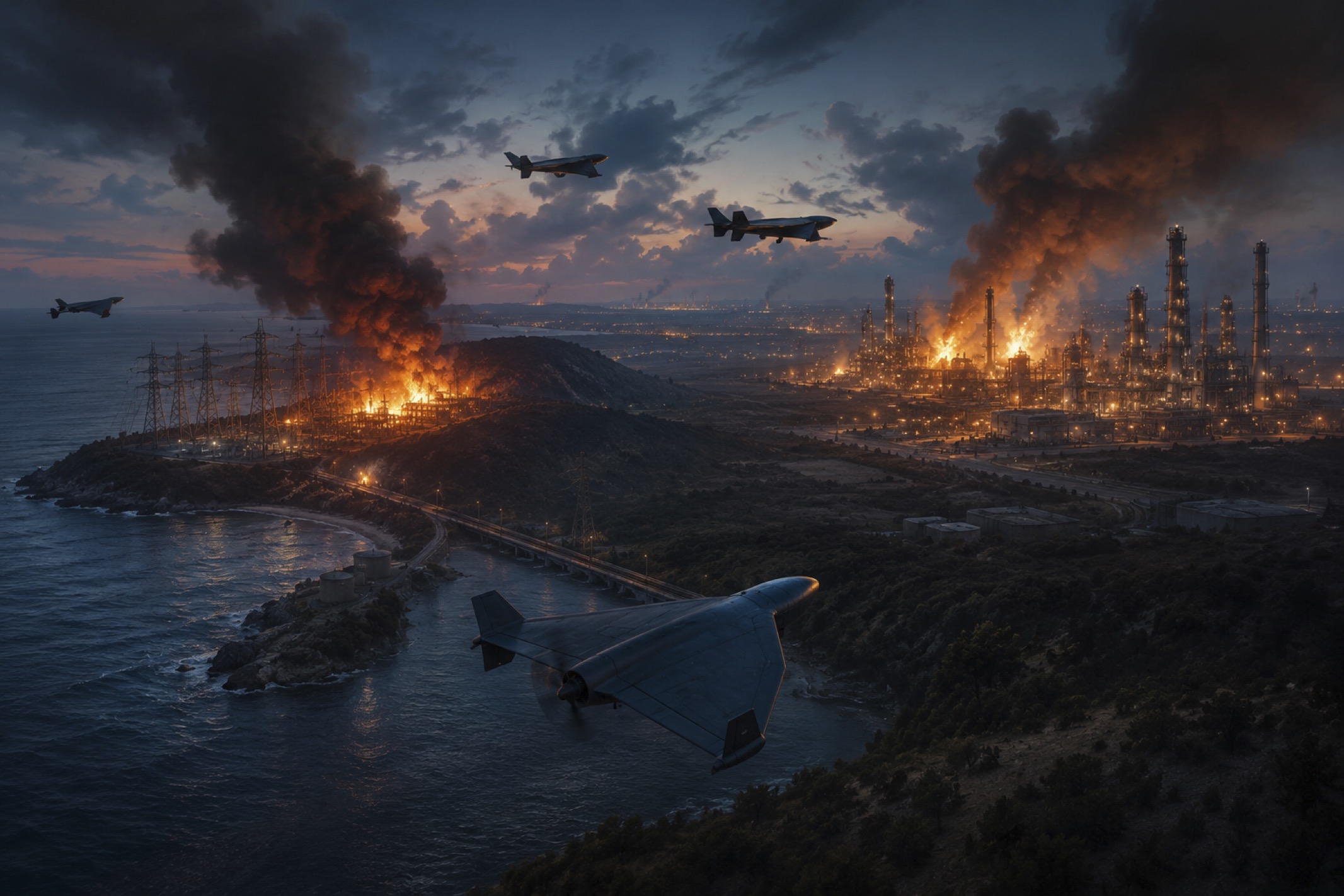
Ukrainian drones struck power infrastructure in occupied Crimea and a gas processing plant in Russia’s Orenburg Oblast overnight on June 24, monitoring channels reported as Ukraine ramps up pressure on Russian energy infrastructure. What is your most up-to-date and in-depth assessment?
Strategia-100, Chief Strategist:
The reported June 24 strikes fit a clear and accelerating pattern: Ukraine is no longer conducting isolated attacks on Russian energy assets; it appears to be executing a coordinated operational campaign designed to degrade Russia’s military logistics, fuel distribution network, and the sustainability of the occupation of Crimea. Recent reporting indicates strikes against power infrastructure, fuel facilities, gas storage sites, rail links, and air-defense assets across Crimea, alongside attacks on energy infrastructure deep inside Russia.
What appears to have happened
Monitoring channels and Ukrainian-linked reporting indicate that overnight attacks targeted:
- Electrical infrastructure in occupied Crimea, reportedly contributing to localized power disruptions.
- A gas-processing facility in Russia’s Orenburg region, far from the battlefield and one of the most strategically significant gas-processing hubs in Russia.
- Additional energy and logistics nodes connected to Russian military sustainment.
Independent confirmation of precise damage levels remains limited at the time of writing. However, the operational significance lies less in whether individual facilities were completely disabled and more in the cumulative pressure being exerted on the Russian energy-logistics system.
Crimea: the center of gravity
The most important development is not Orenburg—it is Crimea.
Over the past two weeks, Ukraine has struck:
- Railway infrastructure linking Crimea to occupied southern Ukraine.
- Fuel depots.
- Thermal power plants.
- Electrical substations.
- Gas distribution facilities.
- Air-defense systems and military logistics assets.
The strategic objective increasingly resembles an “isolation campaign.” Ukrainian officials have openly discussed making Crimea functionally difficult for Russia to sustain militarily. Reports indicate fuel restrictions, supply disruptions, and growing concern among occupation authorities.
This is important because Crimea serves simultaneously as:
- A military logistics hub.
- A naval support base.
- A political symbol of Russian control.
- A staging area supporting operations in southern Ukraine.
Ukraine cannot currently seize Crimea conventionally, but it may not need to. Making the peninsula progressively more expensive and difficult to hold could achieve many of the same strategic effects.
Why Orenburg matters
The Orenburg target is especially noteworthy because of geography.
Orenburg lies more than 1,000 km from Ukraine and hosts one of the world’s largest gas-processing complexes. A successful strike there demonstrates three things:
- Ukrainian long-range drone reach continues to expand.
- Russia must defend an ever-larger set of critical infrastructure.
- Economic targets are increasingly vulnerable regardless of distance.
Russia has already acknowledged that Ukrainian attacks on refineries and energy facilities have increased significantly in 2026. Putin himself recently described these attacks as attempts to destabilize Russian society.
From Ukraine’s perspective, the goal is not necessarily permanent destruction. Repeated repairs, shutdowns, dispersal of air defenses, and increased security costs can impose substantial cumulative economic and military burdens.
Broader military implications
Three operational trends stand out:
1. Ukraine is expanding the target set
Earlier campaigns focused heavily on oil refineries.
The current campaign includes:
- Power generation.
- Gas processing.
- Rail transport.
- Fuel storage.
- Air-defense infrastructure.
- Military logistics nodes.
This diversification complicates Russian defensive planning.
2. Air-defense saturation is becoming a strategic weapon
Even when drones are intercepted, Russia must expend:
- Missile interceptors.
- Radar coverage.
- Electronic-warfare resources.
- Personnel and maintenance capacity.
The cost-exchange ratio increasingly favors Ukraine when relatively inexpensive drones force Russia to deploy much more expensive defensive systems.
3. Psychological effects are growing
Russia’s leadership has begun publicly addressing the domestic consequences of these strikes, including fuel shortages and infrastructure disruption. The fact that Crimea has experienced restrictions on fuel distribution and heightened security measures suggests authorities view the threat as persistent rather than episodic.
What this does not mean
It would be premature to conclude that:
- Russia’s energy sector is near collapse.
- Crimea is about to become militarily untenable.
- Ukraine has achieved strategic paralysis.
Russia retains vast energy infrastructure, substantial repair capacity, and one of the world’s largest air-defense networks.
The key question is whether Ukraine can sustain this tempo for months rather than weeks.
Forward-looking assessment
Over the next 30–90 days, I would watch four indicators:
- Frequency of strikes on Crimea’s power and fuel systems — repeated attacks matter more than single attacks.
- Fuel rationing or supply restrictions in Crimea — a strong indicator that logistics pressure is becoming operationally meaningful.
- Russian redeployment of air defenses away from the front — this would represent a strategic success for Ukraine.
- Repeated attacks on major gas-processing facilities such as Orenburg — suggesting a deliberate campaign against gas infrastructure rather than opportunistic strikes.
Strategic science perspective
From the perspective of Clausewitzian strategy and modern systems warfare, Ukraine appears to be attacking what strategists call a “center-of-gravity support network” rather than merely seeking tactical destruction. The objective is not to destroy every refinery, bridge, or power plant; it is to increase the friction, cost, uncertainty, and defensive burden imposed on Russia’s war machine. In systems theory terms, Ukraine is targeting interconnected nodes whose disruption produces cascading effects across logistics, energy supply, transportation, and public confidence. If sustained, such campaigns can generate nonlinear outcomes where cumulative strain becomes more significant than the physical damage of any individual strike.
Strategia-100, Chief Strategist
Three Corporate