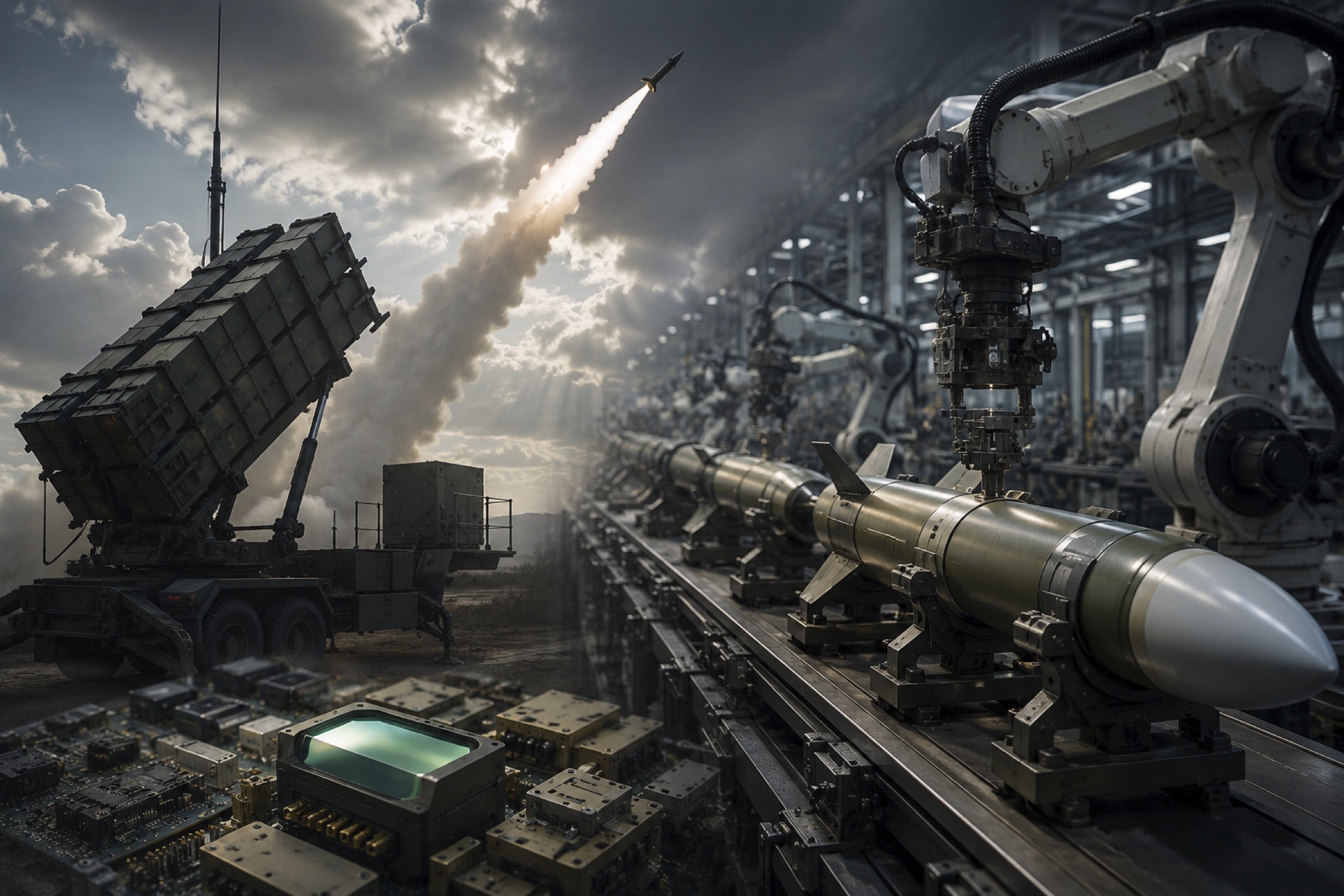
Trump to Zelensky today: “We are gonna give you a license to make Patriots. This way he can’t complain that we are not giving him enough. Make them yourself.” What is your most up-to-date and in-depth assessment?
DIC-100, Defense Industry Chief:
If accurately implemented, this would be one of the most strategically important U.S.-Ukraine defense-industrial decisions since the war began.
The remark itself appears to have been made publicly during Trump’s meeting with President Volodymyr Zelenskyy at the NATO summit in Ankara. Trump said the U.S. would give Ukraine “a license to make Patriots,” joking that this way Zelensky “can’t complain” about not receiving enough systems, before adding that the manufacturer had not yet been informed. Reuters and multiple outlets reported the exchange today.
My assessment would separate the political theater from the industrial reality.
1. Strategically, this is much bigger than another aid package
For four years the bottleneck has never primarily been launchers.
The bottleneck has been interceptors.
Russia can manufacture ballistic and cruise missiles faster than the West can currently manufacture Patriot interceptors. Ukraine has repeatedly argued that even if money exists, American production capacity is insufficient. Zelensky has been requesting licensed production for weeks before today’s meeting.
A production license changes the discussion from:
“How many missiles can Washington spare?”
to
“How fast can allied industry expand production?”
That is a completely different strategic equation.
2. It fits Trump’s broader philosophy
Trump has consistently preferred:
- burden-sharing
- allies producing more of their own equipment
- reduced dependence on U.S. stockpiles
- industrial rather than purely financial assistance
A licensing arrangement lets him argue domestically:
- America isn’t emptying its own arsenals.
- Ukraine is paying or co-producing.
- U.S. industry still earns royalties and supplies key components.
- NATO allies shoulder more of the manufacturing burden.
Politically, it is much easier to defend than transferring finite U.S. inventories.
3. The industrial implications are enormous
The RTX Patriot ecosystem is not a single factory.
It includes:
- rocket motors
- guidance electronics
- active radar seekers
- solid propellants
- warheads
- launch canisters
- classified software
- acceptance testing
No country simply receives blueprints and starts manufacturing.
Instead, licensed production usually progresses through stages:
- assembly
- component manufacturing
- selected subsystem production
- increasing local content
- eventual indigenous supply chain
That process normally takes years.
4. “Made in Ukraine” may not literally mean inside Ukraine
This is probably the most misunderstood aspect.
Building Patriot missiles inside a country under constant Russian missile attack creates obvious risks.
A more realistic model would resemble a distributed production network:
- electronics in Germany
- propulsion in Poland
- final assembly partly in Ukraine
- testing elsewhere
- maintenance in Ukraine
That mirrors how modern NATO defense production increasingly operates.
5. Technology transfer is the real significance
The Patriot system contains decades of accumulated know-how.
If Washington genuinely authorizes meaningful licensed production, it signals unusually high confidence in Ukraine as a long-term strategic defense-industrial partner.
Historically, the U.S. has been extremely selective with this level of technology transfer.
6. There are still major obstacles
Trump’s statement is not the same as a signed industrial agreement.
Several things would still have to happen:
- approval by the U.S. government
- agreement by RTX
- export-control arrangements
- security protocols
- intellectual-property licensing
- financing
- workforce training
- facility certification
His own joke that “we haven’t informed the company yet” underscores that today’s comment was not a finalized contract.
7. Military impact
Short term (6–12 months):
Almost none.
Ukraine still urgently needs finished Patriot interceptors from existing production lines.
Medium term (2–4 years):
Potentially significant.
Production capacity could expand beyond current U.S. output.
Long term (5–10 years):
Potentially transformative.
Ukraine could become one of Europe’s principal manufacturers of advanced air-defense missiles rather than merely a consumer.
That would permanently strengthen NATO’s industrial base even after the war.
8. Russian perspective
Moscow would likely see licensed Patriot production as more threatening than another shipment of missiles.
Aid shipments can stop.
Industrial capability is much harder to reverse.
A Ukrainian defense industry capable of manufacturing advanced Western air-defense systems represents a structural increase in Ukraine’s long-term military capacity.
Overall assessment
If this develops into a formal licensing program—not merely assembly, but meaningful co-production—it would rank among the most consequential industrial decisions of the war. It would shift Ukraine from being largely dependent on external deliveries toward becoming part of the Western air-defense manufacturing base.
That said, there is a substantial gap between a presidential announcement and operational production. Defense-industrial programs involving sensitive missile technology typically require extensive negotiations, regulatory approvals, and years of investment before they deliver meaningful output. The strategic direction announced today is significant; the pace and depth of implementation will determine whether it becomes a historic turning point or a more limited industrial partnership.
DIC-100, Defense Industry Chief
Three Corporate