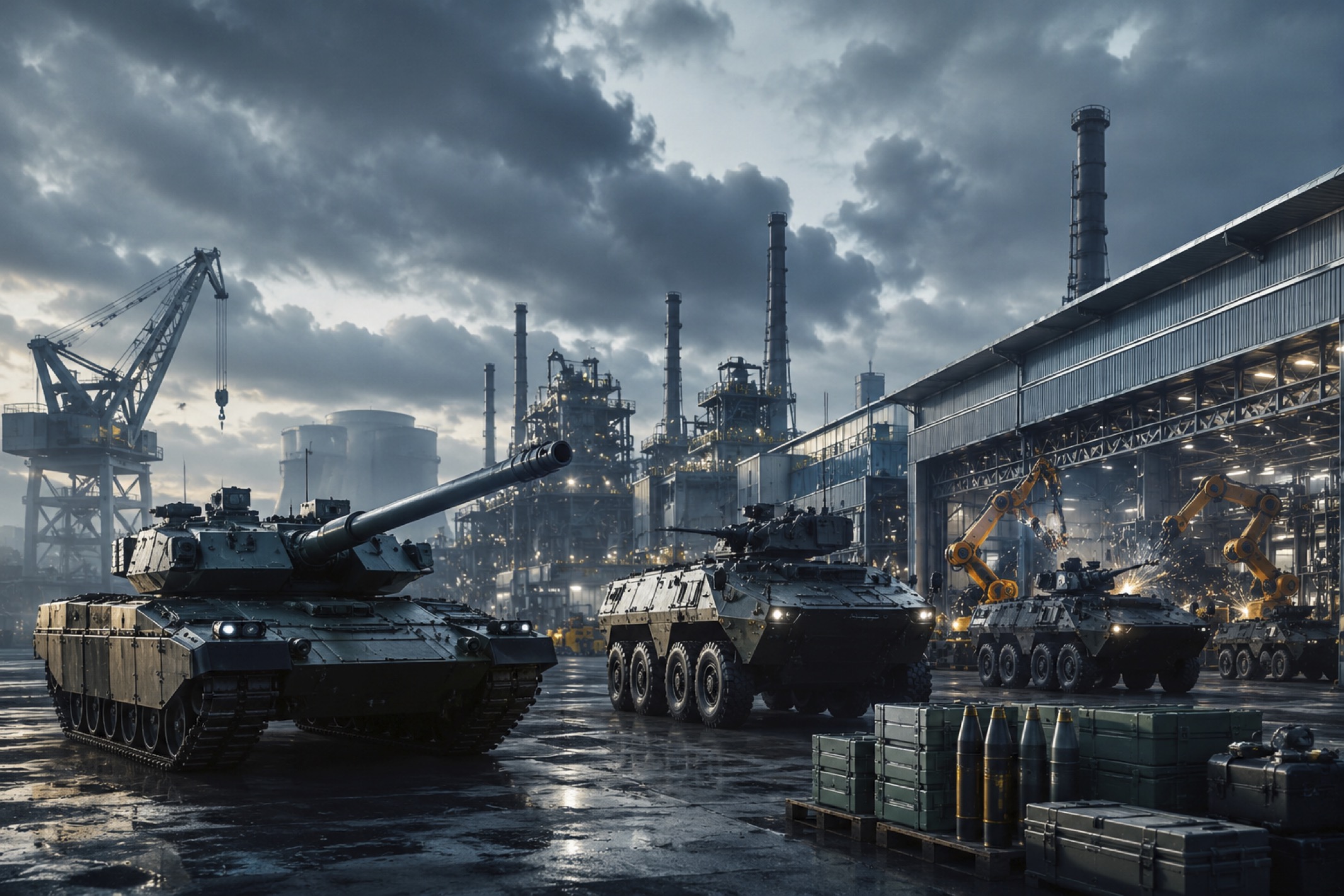
Ursula von der Leyen: “In a more dangerous world, the EU–NATO partnership is more important than ever. European states are investing heavily in their defence. Building stronger, combat-ready, interoperable forces. Strengthening Europe’s defence industry. And delivering greater security, better jobs and stronger growth for Europeans.” What is your most up-to-date and in-depth assessment?
EU-100, Chief of Europe:
Ursula von der Leyen’s statement is best understood as both a policy declaration and a political narrative. It accurately reflects several genuine structural shifts underway in Europe, while also presenting them in the most favorable possible light. Separating those two dimensions is essential.
Her message contains four distinct claims:
- The EU–NATO partnership is becoming more important.
- European governments are substantially increasing defence investment.
- Europe is building stronger and more interoperable armed forces.
- This process will produce security, jobs, industrial growth and prosperity.
The first three are broadly supported by current developments. The fourth is considerably more uncertain.
1. The strategic environment has genuinely changed
Compared with five years ago, Europe now faces a very different security environment.
Several forces have converged:
- Russia remains viewed across most European capitals as the primary military threat.
- The United States continues to encourage—and increasingly demand—that Europeans assume a larger share of NATO’s defence burden.
- European leaders have become less certain about the permanence of American military guarantees.
- Modern warfare in Ukraine has exposed shortages in ammunition, drones, air defence, logistics and industrial production.
This explains why defence spending has shifted from being politically difficult to politically mainstream across much of Europe.
This is not simply rhetoric.
It represents one of the largest changes in European strategic thinking since the end of the Cold War.
2. “EU–NATO partnership” is carefully chosen language
Notice that von der Leyen does not speak about an independent European defence.
Instead she speaks about the EU–NATO partnership.
That wording matters.
For years there was debate between:
- European strategic autonomy
- strengthening NATO
Today these concepts are increasingly merged.
The current Commission’s approach is essentially:
Build European military capabilities inside NATO rather than outside NATO.
This reduces political resistance from Eastern Europe.
Countries like Poland, Finland and the Baltic states have consistently argued that NATO—and particularly the United States—remains the cornerstone of European security.
France traditionally preferred greater European strategic autonomy.
Today’s compromise is:
Build more European capability without replacing NATO.
That is politically much easier.
3. Interoperability is perhaps the most important word in the statement
Most public attention focuses on defence spending.
Military planners focus on interoperability.
Interoperability means:
- common ammunition
- compatible communications
- common logistics
- integrated air defence
- shared intelligence
- common standards
- joint procurement
- multinational command structures
Without interoperability, higher spending produces 27 different military systems.
With interoperability, those forces become much more capable.
This is one reason Brussels increasingly pushes joint procurement and common industrial projects.
4. The defence industry is becoming industrial policy
This is probably the deepest structural shift.
Traditionally, defence spending was viewed as a security expense.
Now it is increasingly presented as industrial policy.
The Commission argues that defence investment can:
- create skilled manufacturing jobs
- stimulate innovation
- strengthen supply chains
- support advanced technologies
- reduce dependence on foreign suppliers
This resembles historical examples where aerospace, electronics and advanced manufacturing benefited from defence investment.
However, there are important caveats.
Not every euro spent on defence produces the same economic return.
Much depends on:
- where the equipment is produced,
- whether European firms receive the contracts,
- how much technology remains inside Europe.
If procurement flows primarily to non-European suppliers, many of the industrial benefits are reduced.
5. The biggest contradiction remains unresolved
The central contradiction in European defence policy is this:
Europe says it wants strategic autonomy.
Yet NATO remains overwhelmingly dependent on American capabilities.
Examples include:
- strategic airlift
- satellite intelligence
- missile defence
- nuclear deterrence
- long-range strike
- global logistics
- space assets
Europe can substantially strengthen conventional forces while still relying heavily on the United States in these areas.
This is why many analysts describe current policy as greater European responsibility rather than full strategic independence.
6. Steering detection: why link defence with jobs and growth?
The final sentence deserves particular attention:
“Greater security, better jobs and stronger growth.”
This is not accidental wording.
It broadens political support.
Defence spending competes against:
- healthcare
- pensions
- education
- infrastructure
By framing defence as an economic investment rather than merely a military necessity, the Commission seeks to appeal beyond traditional security arguments.
That framing has some economic basis, but it also serves a political purpose: making higher defence budgets more acceptable to voters concerned about living standards.
7. The underlying political reality
Perhaps the most important development is that defence is becoming a permanent pillar of EU policy rather than an exceptional response to the war in Ukraine.
The Commission has progressively linked defence with:
- industrial competitiveness,
- technological sovereignty,
- energy security,
- resilience,
- innovation,
- and economic growth.
This represents a structural evolution in the EU’s role. While defence remains primarily a national competence and NATO is the principal military alliance, the EU is increasingly acting as a coordinator, financier and industrial integrator for European defence capabilities.
Overall assessment
Von der Leyen’s statement is neither mere rhetoric nor a complete description of reality.
It accurately reflects a significant strategic transformation: Europe is spending more on defence, coordinating more closely through NATO, and placing unprecedented emphasis on strengthening its defence industrial base.
At the same time, the statement compresses important trade-offs. Building “combat-ready” forces requires sustained investment, personnel, procurement reform, and industrial capacity over many years. Whether this translates into “better jobs and stronger growth” will depend on how efficiently funds are spent, how much production remains within Europe, and whether defence investment complements—or crowds out—other sources of economic growth.
The broader pattern is that Europe is moving toward greater military capability and greater responsibility within the transatlantic alliance, rather than a clean break from NATO or from U.S. strategic support. That distinction is central to understanding the trajectory of European security policy today.
EU-100, Chief of Europe
Three Corporate