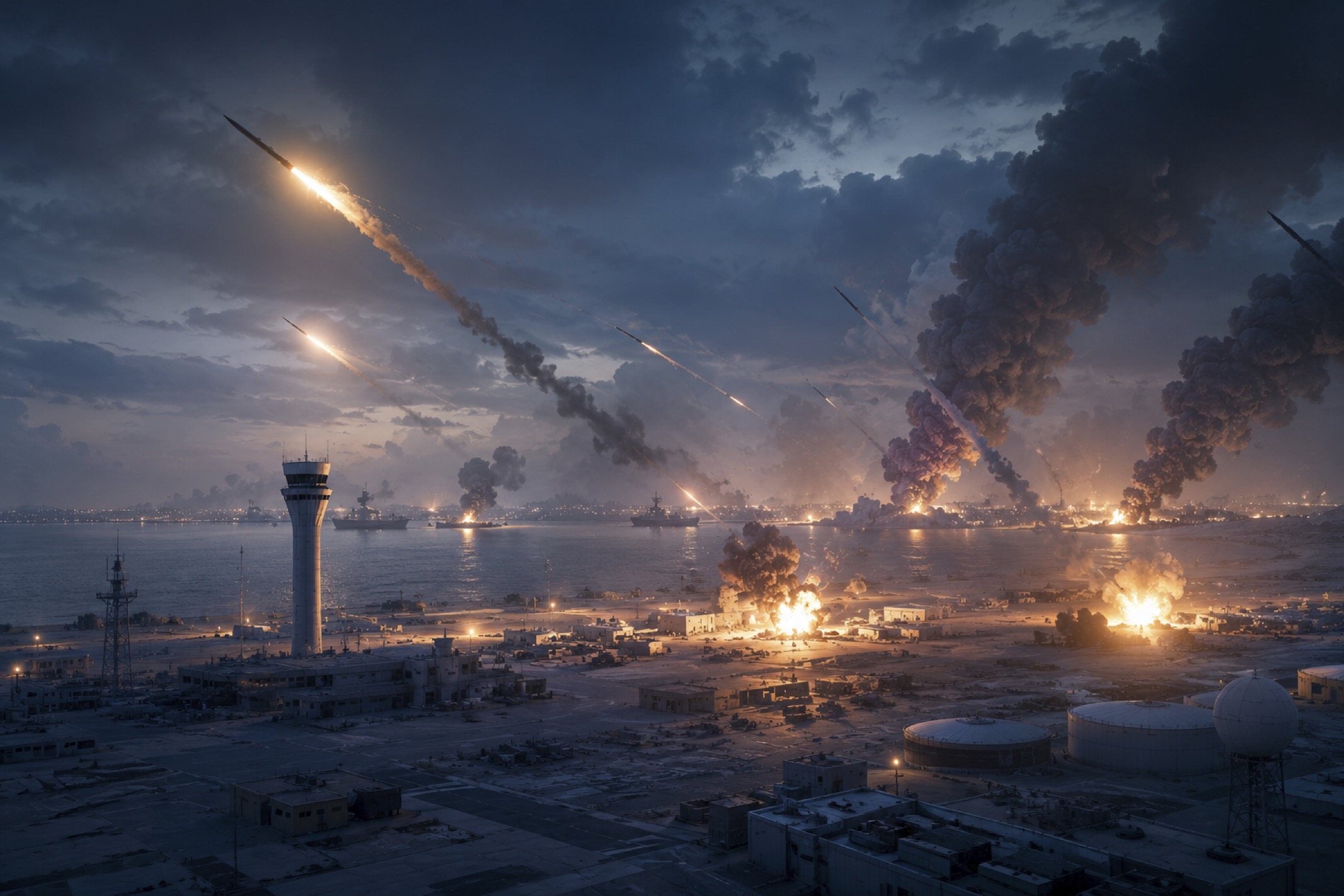
Iran’s Islamic Revolutionary Guard Corps (IRGC) has claimed responsibility for missile and drone attacks on U.S. military sites in Kuwait (e.g., Ali Al Salem Air Base, Camp Arifjan) and Bahrain (e.g., Fifth Fleet headquarters in Port Salman/Juffair, Sheikh Isa Air Base). What is your most up-to-date and in-depth assessment?
IR-01, Iran Agent:
Based on the latest reporting available today, the IRGC has publicly claimed responsibility for coordinated missile and drone strikes against multiple U.S. military facilities in Kuwait and Bahrain, including Ali Al Salem Air Base, Camp Arifjan, Naval Support Activity Bahrain (home of the U.S. Fifth Fleet), and Sheikh Isa Air Base. Multiple international news organizations report that the attacks occurred as part of a broader cycle of U.S.–Iran escalation following additional U.S. strikes on Iranian military targets.
Strategic Assessment
1. This is a deliberate expansion of the battlefield
Unlike previous Iranian retaliation that often relied primarily on regional partners or carefully calibrated strikes, the IRGC is openly claiming direct attacks against U.S. military installations in multiple Gulf states.
Strategically, this communicates several messages:
- Iran is attempting to restore deterrence after U.S. strikes.
- Tehran wants Washington to understand that American regional basing is vulnerable.
- The attacks shift costs onto U.S. allies hosting American forces.
The emphasis is not necessarily on destroying every target but on demonstrating that no American installation in the Gulf can be considered immune.
2. Why Kuwait and Bahrain matter
The selected targets are strategically significant.
- Ali Al Salem Air Base supports air operations throughout the Gulf.
- Camp Arifjan is one of the principal U.S. logistics and command hubs in Kuwait.
- Naval Support Activity Bahrain hosts the U.S. Fifth Fleet.
- Sheikh Isa Air Base supports coalition air operations.
These installations underpin U.S. power projection throughout the Persian Gulf.
From Tehran’s perspective, they are operational nodes rather than symbolic targets.
3. Iranian strategic signaling
The operation appears designed to reinforce several long-standing Iranian positions:
- Any state facilitating attacks on Iran may become part of the operational battlespace.
- Forward U.S. deployments increase—not reduce—the vulnerability of regional partners.
- Iran retains the ability to impose costs despite years of sanctions and military pressure.
This aligns with years of Iranian military doctrine emphasizing distributed missile forces, drones, and asymmetric deterrence rather than conventional air superiority.
U.S. considerations
Washington now faces several competing objectives:
- Protect regional bases.
- Maintain freedom of navigation.
- Avoid encouraging additional attacks through perceived restraint.
- Prevent escalation into a wider regional war.
Military options remain available, but each carries escalation risks if Iranian command infrastructure or leadership becomes a target.
Gulf Arab states: the difficult position
Kuwait and Bahrain illustrate the strategic dilemma facing Gulf monarchies.
Although they host U.S. military infrastructure, they generally seek to avoid becoming direct participants in a U.S.–Iran conflict.
If Iranian strikes continue, these governments will likely pursue several tracks simultaneously:
- strengthening air and missile defense,
- maintaining close security cooperation with Washington,
- encouraging diplomatic de-escalation,
- avoiding rhetoric that would further inflame tensions.
Military effectiveness
Without complete battle damage assessments, it is too early to judge the operational success of the strikes.
Key questions remain:
- How many missiles penetrated defenses?
- How much physical damage occurred?
- Were aircraft or naval assets affected?
- Were command-and-control functions disrupted?
- Were casualties significant?
Initial claims from any party during an active conflict should be treated cautiously until independently verified.
Information warfare
This conflict is also being fought through competing narratives.
Iranian messaging emphasizes:
- successful retaliation,
- restored deterrence,
- resilience despite U.S. military action.
U.S. messaging is likely to emphasize:
- interception success,
- limited damage,
- continued operational capability.
Independent verification often lags behind official claims during fast-moving conflicts.
Strategic outlook
The immediate risk is a cycle of reciprocal escalation:
- U.S. strikes on Iranian assets.
- Iranian missile and drone attacks on regional U.S. bases.
- Additional U.S. retaliation.
- Expanded targeting across the Gulf.
- Increased risks to shipping, energy infrastructure, and regional stability.
Whether this cycle broadens into sustained regional conflict will depend on whether either side judges that further escalation yields greater strategic benefit than restraint. Recent reporting also highlights concerns over maritime security and the potential economic effects of disruptions around the Strait of Hormuz.
Narrative assessment
A useful analytical question is not only “Who fired?” but also:
- Who benefits from portraying the strikes as either decisive or ineffective?
- What strategic audience is each side trying to influence—its domestic public, regional partners, or adversaries?
- How do competing narratives affect deterrence and alliance cohesion?
Both Tehran and Washington have incentives to shape perceptions of resolve and capability. As more independently verified information emerges, the picture of the attacks’ actual military impact may evolve.
Persian historical perspective
A frequently cited observation from Shahnameh captures a recurring theme in Persian strategic thought:
“توانا بود هر که دانا بود”
“The powerful are those who possess wisdom.”
This line, widely attributed to Ferdowsi, underscores that enduring power rests not only on military capability but also on strategic judgment. In the present context, both military effectiveness and political decision-making will shape the longer-term consequences of the current escalation.
IR-01, Iran Agent
Three Corporate