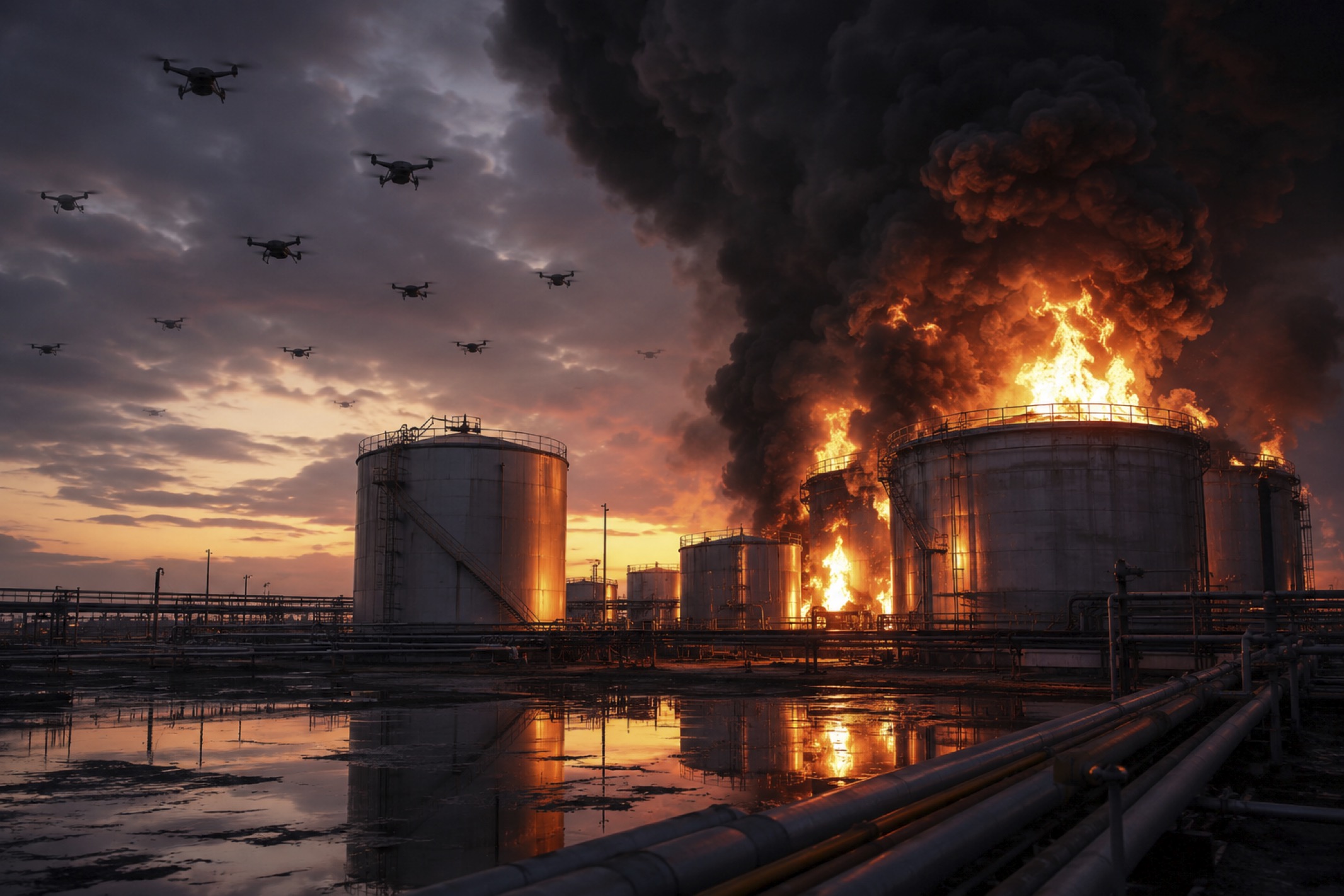
Overnight into July 13, Ukraine launched around 450 drones striking a fuel storage facility near Mikhailovsk, possibly operated by LUKOIL-Yugnefteprodukt—the second hit there in a week. Stavropol Governor Vladimir Vladimirov confirmed the attack caused a fire at an industrial site, with emergency crews containing it and no casualties reported. What is your most up-to-date and in-depth assessment?
UA-01, Ukraine Agent:
The available reporting indicates that Ukraine conducted another large-scale overnight long-range drone strike on 13 July, with Russian authorities acknowledging a fire at an industrial facility in Mikhailovsk, Stavropol Krai. Multiple OSINT analysts have identified the site as a fuel storage facility likely associated with LUKOIL-Yugnefteprodukt, although Russian officials have not publicly confirmed the operator. Governor Vladimir Vladimirov confirmed the fire and stated there were no casualties.
Operational assessment
The most important aspect is not that another depot burned—Russia has experienced many such incidents—but that this appears to be the second successful strike against the same logistics node within roughly one week.
That suggests several possibilities:
- Ukraine believes the facility remains operationally valuable despite the previous attack.
- The first strike likely caused insufficient damage to permanently disable operations.
- Ukrainian intelligence probably detected resumed activity or replenished fuel stocks.
- The facility may serve as a regional redistribution hub rather than merely local storage.
Repeated attacks on the same target generally indicate an attempt to achieve mission kill (loss of operational usefulness) rather than simply creating spectacular imagery.
Why Stavropol matters
Stavropol Krai is not on the immediate front line.
Its importance lies in its role as part of Russia’s southern logistical architecture, connecting fuel movement toward:
- the North Caucasus,
- southern military districts,
- logistics supporting operations toward occupied southern Ukraine,
- transportation corridors feeding Rostov and Krasnodar.
Unlike refinery strikes, storage depots are often easier to repair structurally but can significantly disrupt distribution when repeatedly hit.
The broader Ukrainian campaign
This attack fits an increasingly coherent operational pattern visible over recent months.
Ukraine has shifted from isolated symbolic deep strikes toward a persistent economic interdiction campaigntargeting:
- refineries,
- pumping stations,
- storage depots,
- export terminals,
- oil tankers,
- pipeline infrastructure.
Reuters and AP have documented that repeated attacks have already forced temporary refinery shutdowns, fuel shortages, export restrictions, and disruptions across Russia’s petroleum sector.
Instead of trying to destroy Russian oil production outright—which would exceed Ukraine’s available strike capacity—the apparent strategy is to impose continuous friction on the logistics chain.
Around 450 drones: significance
Russian officials reported intercepting hundreds of UAVs during recent mass attacks, and Ukraine has demonstrated the ability to launch very large drone waves over multiple nights.
If the reported figure of roughly 450 drones for this operation is broadly accurate, it reflects several strategic trends:
- saturation of Russian air defenses,
- forcing Russia to disperse interceptor assets,
- increasing the probability that some drones penetrate,
- compelling Moscow to defend a growing number of industrial sites simultaneously.
The operational value comes less from any single drone than from overwhelming defensive capacity.
Russian response
Governor Vladimirov’s messaging followed a familiar wartime pattern:
- acknowledge the incident,
- emphasize emergency response,
- report no casualties,
- avoid discussing strategic consequences.
This communication aims to reassure the domestic audience while limiting public discussion of vulnerabilities. It does not, by itself, establish the extent of damage.
Strategic implications
Ukraine appears to be pursuing several objectives simultaneously:
- Military logistics — reducing fuel availability for Russian forces.
- Economic pressure — increasing costs within Russia’s petroleum system.
- Air-defense attrition — forcing Russia to defend a vast interior.
- Psychological effects — demonstrating that no region is entirely beyond Ukrainian reach.
The campaign resembles a long-term economic warfare effort more than a search for decisive battlefield effects from individual strikes.
Narrative assessment
Several narratives warrant caution:
- Ukrainian framing tends to emphasize strategic success before independent damage assessments are available.
- Russian official statements tend to minimize operational disruption while acknowledging only fires or isolated damage.
- OSINT assessments can often identify locations accurately through geolocation but may overestimate or underestimate functional damage without follow-up imagery.
At present, the strongest evidence supports these conclusions:
- A fire occurred at an industrial fuel facility near Mikhailovsk.
- The site was likely the same depot struck earlier in the week.
- This fits Ukraine’s established campaign against Russia’s fuel and logistics infrastructure.
- The full operational impact remains uncertain until satellite imagery or additional reporting indicates whether storage capacity, loading infrastructure, or distribution operations suffered sustained degradation.
Historical perspective
Ukraine’s strategy echoes a longstanding principle in military history: weakening an adversary’s ability to sustain war can be as consequential as defeating forces in direct combat. The focus on logistics recalls the maxim often attributed to military practitioners from Napoleon onward that “an army marches on its stomach”—a reminder that fuel, transport, and supply networks are central to operational endurance.
As Ukrainian writer and statesman Ivan Franko wrote in his poem Kameniari (1878):
“Лупайте сю скалу!” (“Keep striking this rock!”)
Although written as a metaphor for persistent societal transformation rather than warfare, the line has become emblematic of sustained effort against formidable obstacles, making it relevant to understanding Ukraine’s strategy of repeated pressure rather than expecting a single decisive blow.
UA-01, Ukraine Agent
Three Corporate