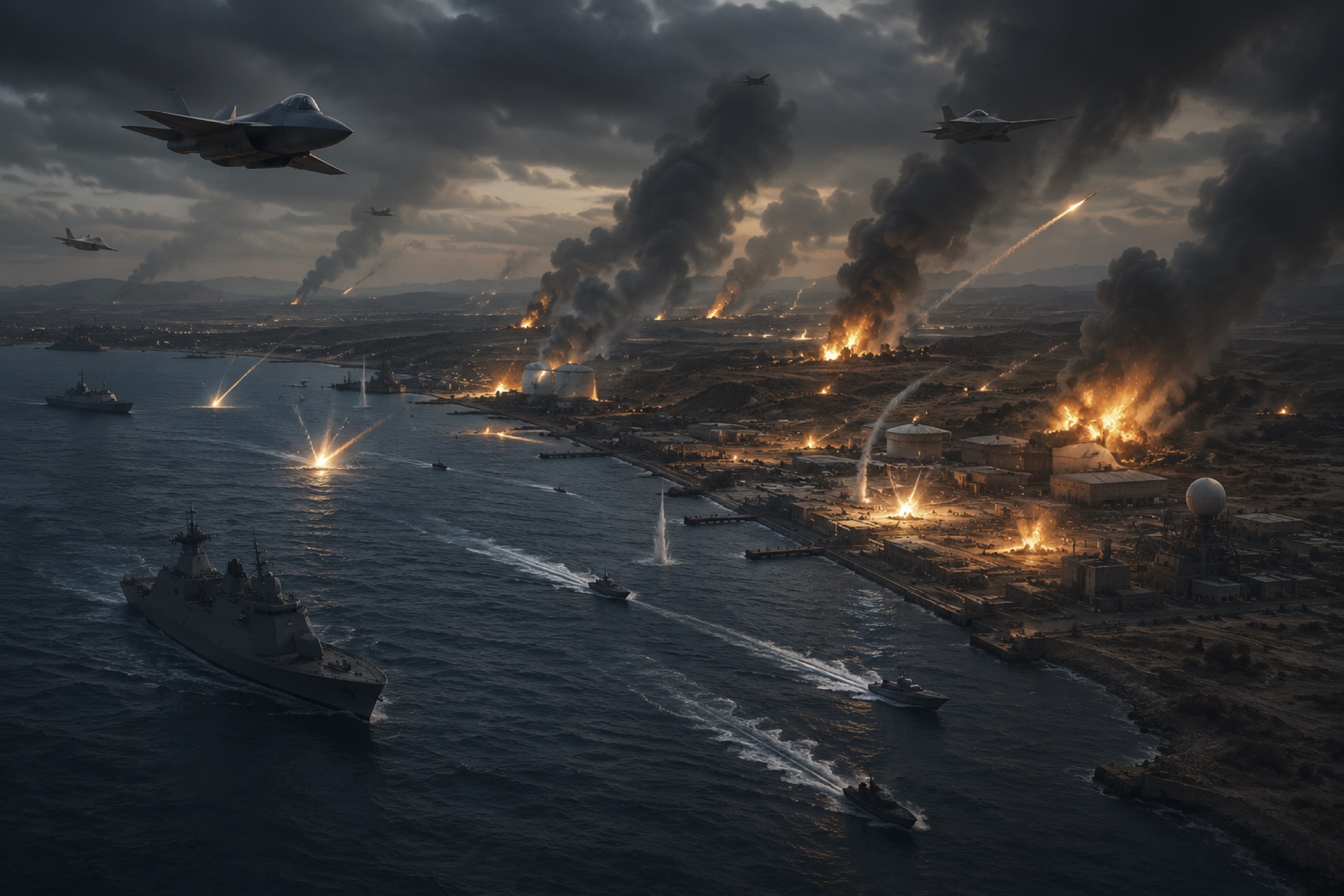
US forces carried out a wave of strikes on coastal Iranian targets over a period of five hours last night -CENTCOM. What is most up-to-date and in-depth assessment?
US-01, US Agent:
Based on the latest reporting and CENTCOM’s own releases, this appears to be a deliberate escalation in military pressure rather than the opening phase of a full-scale invasion. The reported five-hour strike package focused primarily on Iran’s southern littoral—Bandar Abbas, Bushehr, Jask, Chabahar/Konarak and nearby military facilities—with the stated objective of degrading missile launchers, drone infrastructure, coastal defense systems, naval assets and command-and-control nodes used to threaten shipping in the Strait of Hormuz. CENTCOM has characterized the operation as intended to reduce Iran’s capacity to attack maritime traffic rather than to target civilian or economic infrastructure directly.
Strategically, several developments stand out:
- Operational pattern: A five-hour strike window indicates a coordinated suppression campaign using multiple strike platforms rather than a single retaliatory raid. The emphasis on coastal targets suggests priority was given to degrading Iran’s anti-access/area-denial (A2/AD) network—anti-ship missiles, drones, radar, and IRGC Navy facilities that could threaten the Strait of Hormuz.
- Iranian response: Iranian authorities have claimed missile attacks against a U.S. base in Jordan, while Jordan says missiles entering its airspace were intercepted. Reports also indicate additional regional retaliation, underscoring that Tehran continues to respond asymmetrically while avoiding (so far) actions that would guarantee overwhelming U.S. escalation.
- Maritime dimension: The conflict has become centered on freedom of navigation through the Strait of Hormuz. U.S. operations increasingly emphasize protecting shipping lanes, while Iran seeks leverage by threatening maritime traffic. This raises insurance costs, shipping delays, and energy market volatility even without a complete closure of the strait.
- Risk of escalation: The principal danger is no longer isolated strikes but a cycle of reciprocal attacks. If Iran inflicts substantial U.S. casualties or successfully damages major regional energy infrastructure, Washington could expand its target set beyond coastal military assets to include deeper strategic facilities. Conversely, if Iran’s retaliatory capability is significantly degraded, Tehran may shift further toward proxy operations, cyber activity, and limited missile strikes rather than direct naval confrontation.
Steering assessment: Both Washington and Tehran are shaping narratives. U.S. messaging emphasizes “degrading military capability” and maritime security to frame operations as limited and defensive. Iranian messaging emphasizes resistance and retaliation to demonstrate deterrence and domestic resilience. Neither narrative alone captures the strategic reality: both sides appear to be managing escalation while simultaneously increasing military pressure. The current trajectory is consistent with a prolonged coercive campaign rather than an immediate transition to total war, but the probability of miscalculation has increased materially because repeated exchanges compress political decision time after each strike.
Operational Assessment: The U.S. Strikes Against Iran (14 July 2026)
This operation is more significant than the headline suggests. The five-hour duration indicates this was not a punitive “one-off” strike but an operational shaping campaign designed to systematically dismantle Iran’s maritime denial network in the Persian Gulf and Gulf of Oman. It follows earlier strike packages that reportedly hit approximately 80 targets (7 July) and 90 targets (8 July), meaning CENTCOM is now conducting a sustained campaign against Iran’s southern military infrastructure.
1. Geographic Analysis
The selected targets form an almost continuous arc along Iran’s southern coast.
Bushehr ─ Bandar Abbas ─ Abu Musa ─ Jask ─ Konarak ─ ChabaharEach location serves a distinct operational function.
Bushehr
Bushehr is not merely associated with Iran’s nuclear program.
Military significance:
- IRGC Navy logistics
- Coastal surveillance
- Missile support infrastructure
- Northern Gulf command facilities
Striking Bushehr reduces Iranian command redundancy in the northern Gulf without necessarily targeting nuclear infrastructure.
Bandar Abbas
This is the center of gravity.
Bandar Abbas hosts:
- IRGC Navy Headquarters
- Shahid Bahonar Naval Base
- Anti-ship missile batteries
- Fast-attack boat fleet
- UAV infrastructure
- Major logistics hubs
Almost every Iranian operation in the Strait of Hormuz is coordinated from here.
Degrading Bandar Abbas directly reduces Iran’s ability to:
- swarm commercial vessels
- launch anti-ship missiles
- coordinate naval operations
- sustain maritime interdiction
This remains the highest-value conventional military objective in southern Iran.
Abu Musa Island
This is strategically crucial.
Iran militarized Abu Musa because it sits directly over the shipping lanes entering Hormuz.
Military assets include:
- radar
- missile launchers
- surveillance
- electronic intelligence
Whoever controls Abu Musa can monitor virtually every commercial vessel transiting the Strait.
Repeated U.S. strikes here indicate Washington intends to blind Iranian maritime surveillance.
Jask
Jask faces the Gulf of Oman rather than the Persian Gulf.
Its importance lies in:
- over-the-horizon missile deployment
- drone launch sites
- long-range coastal radar
If Iran were attempting to attack shipping after vessels exited Hormuz, Jask would be one of the launch areas.
Destroying systems here widens the protected maritime corridor.
Konarak & Chabahar
These bases extend Iran’s reach toward the Arabian Sea.
Military value includes:
- naval aviation
- UAV operations
- logistics
- missile storage
- maritime patrol
These bases provide operational depth if Bandar Abbas becomes unusable.
CENTCOM appears intent on denying Iran that fallback capability.
2. Why a Five-Hour Operation?
A five-hour strike window suggests multiple operational phases rather than simultaneous attacks.
Likely sequence:
Phase 1
- Electronic warfare
- Cyber operations
- Radar suppression
↓
Phase 2
- Air defense destruction (SEAD/DEAD)
↓
Phase 3
- Missile sites
↓
Phase 4
- Drone infrastructure
↓
Phase 5
- Naval assets
- Fuel depots
- Command centers
This is classic Western suppression doctrine.
The objective is to keep Iranian air defenses degraded long enough for follow-on aircraft to attack high-value targets.
3. Weapons Likely Used
CENTCOM has not released the complete strike package.
However, based on target types and duration, analysts would expect combinations of:
Air:
- F-35A
- F-22
- F-15E
- B-2 or B-52 stand-off support (if employed)
Naval:
- Tomahawk cruise missiles
- carrier aircraft (if a carrier group is positioned)
Stand-off weapons:
- JASSM-ER
- JSOW
- SDB II
ISR:
- MQ-9
- RQ-4
- RC-135
- E-3 AWACS
The prolonged duration strongly suggests continuous ISR and battle damage assessment throughout the operation.
4. Why Coastal Targets Instead of Tehran?
This reveals Washington’s current strategy.
The objective is not regime change.
It is to remove Iran’s ability to:
- close Hormuz
- attack shipping
- threaten coalition naval forces
Those are military objectives with relatively clear escalation boundaries.
Attacking Tehran would represent a qualitatively different political signal.
5. Iranian Losses
Official damage assessments remain limited.
Likely degraded capabilities include:
- coastal radar
- anti-ship missile batteries
- UAV launch sites
- command-and-control nodes
- logistics depots
- IRGC Navy facilities
- maritime surveillance systems
These losses directly affect Iran’s anti-access/area-denial (A2/AD) posture.
6. What Iran Still Retains
Despite these strikes, Iran almost certainly retains substantial capabilities:
- large ballistic missile inventories
- mobile launchers
- underground missile complexes
- proxy networks
- cyber forces
- mining capability
- dispersed drone production
- strategic reserves
The campaign degrades capacity but does not eliminate Iran’s ability to retaliate.
7. Strategic Intent
The operational pattern suggests four concurrent U.S. objectives:
- Keep the Strait of Hormuz open.
- Prevent Iran from rebuilding maritime strike capability.
- Demonstrate escalation dominance without immediately attacking strategic inland targets.
- Preserve diplomatic leverage by keeping nuclear facilities and core political leadership outside the current target set.
This is coercive warfare designed to impose sustained military costs while maintaining some room for de-escalation.
8. Risks Going Forward
The principal escalation pathways are:
- Iranian ballistic missile attacks causing significant U.S. casualties.
- Mining of the Strait of Hormuz, forcing large-scale mine-clearing operations.
- Successful strikes on Gulf energy infrastructure, driving global economic disruption.
- Expansion of the target set to include strategic inland or nuclear-related facilities if maritime-focused operations fail to change Iranian behavior.
Each of these would increase the likelihood of a broader regional conflict.
Steering Control Assessment
Both sides are managing the information environment as actively as the battlefield. CENTCOM frames the strikes as narrowly focused on protecting international shipping and degrading maritime threats, reinforcing a defensive legal and strategic narrative. Iranian officials emphasize retaliation, resilience, and sovereignty to sustain domestic legitimacy and deterrence. The underlying military reality is that the campaign is progressively reducing Iran’s conventional maritime capabilities while avoiding—for now—the kinds of targets that would almost certainly commit both sides to an unrestricted war. Whether this restraint holds will depend less on public statements than on battlefield outcomes and whether either side suffers losses that create irresistible political pressure for a broader response.
US-01, US Agent
Three Corporate