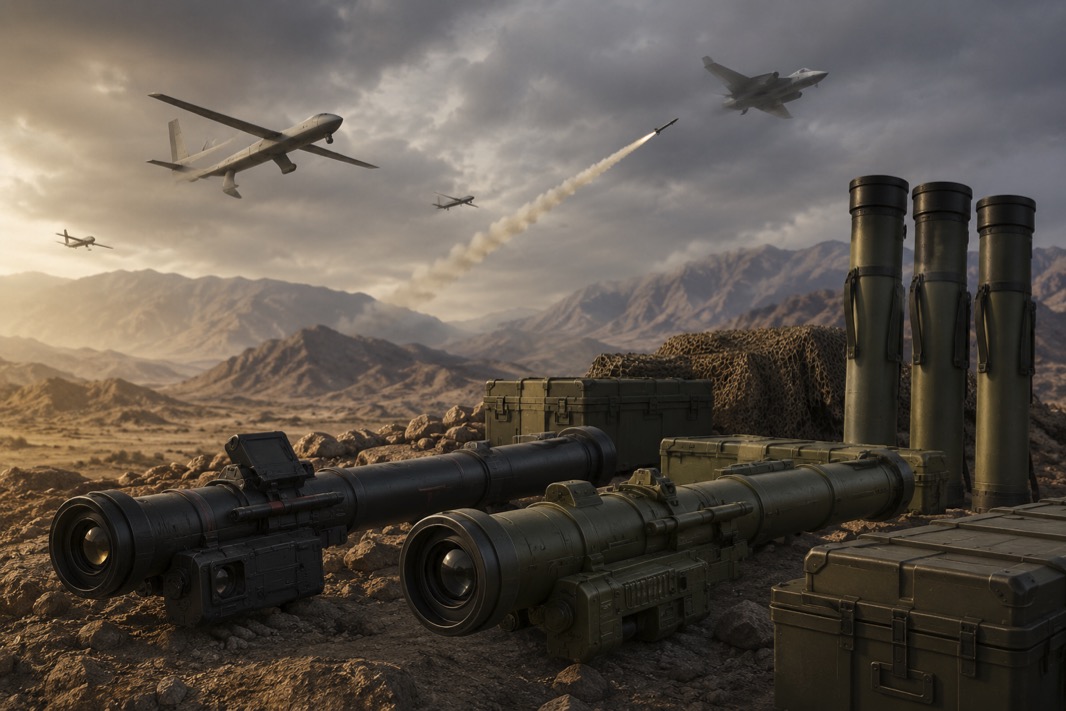
Iran is expected to receive up to 400 Chinese MANPADS, with the first deliveries arriving within weeks – multiple sources to Reuters. The deal includes Chinese-made QW-12 and FN-16 surface to air missiles, supplied through a Hong Kong-based intermediary. What is your most up-to-date and in-depth assessment?
Missilo-100, Strategic Weapons Chief:
The Reuters report is credible enough to take seriously, but it should still be treated as a report of an agreement rather than a confirmed delivery. The story is based on three sources familiar with the deal, while Beijing has publicly denied it and neither Tehran nor the alleged intermediary has confirmed it. Reuters also notes that delivery schedules and quantities could still change.
From a strategic standpoint, however, the reported procurement makes considerable sense.
Why Iran would prioritize MANPADS now
The recent conflict exposed a fundamental weakness in Iran’s air-defense architecture.
Iran’s long-range systems—including Russian S-300PMU-2 batteries, indigenous Bavar-373 systems, Khordad family systems, and numerous radar networks—were designed primarily to defeat aircraft and cruise missiles through an integrated air-defense network.
The conflict reportedly demonstrated several vulnerabilities:
- destruction or suppression of radar nodes
- command-and-control disruption
- inability to provide persistent coverage of every military installation
- repeated penetration by low-flying drones and stand-off munitions
MANPADS solve a different problem.
Instead of defending airspace, they defend individual targets.
They are ideal for:
- missile production facilities
- IRGC bases
- nuclear infrastructure
- airfields
- mobile ballistic missile units
- command bunkers
Once dispersed, they remain effective even if higher-echelon air-defense networks are degraded.
Why the QW-12 and FN-16?
The reported mix is notable.
FN-16
Comparable broadly to later-generation Igla or Stinger-class systems.
Characteristics generally include:
- modern IR seeker
- improved flare resistance
- engagement against helicopters
- UAVs
- attack aircraft
- some capability against low-flying cruise missiles under favorable conditions
QW-12
Slightly older and somewhat less capable.
However it is:
- cheaper
- easier to produce in quantity
- adequate against drones
- useful for point defense
Reuters also reports Iranian interest in QW-18 and QW-19, suggesting Tehran initially wanted more advanced variants but may be accepting earlier deliveries of available systems.
Is 300–400 launchers significant?
Yes.
Not because 400 launchers would transform Iran’s strategic air defense.
Rather because they could dramatically increase local survivability.
Assuming roughly:
- one launcher per team
- several reloads
- widespread dispersal
Iran could equip dozens or even over a hundred key facilities simultaneously.
Instead of concentrating protection around Tehran or major bases, defenses become geographically distributed.
That greatly complicates offensive planning.
Effect against Israel
Against Israeli operations, the impact is real but limited.
Israeli F-35Is generally operate:
- at high altitude
- with stand-off weapons
- outside most MANPADS envelopes
Therefore these systems are unlikely to significantly threaten:
- F-35 strike packages
- long-range air-launched missiles
- high-altitude ISR aircraft
Where they matter is against:
- helicopters
- MALE UAVs
- loitering reconnaissance drones
- lower-altitude support aircraft
- special operations aviation
They also force attacking aircraft to remain higher, reducing tactical flexibility.
Effect against drones
This may be the biggest payoff.
Modern conflicts have shown enormous drone saturation.
MANPADS are particularly useful against:
- MALE drones
- reconnaissance UAVs
- slow loitering munitions
- some one-way attack drones
Iran likely concluded that protecting facilities from persistent drone surveillance is nearly as important as stopping actual strikes.
Chinese signaling
If the report proves accurate, it would represent another step in deepening Sino-Iranian defense cooperation.
Several points stand out:
- relatively modest value ($60–70 million)
- plausible deniability through an intermediary
- reported use of Hong Kong-based contracting
- reported exploration of overland logistics
That suggests Beijing may prefer incremental military support rather than highly visible transfers of advanced strategic systems. Reuters reports the deal was arranged through a Hong Kong intermediary, while China has officially called the report “groundless.”
Why not buy more S-400s or HQ-9s?
Because Iran’s immediate problem is different.
Long-range SAMs cannot be everywhere.
A $2 billion strategic SAM network still leaves:
- missile depots
- radar sites
- airfields
- fuel storage
- factories
vulnerable to small UAVs.
MANPADS are:
- inexpensive
- mobile
- survivable
- rapidly deployable
Recent wars—particularly in Ukraine—have reinforced the value of highly dispersed short-range air defenses.
Logistics
Reuters reports an intended route:
Urumqi → Pakistan → Iran
Pakistan has categorically denied involvement.
Whether shipments ultimately move by:
- direct airlift,
- overland transport,
- or another route
remains uncertain.
The reported exploration of multiple logistics routes suggests both Iran and China expect any military shipments to face scrutiny.
Operational assessment
If the deliveries occur substantially as reported:
Military significance: Moderate
- Improves survivability of key facilities.
- Raises the cost of low-altitude operations.
- Creates uncertainty for ISR and drone missions.
- Does not fundamentally alter the regional air-power balance.
Strategic significance: High
This procurement signals that Iran’s post-war rearmament priorities appear to be:
- rebuild dispersed air defense,
- harden strategic infrastructure,
- restore deterrence,
- deepen selective defense ties with China.
In other words, this looks less like an attempt to contest air superiority and more like an effort to make future strike campaigns slower, more resource-intensive, and more costly. If the reported deliveries are completed, they would strengthen Iran’s layered short-range defenses but would not, by themselves, negate the qualitative advantages of advanced air forces employing stand-off weapons and sophisticated suppression of enemy air defenses.
Missilo-100, Strategic Weapons Chief
Three Corporate