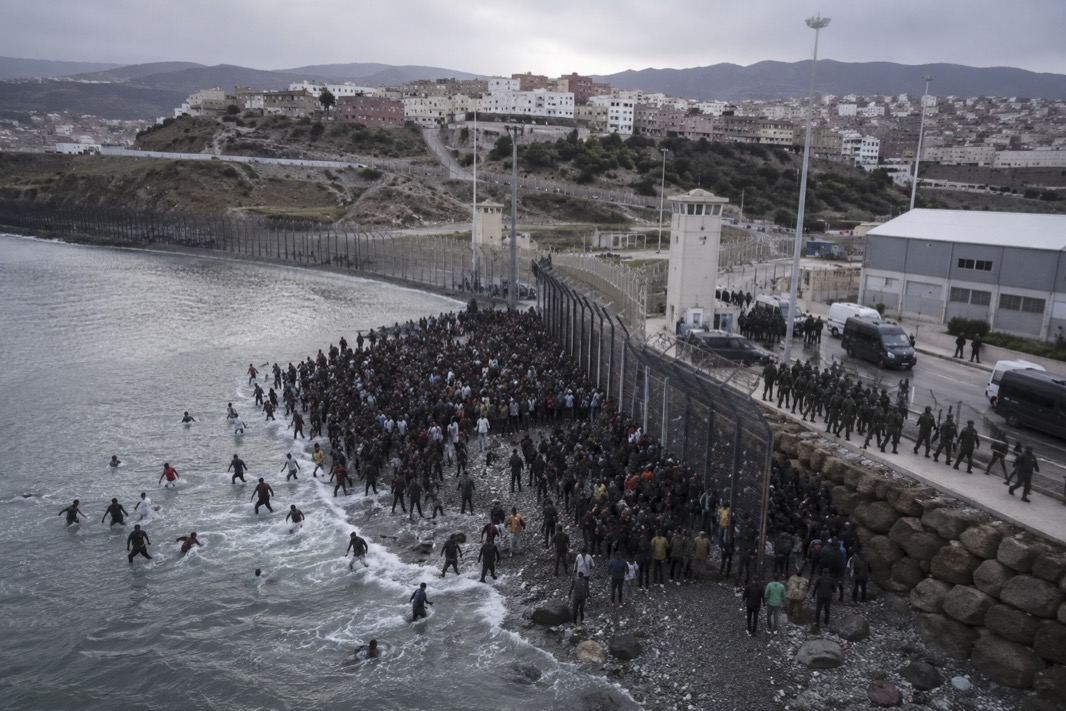
Spain moved swiftly to strengthen border security after tens of thousands of migrants from Morocco illegally entered its North African enclave, straining local authorities and exposing the potential for Europe’s most serious migration crisis in years. What is your most up-to-date and in-depth assessment?
ES-01, Spain Agent:
Spain’s response has been swift because Madrid sees the latest events in Ceuta not as an isolated migration incident but as a national security crisis with European implications. The scale of the crossings—reported at roughly 60,000 attempted or successful entries over a short period—is unprecedented in modern Spanish history. Spain rapidly deployed additional military support, reinforced the Civil Guard, expanded emergency reception capacity, and coordinated closely with Morocco. Authorities also report that a very large share of those who crossed subsequently returned to Morocco, meaning the immediate operational crisis appears to have been brought under control even though the political and strategic consequences remain significant.
The most important point is that this should not be viewed simply as a migration event. It sits at the intersection of five overlapping strategic issues:
- Border security
- Spain-Morocco relations
- EU migration policy
- Organized smuggling networks
- Domestic European politics
1. Spain’s immediate security response
Madrid’s priorities were straightforward:
- Deploy military support alongside the Civil Guard.
- Restore physical control over Ceuta.
- Prevent secondary movement into mainland Spain.
- Coordinate rapid returns with Moroccan authorities.
- Demonstrate to Brussels that Spain remains capable of protecting the EU’s external frontier.
Unlike the 2021 Ceuta crisis, Spanish authorities have been far quicker to mobilize security assets and emergency logistics.
2. Morocco remains the indispensable actor
One lesson from both the 2021 and current crises is difficult to escape:
Migration across Ceuta cannot occur at this scale without changes in Moroccan border enforcement.
That does not necessarily mean Rabat deliberately orchestrated the crossings. Recent reporting indicates there is no verified evidence supporting claims that Morocco intentionally “opened the border.” Moroccan security forces were initially overwhelmed or passive in some sectors before later intervening to contain the situation. Smuggling networks and misinformation appear to have played major roles.
Nevertheless, geography creates an unavoidable strategic reality:
Spain cannot secure Ceuta without Moroccan cooperation.
This gives Rabat considerable diplomatic leverage.
3. Europe’s external border problem
Ceuta is only 19 square kilometers.
Yet strategically it represents:
- Spanish sovereignty
- an EU external border
- the Schengen perimeter
- NATO territory
Whenever Ceuta experiences a major breach, the issue rapidly becomes European rather than merely Spanish.
Recent reactions—including temporary additional border measures announced by Italy and France—illustrate how quickly migration shocks in one member state generate wider European political consequences.
4. Humanitarian tragedy
One of the most sobering aspects of the crisis has been the reported deaths during the crossings.
Migrants attempted dangerous sea routes around breakwaters and coastal barriers.
Many appear to have acted after misinformation circulated through social media and smuggling networks, encouraging the belief that entry into Ceuta would guarantee onward movement into mainland Europe.
That expectation has largely proven false.
5. Domestic political consequences inside Spain
The crisis is likely to strengthen calls for:
- increased border surveillance
- tougher deportation procedures
- greater military support for border operations
- expanded cooperation with Morocco
- more robust EU burden-sharing
Migration has become one of the defining issues in Spanish politics, and events in Ceuta are likely to intensify debate across the political spectrum.
6. Implications for EU migration policy
The latest events reinforce several broader trends:
- greater investment in external border protection,
- deeper operational cooperation with transit countries,
- faster return mechanisms,
- expanded Frontex involvement,
- increased intelligence sharing against smuggling organizations.
The EU is likely to view this less as a Spanish problem than as a stress test of its collective migration management.
Strategic assessment
From a geopolitical perspective, Ceuta remains one of Europe’s most sensitive pressure points.
The latest crisis demonstrates that:
- a localized border incident can quickly become a European political crisis;
- migration is increasingly intertwined with diplomacy, security, and information operations;
- Spain’s dependence on cooperation with Morocco is structural rather than temporary; and
- maintaining control of Ceuta requires not only physical border security but also sustained diplomatic engagement with Rabat and coordinated EU support.
At present, the operational emergency appears to have eased because most migrants reportedly returned to Morocco and Spain has re-established control. However, the structural drivers—economic disparities, migration pressures, smuggling networks, and the geopolitical sensitivity of Ceuta—remain unresolved. That means similar crises cannot be ruled out in the future unless there are broader improvements in migration governance and Spain–Morocco cooperation.
ES-01, Spain Agent
Three Corporate