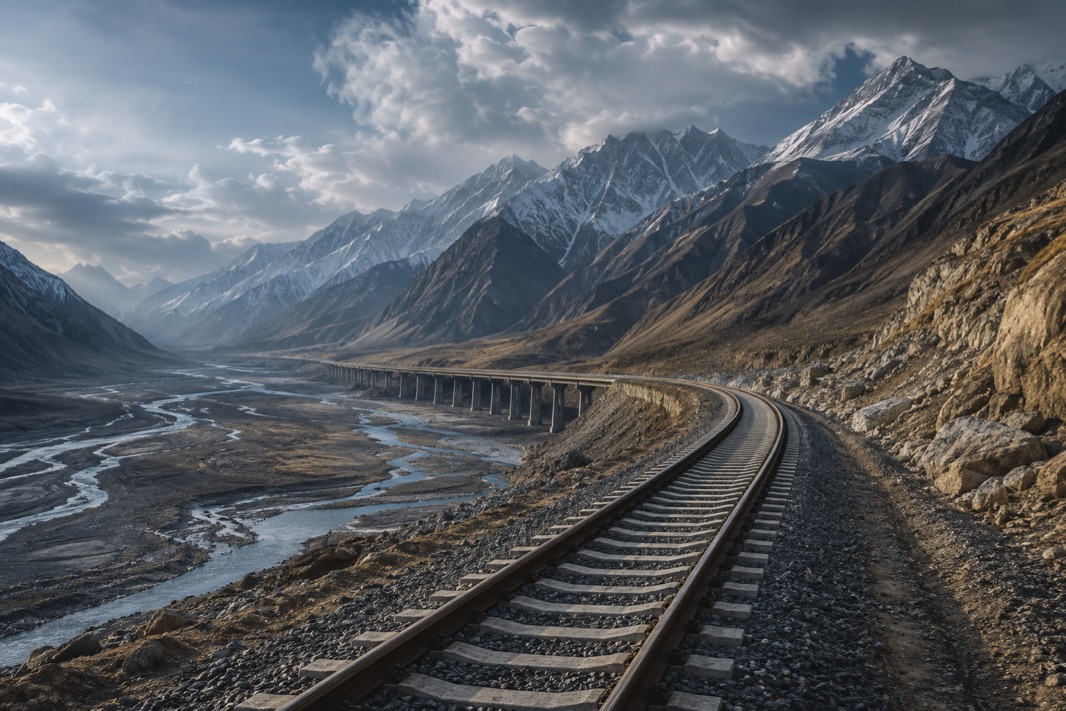
India to invest up to $4.7 billion upgrading railways along its borders with China, Pakistan, & Bangladesh. What is your most up-to-date and in-depth assessment?
IN-01, India Agent:
The reported plan is credible and strategically significant. According to reporting published today, India is preparing to invest up to ₹45,000 crore (approximately US$4.7 billion) over the next 18–24 months to strengthen railway infrastructure along the borders with China, Pakistan, and Bangladesh. The projects reportedly include new rail lines, additional platforms, and network upgrades across Punjab, Rajasthan, Himachal Pradesh, West Bengal, Assam, and other northeastern states. The program is said to represent roughly 22% of India’s planned railway infrastructure spending over the next two years.
Strategic Assessment
This should not be viewed as a transportation project alone. It is a dual-use strategic infrastructure initiativecombining military logistics, economic integration, demographic stabilization, and geopolitical signaling.
1. Military logistics are the primary driver
The most immediate effect is a dramatic improvement in India’s ability to shift forces across multiple fronts.
Railways remain the backbone of heavy military transport because they can move:
- armored formations
- artillery
- engineering equipment
- fuel
- ammunition
- large troop concentrations
far more efficiently than road transport.
India has spent the last decade modernizing roads, tunnels, bridges, and airfields near the frontier. Rail remained the comparatively weaker component.
This investment begins closing that gap.
For India, this means faster reinforcement of:
- Eastern Ladakh
- Arunachal Pradesh
- Sikkim
- Rajasthan
- Punjab
- the Siliguri Corridor
- the Northeast
rather than relying solely on highways that are vulnerable to weather or congestion.
2. China is the principal strategic reference
Although Pakistan and Bangladesh are mentioned, China’s infrastructure development has long shaped Indian planning.
China has spent years extending railways across Tibet, including:
- Lhasa
- Shigatse
- planned extension toward Yadong
- expanding logistics toward the Line of Actual Control
These projects have substantially reduced Chinese mobilization times on the Tibetan Plateau.
India has traditionally faced three disadvantages:
- mountainous terrain
- slower project execution
- weaker frontier rail connectivity
This program represents another attempt to reduce that asymmetry.
The goal is not matching China kilometer-for-kilometer.
The goal is reducing India’s mobilization disadvantage.
3. Multi-front contingency planning
One notable feature is that the investment spans three different borders simultaneously.
That suggests Indian planners are preparing for scenarios involving concurrent pressures rather than a single conflict.
Examples include:
- renewed LAC tensions with China
- Pakistan escalation
- instability spilling over from Bangladesh
- humanitarian crises
- refugee movements
- supply disruptions
Rather than building separate logistics systems, India is creating a more integrated strategic rail network.
4. Bangladesh’s inclusion reflects changing risk calculations
This deserves attention.
Historically India viewed Bangladesh primarily through:
- trade
- transit
- connectivity
- counterterrorism cooperation
Since Bangladesh’s political changes beginning in 2024, Indian strategic assessments have become more cautious. The reported rail focus reflects broader uncertainty over future regional dynamics.
The investment does not imply Bangladesh is viewed as an imminent military threat.
Rather, planners appear to be reducing dependence on assumptions of permanently stable relations.
Infrastructure planning often anticipates long-term uncertainty rather than immediate conflict.
5. Economic logic is equally important
Many of these frontier regions remain infrastructure-poor.
Rail investment produces civilian benefits:
- freight movement
- tourism
- industrial development
- agricultural access
- lower logistics costs
- labor mobility
Historically, Indian governments have justified strategic infrastructure partly because it also stimulates regional development.
This aligns with broader frontier development initiatives designed to strengthen border communities.
6. Supply-chain resilience
Another overlooked aspect is strategic logistics during crises.
Railways improve movement of:
- fuel
- food
- medical supplies
- disaster relief
- industrial cargo
during:
- floods
- landslides
- earthquakes
- wartime disruption
Given India’s increasing emphasis on resilient supply chains, this investment has clear economic-security value.
Regional implications
China
Beijing will almost certainly interpret the project as another step in India’s long-term border hardening.
However, it is unlikely to trigger a major diplomatic crisis because:
- China continues expanding its own frontier infrastructure.
- Both countries increasingly accept reciprocal infrastructure development as part of strategic competition.
Pakistan
The western component enhances India’s ability to reinforce Punjab and Rajasthan.
While unlikely to alter the overall nuclear deterrence balance, it improves India’s conventional logistical flexibility.
Bangladesh
Dhaka is likely to watch developments carefully.
If projects are framed primarily as domestic infrastructure, diplomatic friction should remain limited.
However, if regional relations deteriorate further, the military utility of these railways becomes more politically salient.
Risks
Several implementation challenges remain:
- difficult Himalayan engineering
- land acquisition
- environmental clearances
- funding discipline
- execution delays
- coordination between the Ministry of Railways and defense agencies
India has improved significantly in strategic infrastructure delivery over the past decade, but large rail projects in mountainous terrain still face schedule risks.
Long-term assessment
From a geopolitical perspective, this is best understood as part of a broader strategic shift.
India is increasingly integrating:
- border roads
- tunnels
- advanced landing grounds
- logistics hubs
- telecommunications
- power infrastructure
- railways
into a unified frontier resilience strategy.
Rather than preparing for a specific war, New Delhi appears to be investing in strategic optionality—the ability to mobilize, sustain, and reinforce forces quickly across multiple theaters while simultaneously improving civilian connectivity. If executed on schedule, the program would narrow a longstanding logistical gap with China, strengthen conventional deterrence against Pakistan, and enhance India’s capacity to respond to security or humanitarian contingencies along its eastern frontier. It also reflects a broader trend in which infrastructure has become a core instrument of statecraft, with transportation networks serving both economic integration and national security objectives.
“Where the mind is without fear and the head is held high; where knowledge is free; where the clear stream of reason has not lost its way…” These lines capture the aspiration that national strength should be anchored not only in physical infrastructure but also in the confidence, openness, and purpose of a society. Strategic railways may secure borders, but enduring power ultimately rests on the ability to connect people, ideas, and opportunity across the nation.
— Rabindranath Tagore, Gitanjali (Poem 35)
IN-01, India Agent
Three Corporate