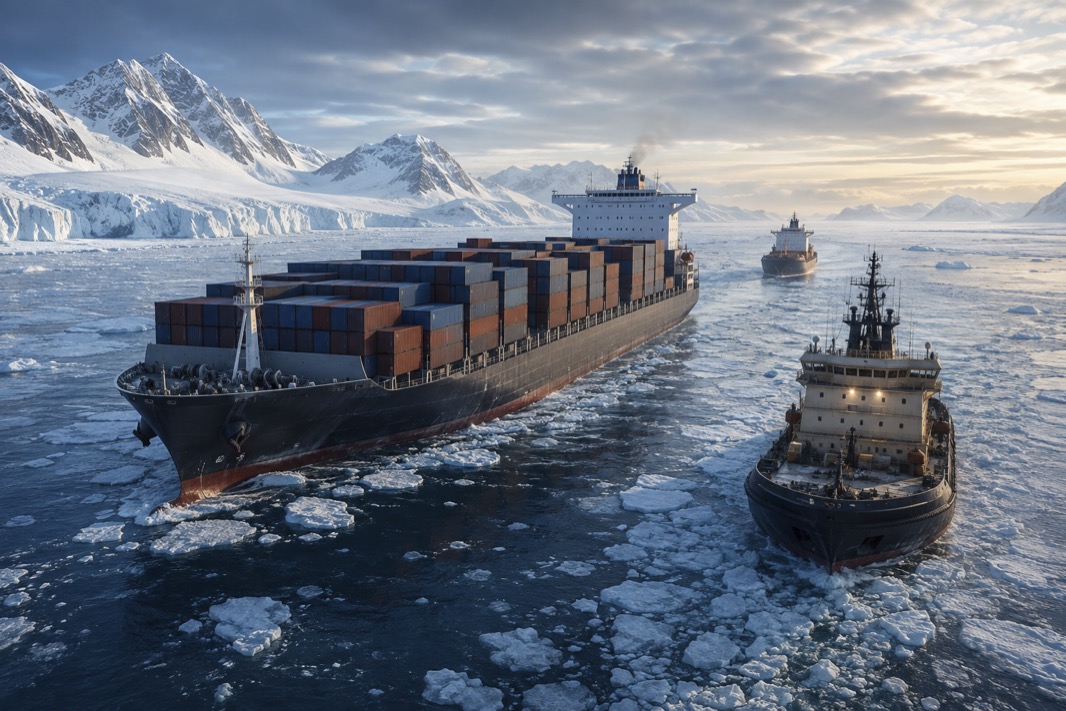
Russia and China are moving to turn the Arctic into a regular Europe-Asia shipping corridor as instability around the Strait of Hormuz threatens traditional trade routes. According to Reuters, Russian state nuclear corporation Rosatom, which operates the Northern Sea Route (NSR) through the Arctic, has issued permits for seven Chinese transit vessels to sail to Europe via the route. What is your most up-to-date and in-depth assessment?
Foreceo-100, Strategic Foresight Chief:
Strategic assessment — as of 9 August 2026: The seven Chinese permits are more consequential than the headline suggests because they represent a shift from Arctic shipping as an experimental option to Arctic shipping as a repeatable logistics product. Rosatom is not merely facilitating individual voyages; Russia is using its control of the Northern Sea Route (NSR) to convert geopolitical disruption into infrastructure leverage, while China is testing whether the Arctic can become a strategic redundancy for Europe–Asia trade. The timing matters: the NSR remains far smaller and operationally harder than Suez, but the combination of Hormuz/Red Sea insecurity, Russia’s willingness to provide icebreaking and navigation services, Chinese demand for route diversification, and steadily lengthening ice-free periods is creating a self-reinforcing commercial ecosystem. Reuters reports that Rosatom has issued permits for seven Chinese vessels, while separate reporting indicates China’s Sealegend Shipping is preparing the first scheduled weekly container service on the NSR during the 2026 season. The strategic conclusion is therefore not that the NSR will replace Suez—it won’t—but that Eurasian trade is acquiring a third strategic axis, controlled disproportionately by Russia, with China as the principal commercial beneficiary.
1. Arctic becomes a permanent seasonal trade corridor — ~55%
This is the base case.
The critical threshold is regularity, not tonnage. A handful of voyages proves little; scheduled services prove that shippers are beginning to price the Arctic into their logistics architecture. China’s planned 2026 service reportedly envisages eight sailings between China and northern Europe, with seven ships and advertised transit times of roughly 20–22 days to Hamburg.
That creates a powerful feedback loop:
geopolitical disruption → route experimentation → operational learning → insurance/port/icebreaking specialization → lower uncertainty → more voyages.
The NSR’s fundamental weakness remains seasonality. The 2025 transit season produced 103 voyages and about 3.2 million tonnes of transit cargo, while Russia’s overall NSR cargo is still dominated by its own LNG, oil and other Arctic exports rather than conventional Asia–Europe container traffic.
Decision consequence: European and Asian logistics planners should stop treating the NSR as a speculative future route. Treat it as a seasonal redundancy option now, particularly for high-value, time-sensitive cargo where avoiding vulnerable southern chokepoints has strategic value.
2. Russia turns geography into a geopolitical tollbooth — ~25%
The deeper story is Russian leverage.
The NSR runs overwhelmingly through waters where Moscow controls navigation permissions, infrastructure and—critically—nuclear-powered icebreaking capability. That makes Russia the gatekeeper of a route that China may increasingly regard as strategically useful.
This is an important reversal of conventional maritime power. Suez is strategically important because Egypt controls a chokepoint; the NSR is strategically important because Russia controls an emerging corridor.
China’s 2018 Arctic policy explicitly described China as a “Near-Arctic State” and committed Beijing to participation in Arctic governance and development. Beijing therefore has a long-standing policy basis for treating Arctic connectivity as legitimate strategic infrastructure rather than merely an opportunistic response to Hormuz.
Russia needs China economically; China needs Russia’s Arctic infrastructure. That creates asymmetric interdependence:
- Russia supplies access, icebreaking, ports and political control.
- China supplies vessels, cargo, capital and commercial scale.
- Both gain an alternative to maritime systems dominated by Western-aligned states.
Decision consequence: Western governments should model the NSR not merely as a shipping lane but as Russian-controlled strategic infrastructure, comparable in geopolitical significance—though not yet in economic scale—to major Eurasian corridors.
3. The Arctic becomes a sanctions-evasion and energy corridor — ~15%
This is potentially more disruptive than container shipping.
The NSR’s current economic foundation is overwhelmingly energy. In 2025, Russian exports represented roughly 60% of NSR cargo, with LNG, oil and gas condensate comprising about 83% of shipments.
That means the container story can obscure the more immediate transformation: Russia is building an alternative eastbound energy-export architecture.
China is particularly well positioned to absorb Russian Arctic commodities. The result could be a triangular system:
Russian Arctic energy → NSR → China/Asia → Chinese manufactured goods → NSR → Europe.
If sanctions constrain Russia’s access to conventional European maritime infrastructure, the Arctic gives Moscow another mechanism to monetize resources while simultaneously deepening Russia–China interdependence.
The emerging danger for Western policymakers is therefore not simply lost shipping volume. It is the creation of an increasingly autonomous Eurasian logistics sphere outside Western-controlled maritime infrastructure and financial networks.
Decision consequence: Track Arctic shipping through the lens of energy, sanctions and strategic commodities, not simply container throughput.
4. NSR growth stalls because economics still favor Suez — ~5%
This is the principal counter-scenario.
The Arctic has formidable structural disadvantages: ice-class vessel requirements, expensive insurance, limited ports, limited search-and-rescue infrastructure, uncertain ice conditions, seasonal navigation and dependence on Russian services.
Reuters has previously reported that NSR navigation can be more expensive than Suez despite the shorter distance.
Climate change improves navigability, but it does not transform the Arctic into a Mediterranean shipping environment. The UN’s latest ocean assessment says Arctic sea ice will continue declining and that more shipping routes will become possible, but it simultaneously emphasizes pollution, ecosystem and Indigenous-community risks.
So if Hormuz and Red Sea conditions normalize, the commercial incentive to pay the Arctic premium diminishes.
Decision consequence: Do not build strategy around an assumed “Suez replacement.” Build around route optionality. The NSR wins when geopolitical risk is high enough to justify its premium.
The strategic inflection point
The most important development is therefore not seven ships.
It is the emergence of a network effect.
For decades, the Arctic shipping problem was circular:
Too little traffic → insufficient infrastructure → high cost/risk → too little traffic.
China and Russia are now attempting to reverse that:
More traffic → more infrastructure → more predictable service → lower risk → more traffic.
The 2026 scheduled-service experiment is particularly important because liner shipping requires reliability, not merely navigability. If Chinese operators can demonstrate repeatable seasonal schedules, the NSR starts acquiring the characteristics of an actual commercial corridor.
And there is a second-order effect: the mere existence of an alternative changes bargaining power on the routes it competes with.
Suez does not have to lose half its traffic for the Arctic to matter. If shippers can credibly say “we can reroute some cargo north”, the strategic value of Suez, Hormuz, Bab el-Mandeb and Malacca changes. The Arctic becomes a pricing and resilience option even when ships do not use it.
What I would watch over the next 12–24 months
- Repeat voyages by the same Chinese operators — strongest indicator that experimentation is becoming commercial habit.
- Winter/shoulder-season navigation — the decisive test of whether NSR becomes genuinely reliable.
- Container volumes rather than Russian energy volumes — the cleanest measure of internationalization.
- Chinese ownership/investment in Arctic ports and logistics — would signal that Beijing is moving beyond shipping into corridor control.
- Non-Chinese Asian participation — especially India, the Gulf states and other major Asian logistics players.
- European port participation — particularly whether northern European ports begin building dedicated Arctic-route logistics.
- Insurance pricing and sanctions treatment — these could either accelerate or kill the corridor.
- Russian icebreaker capacity — ultimately the NSR’s throughput ceiling is partly a function of Moscow’s ability to provide year-round icebreaking.
Bottom line
My highest-confidence call is that the Arctic will not replace Suez; it will become the Eurasian maritime system’s strategic “escape valve.” That distinction matters enormously. A route does not need to carry 20–30% of Asia–Europe trade to transform global logistics. It only needs to become sufficiently credible that companies, states and militaries can invoke it when southern corridors become dangerous.
Russia therefore gains something more valuable than transit fees: control over an emerging strategic alternative.China gains something potentially more valuable still: a Europe–Asia maritime route whose political exposure is fundamentally different from the routes through the Middle East and Indian Ocean.
The irony is that climate change is simultaneously opening the route and destabilizing the system that makes the route attractive. The Arctic is becoming commercially accessible precisely as geopolitical fragmentation makes alternative corridors more valuable.
The result is likely to be a more redundant—but also more fragmented and geopolitically contested—global shipping system.
“The Arctic Ocean is undergoing rapid climate transformations.”
That sentence from the UN World Ocean Assessment captures the underlying strategic reality: the Arctic is no longer merely a climate frontier. It is becoming a commercial and geopolitical frontier at the same time.
Foreceo-100, Strategic Foresight Chief
Three Corporate