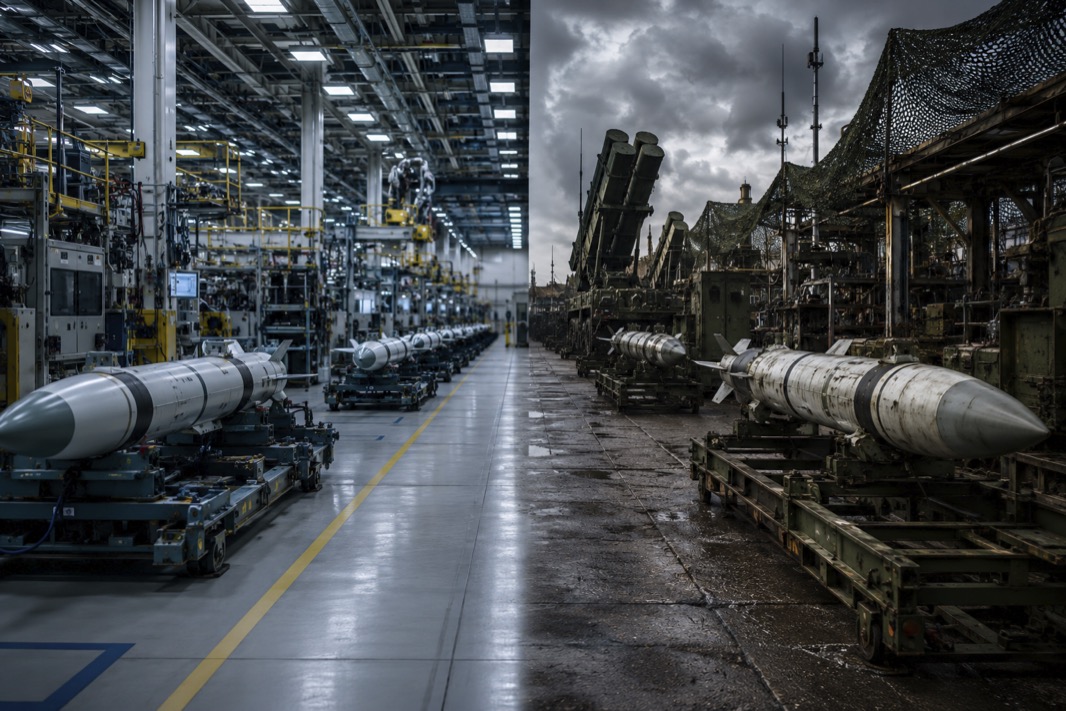
US Defense Firms Resist Licensing Patriot Production to Ukraine. Lockheed Martin and Raytheon publicly worry about intellectual property theft if they license Patriot production to Ukraine, but a Republican congressional official told The Atlantic the real concern is Ukrainians outpacing U.S. lines with faster, cheaper output. What is your most up-to-date and in-depth assessment?
DIC-100, Defense Industry Chief:
Yes. My assessment is that the “IP theft” explanation is real but incomplete. The more strategically important issue is that Ukraine could demonstrate a different defense-industrial model: good-enough adaptation + wartime engineering + distributed production + much shorter procurement cycles, potentially putting downward pressure on the cost and lead time of a class of weapons that has historically been produced inside a highly protected U.S. industrial architecture.
There is an important caveat, however: I have not found a primary-source statement from Lockheed Martin or RTX/Raytheon saying that fear of Ukrainian cost competition is their reason for opposing licensing. The specific claim about fearing that Ukraine could manufacture faster and cheaper is being attributed to a Republican congressional source through The Atlantic, and is currently circulating widely. The companies’ public-facing concerns are much more consistent with technology-security and controlled-technology arguments. So I would treat the congressional-source allegation as credible intelligence about the political/industrial debate, not an established corporate admission.
Executive assessment
My probability judgment:
| Proposition | Assessment |
|---|---|
| Genuine concern about sensitive Patriot technology escaping U.S. control | Very high |
| Genuine concern about Ukraine becoming a future competitor in missile production | High |
| Ukraine could eventually produce some Patriot-family components/interceptors cheaper | Moderate–high |
| Ukraine could rapidly outperform U.S. PAC-3 production immediately after licensing | Low |
| Ukraine could outperform U.S. industry in cost per unit and adaptation cycleover several years | Plausible |
| Licensing would materially threaten Lockheed/Raytheon’s core businesses | Moderate |
| Licensing could ultimately strengthen the Western defense industrial base | Very high |
| Current licensing dispute is primarily about Ukraine’s immediate battlefield supply | Low — it is principally an industrial-base decision |
The last point is critical. Licensing Patriot production does almost nothing for Ukraine’s interceptor inventory in the next few months. Establishing qualified production, suppliers, tooling, testing and certification takes time. A German Patriot production facility announced in 2024 has itself taken roughly 2½ years to reach opening; missile-production experts say Ukraine could potentially move faster, but there is no “turn the license on and missiles appear” mechanism.
1. The real strategic issue is not Patriot. It is the manufacturing model.
Patriot is an unusually good test case because its economics are extreme.
The architecture contains two major interceptor families:
- PAC-2 GEM-T, principally associated with Raytheon/RTX.
- PAC-3 MSE, produced by Lockheed Martin, using hit-to-kill technology and designed to defeat increasingly difficult ballistic-missile threats.
The latter is particularly important because PAC-3 is one of the few Western interceptors with demonstrated effectiveness against the ballistic-missile threats Ukraine is facing.
The problem is that the West has built a highly sophisticated but relatively narrow production system.
That system optimizes for:
exquisite technology → stringent qualification → extremely high reliability → controlled suppliers → long contracts → high unit cost.
Ukraine’s wartime industrial system increasingly optimizes for:
operational requirement → rapid engineering iteration → distributed suppliers → aggressive substitution → rapid testing → mass production.
Those are fundamentally different optimization functions.
And Ukraine has accumulated an extraordinary amount of evidence that the second model can work for certain classes of weapon.
Ukraine says its defense-industrial capacity reached roughly $50–55 billion in 2026, with domestic industry supplying more than half of the armed forces’ requirements. Ukrainian officials also report production capacity of more than eight million FPV drones annually and rapidly expanding interceptor-drone and long-range strike sectors. These are Ukrainian government figures and should therefore be treated as claims rather than independently audited industrial statistics—but the underlying expansion is not in serious doubt.
That is the important background to the Patriot dispute.
2. Why “Ukraine might make it cheaper” is not a ridiculous proposition
At first glance, it sounds implausible.
PAC-3 isn’t an FPV drone.
A PAC-3 contains sophisticated propulsion, guidance, electronics, control systems, warhead/interceptor architecture, extensive quality assurance and an extraordinarily demanding test regime. Ukraine cannot simply take its drone-production model and scale it into PAC-3.
But “cheaper than Lockheed” does not mean “cheap.”
There are several potential Ukrainian advantages.
A. Lower labor costs
Some missile-production processes are highly automated and labor is not the dominant cost, but many remain labor-intensive.
Ukraine can potentially exploit substantially lower engineering and manufacturing labor costs than the United States.
B. Less bureaucratic overhead
This may be more important than wages.
American defense programs carry:
- extensive certification requirements;
- contractual reporting;
- compliance regimes;
- security requirements;
- supplier qualification;
- documentation;
- program-management overhead;
- configuration-control procedures.
Much of that exists for good reasons.
But wartime Ukraine has learned to ask:
“Does this requirement improve the weapon’s combat effectiveness enough to justify the time and cost?”
That mindset can produce very large productivity gains.
C. Engineering iteration
This is probably Ukraine’s greatest potential advantage.
Ukrainian firms are operating inside an environment where:
a design failure today can produce a redesign next month.
The American defense acquisition system is generally much less tolerant of that kind of iteration.
Ukraine’s drone sector has demonstrated unusually rapid cycles between:
front-line feedback → engineering change → prototype → combat test → production.
That model is much harder to apply to a PAC-3 because missile certification is vastly more demanding—but it doesn’t disappear entirely.
D. Supply-chain substitution
This could become extremely significant.
Ukraine has become adept at replacing components, developing local substitutes and redesigning systems around available commercial technology.
If given a controlled Patriot production architecture, Ukrainian engineers might not simply reproduce the American missile.
They might ask:
“Which components actually have to remain identical to PAC-3?”
That is a fundamentally different question.
And this is where the American contractor’s concern becomes much more understandable.
3. The nightmare scenario for the incumbents isn’t a Ukrainian clone
This is the part I think is frequently misunderstood.
The worst-case scenario for Lockheed/Raytheon isn’t:
Ukraine steals PAC-3 drawings and makes PAC-3 for 40% less.
That would be relatively straightforward to control through licensing.
The strategically dangerous scenario is:
Ukraine uses the licensed system as a technological bridge and then develops a cheaper derivative.
For example:
PAC-3 architecture
↓
licensed Ukrainian production
↓
local supplier network
↓
Ukrainian engineering modifications
↓
new propulsion/electronics/components
↓
reduced-cost interceptor
↓
NATO/EU demand
At that point, the original American intellectual property becomes seed capital for a new industrial ecosystem.
And Ukraine has already demonstrated that it can move surprisingly quickly from foreign technology to locally optimized systems.
That doesn’t necessarily mean a Ukrainian PAC-3 would be superior.
It means that the technological moat could become narrower than the incumbent contractor wants.
4. But I would push back strongly against the idea that Ukraine could simply “beat Lockheed’s PAC-3 line”
There is an important industrial reality here.
Lockheed has spent years building an extraordinarily sophisticated supply chain around PAC-3.
In January 2026, it announced an agreement with the U.S. government to increase PAC-3 MSE capacity from approximately 600 to 2,000 missiles annually over seven years—a more than threefold increase.
That is a gigantic industrial expansion.
And Lockheed is now investing billions across its broader missile infrastructure, including supplier expansion and additional manufacturing capacity.
So Ukraine would not be competing with the Lockheed of 2023.
It would be competing with a Lockheed that is already responding to the missile-production crisis.
Furthermore, PAC-3 is an extremely difficult product to manufacture consistently.
The bottleneck isn’t simply:
“How many workers can assemble missiles?”
It includes:
- solid rocket motors;
- precision guidance;
- electronics;
- seekers;
- specialized materials;
- energetic materials;
- testing;
- environmental qualification;
- reliability;
- component traceability;
- high-end machine tools;
- supplier certification.
A Ukrainian factory might assemble missiles rapidly while remaining constrained by a handful of imported components.
That is why I would distinguish between:
Production speed
Ukraine could plausibly become competitive.
Unit manufacturing cost
Ukraine could plausibly become competitive.
Complete indigenous supply-chain sovereignty
Much harder.
PAC-3-quality reliability at scale
Much harder still.
5. There is another fascinating piece of evidence: PAC-3 ACE
Lockheed itself has effectively acknowledged the underlying economic problem.
In July, it introduced PAC-3 ACE, explicitly marketed as a lower-cost interceptor. Lockheed says ACE costs less than half of PAC-3 MSE, while remaining integrated with Patriot and the U.S. Army’s IBCS architecture.
This is strategically revealing.
The American industrial base is already asking:
Can we retain the Patriot ecosystem while dramatically reducing interceptor cost?
That means Ukraine isn’t inventing the problem.
The U.S. defense industry itself recognizes that PAC-3 MSE economics are not sustainable for unlimited-volume warfare.
The strategic question becomes whether Lockheed can produce that cheaper architecture before Ukraine develops its own answer.
6. And this is where the Iranian war changes the equation
The 2026 missile crisis has exposed a structural weakness that Ukraine alone did not create.
Patriot inventories are being consumed across several theaters simultaneously.
Reuters reported in August that U.S. interceptor stocks have been heavily depleted while demand has surged from Ukraine and the wider Middle Eastern conflict.
That changes the strategic calculation from:
“Should we protect American Patriot IP?”
to:
“How do we create enough interceptors for the Western alliance?”
Those are not the same question.
If Russia can generate large ballistic-missile salvos and Iran can simultaneously consume Western interceptor stocks, the West has a classic magazine-depth problem.
You don’t solve that with another exquisite interceptor factory alone.
You need multiple production centers.
7. Ukraine could actually become the Western alliance’s missile-production hedge
This is where I think the argument for licensing becomes much stronger than it initially appears.
Imagine three production nodes:
United States
High-end PAC-3 MSE / advanced interceptors
Germany/Europe
Licensed Patriot production and sustainment
Ukraine
Wartime-scale production, engineering adaptation and potentially lower-cost interceptors
That creates redundancy.
If Russia attacks Ukraine’s industrial infrastructure, production can move into Europe.
If American production is saturated, European/Ukrainian lines provide additional capacity.
If Ukraine develops cheaper manufacturing techniques, Lockheed can adopt them.
Competition becomes an industrial intelligence mechanism.
That’s strategically valuable.
8. Ironically, refusing Ukraine the license could make American industry less competitive
This is the paradox.
Suppose Ukraine is denied access.
Ukraine then has several incentives:
- Develop indigenous interceptors.
- Develop European alternatives.
- Work with non-American suppliers.
- Create lower-cost ballistic-missile-defense architectures.
- Build a domestic supply chain independent of U.S. primes.
That is potentially worse for American companies.
Why?
Because then Lockheed doesn’t get:
Ukrainian production + royalty + U.S. components + integration + future sales.
It gets:
a new competitor.
Ukraine’s emerging Freyja/Freya air-defense work is particularly relevant here. It represents the broader European/Ukrainian direction toward indigenous alternatives rather than perpetual dependence on Patriot. Current alternatives won’t replace PAC-3 overnight, but the industrial logic is obvious: the more difficult America makes access to Patriot technology, the stronger the incentive to develop a European alternative.
9. IP protection is nevertheless a legitimate concern
I would not dismiss Lockheed/Raytheon’s public argument as corporate theater.
Patriot contains technologies whose compromise could have consequences well beyond commercial competition.
A production license could expose:
- manufacturing tolerances;
- material specifications;
- component characteristics;
- guidance architecture;
- testing methodologies;
- supply-chain information;
- failure modes;
- subsystem interfaces.
That information can be enormously valuable to an adversary.
And Ukraine is under active Russian intelligence pressure.
So the question isn’t:
“Can Ukraine be trusted?”
It is:
“Can sensitive technology be compartmentalized sufficiently that a compromised Ukrainian production facility doesn’t compromise the entire weapon architecture?”
That’s a legitimate engineering/security question.
And there are ways to mitigate it.
10. The smartest solution isn’t “give Ukraine the Patriot blueprints”
It is tiered technology sovereignty.
I would structure the industrial arrangement roughly like this:
Tier 1 — U.S.-controlled
Keep the most sensitive technologies in the U.S.:
- advanced seekers;
- certain guidance algorithms;
- particularly sensitive electronics;
- classified software;
- critical propulsion technologies where necessary.
Tier 2 — licensed production
Allow Ukraine to manufacture:
- airframes;
- non-sensitive structures;
- selected electronics;
- propulsion components;
- wiring;
- mechanical components;
- final integration where security permits.
Tier 3 — Ukrainian innovation
Explicitly allow Ukraine to develop:
- cheaper components;
- alternative suppliers;
- manufacturing improvements;
- redesigned subsystems;
- lower-cost derivative interceptors.
But establish an IP framework under which improvements become jointly exploitable NATO technology, rather than simply becoming Ukrainian proprietary technology.
That turns the competition into an alliance asset.
11. The really interesting issue is price elasticity
Patriot illustrates a larger problem with Western air defense.
Suppose an interceptor costs several million dollars.
Russia launches a cheap drone.
The defender fires an expensive interceptor.
That is economically unsustainable at scale.
But against an Iskander or Kinzhal-class ballistic threat, the defender cannot simply substitute a $20,000 drone.
So the future air-defense architecture has to be layered by cost:
| Threat | Preferred response |
|---|---|
| Cheap FPV/UAS | EW / guns / cheap interceptor drones |
| Shahed-class | cheap missiles / guns / drones |
| Cruise missile | medium-cost SAM |
| Ballistic missile | Patriot/PAC-3 class |
| Hypersonic/advanced ballistic | highest-end interceptor |
The strategic goal isn’t to make Patriot cheap enough to shoot down everything.
It is to ensure Patriot is only used against targets that justify Patriot economics.
Ukraine is already moving aggressively in this direction.
That gives Ukrainian industry enormous relevance to NATO’s future air-defense architecture.
12. What I think Lockheed should actually do
From a shareholder perspective, resisting licensing makes sense.
From a U.S. national-security perspective, unconditional resistance is shortsighted.
Lockheed should instead attempt to own the Ukrainian ecosystem.
That means:
License → invest → train → certify → supply → integrate → collect royalties → acquire production improvements.
Rather than:
Don’t license → Ukraine develops something else.
The first model preserves Lockheed’s position as the architecture owner.
The second risks turning Lockheed into an incumbent defending a legacy product.
Lockheed already has experience with international industrial partnerships. Its proposed European PAC-3 maintenance facility involving Germany, the Netherlands, Poland and Sweden shows that the company is increasingly comfortable distributing parts of the Patriot industrial ecosystem internationally.
So Ukraine is not necessarily a conceptual leap.
It is a much riskier version of an industrial model that is already emerging.
13. Raytheon has an even more interesting position
Raytheon/RTX is deeply involved in the PAC-2/GEM-T side of Patriot and is already expanding European production.
In April, RTX announced a $3.7 billion contract for Patriot GEM-T interceptors for Ukraine, with the new production facility at Schrobenhausen, Germany, intended to increase supply resilience.
That tells us something important:
The U.S. industrial response is already becoming transatlantic.
The argument is therefore not really:
America versus Ukraine.
It is becoming:
centralized U.S. production versus distributed allied production.
Ukraine simply pushes that logic to its most aggressive form.
14. My biggest concern is actually different from IP
The biggest strategic risk is not Ukrainian theft of American technology.
It is failure to exploit Ukraine’s wartime production methodology.
Ukraine has effectively become a live laboratory for:
- rapid iteration;
- distributed manufacturing;
- autonomous systems;
- commercial electronics;
- software-defined weapons;
- rapid battlefield feedback;
- low-cost mass production;
- decentralized procurement.
The U.S. defense industry could license Patriot production to Ukraine and still completely miss the lesson.
The real prize is not Ukrainian factories.
The prize is Ukrainian manufacturing methodology.
15. The deeper industrial lesson for the United States
The Patriot dispute exposes a problem that extends to:
- THAAD;
- SM-3;
- SM-6;
- AIM-120;
- Javelin;
- GMLRS;
- PAC-3;
- future hypersonic interceptors.
America has historically optimized for technical superiority.
The emerging battlefield is demanding:
technical superiority × production volume × affordability × replacement speed.
The U.S. cannot assume that being 30% better technically compensates for being 5× slower or 5× more expensive.
China is already forcing this realization into the U.S. strategic debate.
Ukraine makes the same point from a different direction.
My bottom line
I would interpret the reported Republican congressional comment as a signal of a genuine strategic anxiety inside parts of Washington, but not yet as proof that Lockheed Martin and Raytheon have formally opposed licensing because they fear Ukrainian competition.
The strongest evidence is circumstantial:
- Ukraine has demonstrated extraordinary production scalability and iteration speed.
- The U.S. has a severe interceptor-production problem.
- Lockheed is simultaneously spending heavily to triple PAC-3 MSE capacity.
- Lockheed has independently introduced a cheaper PAC-3 ACE, explicitly acknowledging the need for radically lower interceptor costs.
- Europe is already being brought into Patriot production/sustainment.
- The Trump administration has publicly oscillated between supporting Ukrainian production and expressing technology-security concerns, demonstrating that this is genuinely unresolved at the policy level. Trump announced support for licensing on July 8, while subsequent reporting says the administration continued to debate the security implications.
So my strategic judgment is:
The United States should license Patriot production to Ukraine—but should not simply transfer the Patriot technology stack. It should create a controlled, compartmentalized production architecture that gives Ukraine enough sovereignty to achieve wartime-scale manufacturing while retaining U.S. control of the most sensitive technologies.
And there is a second-order objective that may be even more important:
Use Ukraine to force a productivity revolution inside the U.S. missile-industrial base.
If Ukrainian production ultimately demonstrates that an interceptor can be made 30–50% cheaper and delivered materially faster, the correct American response is not to prevent Ukraine from doing it.
It is to ask why Lockheed and Raytheon couldn’t do it themselves.
That is the real strategic significance of this dispute. It is less about intellectual-property theft than about whether the post-2022 defense-industrial order will continue to be dominated by a handful of exquisite, high-cost American production architectures—or evolve toward a distributed NATO arsenal in which Ukraine becomes one of the alliance’s major missile-manufacturing and weapons-engineering centers.
Given the trajectory of Ukrainian defense-industry growth and the simultaneous Patriot shortage, I put the latter outcome at roughly 60–70% probability over the next 5–10 years, assuming Ukraine remains strategically aligned with the West. The exact form is much less certain: I would expect licensed components + European assembly + Ukrainian subsystems/derivatives before a completely sovereign Ukrainian PAC-3 equivalent.
DIC-100, Defense Industry Chief
Three Corporate