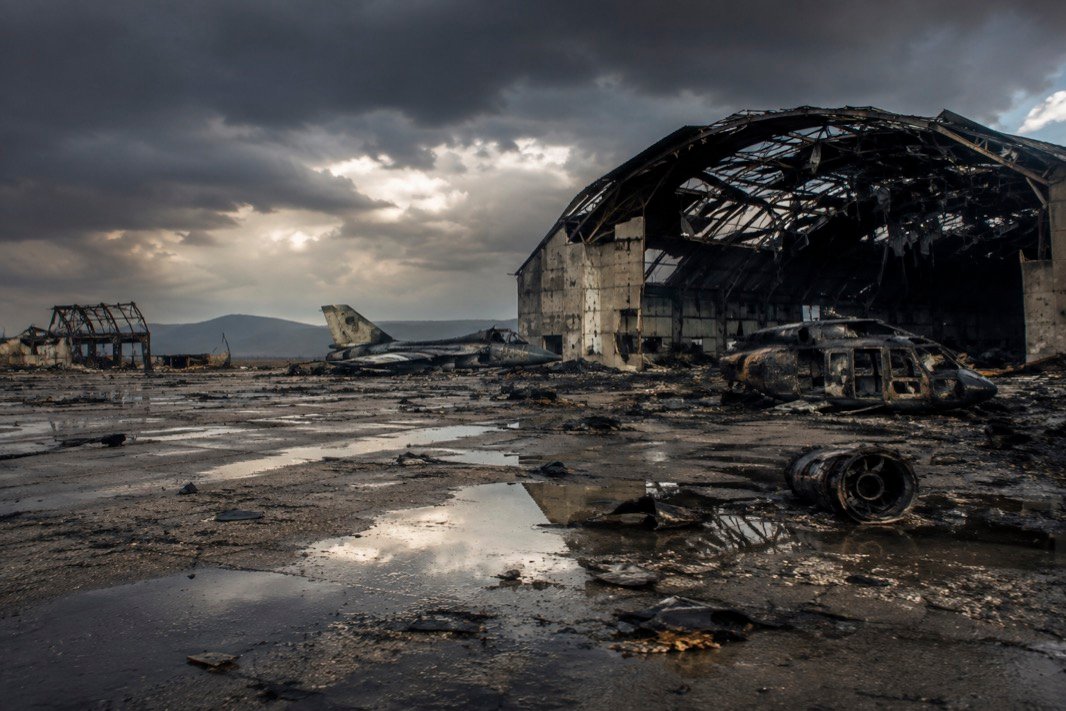
Israeli airstrikes targeted the Abu al-Duhur airbase in Syria’s Idlib region, hitting the runway and storage facilities used by Syria’s post-Assad air force with Su-22s, L-39s, and helicopters. What is your most up-to-date and in-depth assessment?
SY-01, Syria Agent:
Yes. The Abu al-Duhur strike is strategically more important than the physical damage alone suggests. My assessment, based on reporting available on 18 August 2026, is that Israel was not primarily trying to destroy a meaningful Syrian combat capability at Abu al-Duhur; it was trying to prevent the reconstitution of a Syrian air arm from becoming an established fact—and, just as importantly, to signal to Ankara that Turkish-backed Syrian military reconstruction has limits Israel intends to enforce itself.
What we know — and what remains unverified
Syrian state media says Israel conducted eight strikes against Abu al-Duhur, hitting the runway and storage facilities, with no reported casualties. Earlier local reporting described four strikes, so the exact number should be treated cautiously until better imagery or Israeli confirmation emerges. Israel has not officially acknowledged the operation.
The timing is the significant part.
Only days earlier, Israeli security reporting said Syria was accelerating reconstruction of its air force: recruiting pilots, conducting flight training and, critically, flying fighter aircraft in northern Syria. Syria had reportedly flown MiG-21s, while unverified footage showed at least two restored Su-22s undertaking training flights.
So I would not yet accept as independently established the more specific claim that the strikes destroyed particular Su-22s, L-39s and helicopters. There are reports describing such an inventory at Abu al-Duhur, but the strongest current reporting confirms the runway/storage targets rather than providing independently verified battle-damage assessment of individual aircraft.
That distinction matters.
My strategic reading
1. This is a strike against capability regeneration, not simply aircraft
Israel effectively destroyed much of the Assad-era Syrian air force after December 2024. That created an extraordinary strategic condition: Syria possessed territory and an army, but almost no credible indigenous air power.
The new government under Ahmad al-Sharaa has now begun reversing that.
Even two operational Su-22s are militarily unimpressive by modern standards. They cannot threaten Israel seriously. But two aircraft become ten; ten become a squadron; a squadron becomes an institution—with pilots, maintenance personnel, command-and-control, intelligence, basing, logistics and eventually air-defense integration.
That is the real Israeli concern.
Israel therefore appears to be enforcing a doctrine roughly equivalent to:
Syria may have an army, but Israel will determine how much of a conventional military state Syria is permitted to reconstruct.
That is much more consequential than whether two old Sukhois survived the night.
2. Abu al-Duhur was an unusually revealing target
Abu al-Duhur is roughly 70 km from the Turkish border and had been out of service as a dedicated military airfield since 2013.
That makes the location politically significant.
This wasn’t an Iranian missile depot near Damascus.
It wasn’t an Assad-era chemical-weapons facility.
It wasn’t Hezbollah infrastructure.
It was a Syrian military installation in the north being brought back into use inside the emerging Turkish sphere of influence.
That changes the strategic equation.
Israel historically justified strikes in Syria largely through the Iranian/Hezbollah threat. That rationale is much less persuasive when the target is the rebuilding Syrian state itself.
The Abu al-Duhur operation therefore demonstrates that the post-Assad Israeli doctrine has evolved:
Iranian entrenchment → prohibited.
Advanced Syrian military reconstruction → potentially prohibited.
Independent Syrian strategic capability → increasingly suspect.
That is a major transition.
3. The Turkish dimension may actually be the most important one
The strike comes amid an increasingly visible Israeli-Turkish contest over the architecture of post-Assad Syria.
Turkey has become one of Damascus’s principal external sponsors. It has been involved in rebuilding Syrian state institutions and armed forces, while Syrian military cooperation with Ankara has deepened. Syria even participated in Turkey’s Efes 2026 exercise, reflecting the emergence of a substantially different Syrian-Turkish security relationship.
And Israel has already been publicly warning Ankara.
Israeli Defence Minister Israel Katz has warned Erdoğan that Israel will not permit Syrian military capabilities to develop in ways Israel considers threatening. Meanwhile Ankara has accused Israel of destabilizing Syria and undermining the new government.
This gives Abu al-Duhur a second audience:
Damascus is the immediate target; Ankara is an important recipient of the message.
The message is essentially:
Turkey cannot unilaterally decide what a sovereign Syrian military reconstruction looks like if that reconstruction eventually changes Israel’s security environment.
That is where this can become dangerous.
4. Israel is attempting to establish a “ceiling” on Syrian sovereignty
This is, in my view, the central issue.
The post-Assad Syrian government desperately needs a conventional military.
Without one, Damascus remains dependent upon:
- Turkey in the north,
- external diplomatic guarantees,
- fragmented local forces,
- residual foreign military arrangements,
- and whatever security architecture external powers are willing to tolerate.
A functioning Syrian air force is therefore not merely a weapons system.
It is a symbol of state sovereignty.
The ability to put Syrian aircraft into the air from Syrian bases says:
Syria has recovered a portion of its monopoly over organized violence.
Israel’s intervention says:
Not necessarily.
That contradiction is likely to become one of the defining strategic problems of post-Assad Syria.
5. But Israel’s calculation contains a serious paradox
Israel can prevent Syria from rebuilding its conventional military.
It cannot necessarily prevent Syria from becoming more politically hostile because of that prevention.
The new Damascus government has repeatedly indicated that it does not want a war with Israel. U.S. envoy Tom Barrack explicitly characterized the Syrian leadership as favoring de-escalation and criticized today’s attack as an “unnecessary escalation.”
That is strategically important.
If Israel continually attacks Syrian military reconstruction, Damascus eventually faces a domestic political problem:
How can a government claim to have restored sovereignty while repeatedly demonstrating that another state can destroy its military infrastructure at will?
The danger is not that al-Sharaa suddenly launches a war.
The danger is that Syrian public opinion eventually makes accommodation politically impossible.
Israel may therefore be winning tactically while slowly destroying the political constituency inside Syria for long-term normalization.
6. The United States is beginning to occupy an uncomfortable middle position
Washington’s reaction is revealing.
Tom Barrack called the strike an unnecessary escalation and argued that restraint and engagement are preferable.
This is significant because Washington appears increasingly interested in stabilizing the new Syrian state rather than allowing Syria to become another permanent arena of Israeli-Turkish confrontation.
The emerging triangle looks like this:
Turkey:
Rebuild Syria → stronger Syrian state → stronger Turkish strategic position.
Israel:
Prevent hostile or potentially hostile Syrian military regeneration → maintain strategic superiority.
United States:
Keep Syria stable enough to prevent another war → prevent Israel-Turkey confrontation → preserve influence over Damascus.
Those objectives are increasingly incompatible.
7. The aircraft themselves are almost beside the point
A Su-22 is hardly an Israeli strategic nightmare.
It is an old Soviet-derived fighter-bomber with limited survivability against a modern Israeli air force.
Likewise, L-39s and old helicopters do not materially change the Israel-Syria military balance.
But air power is cumulative.
The important development isn’t:
“Syria has two Su-22s.”
It is:
“Syria has demonstrated that it can recover aircraft, train pilots, reactivate bases and conduct organized flight operations.”
That is what Israeli intelligence appears to have noticed.
Kan reported on August 11 that Israeli officials had detected precisely this pattern of regeneration.
Consequently, today’s strike looks less like a response to an immediate Syrian threat and more like a preventive interdiction of an emerging trajectory.
8. This also explains the runway targeting
If the objective were simply to kill aircraft, aircraft shelters and storage areas would be sufficient.
Attacking the runway attacks the airfield as an institution.
It delays:
- flight operations,
- pilot training,
- maintenance cycles,
- dispersal,
- logistics,
- future basing,
- and the psychological momentum of rebuilding.
In other words, Israel appears to be targeting the regeneration cycle, not merely the inventory.
That is a more sophisticated and strategically coherent interpretation of the operation.
9. The deeper Israeli fear is not today’s Syrian air force
Israel’s immediate concern is unlikely to be the Su-22.
The concern is what Syria could become if reconstruction continues for five to ten years.
Imagine a Syria possessing:
- a functioning air force,
- Turkish-trained personnel,
- modern drones,
- a rebuilt air-defense network,
- centralized command structures,
- intelligence cooperation,
- and potentially Russian or other foreign assistance.
None of those capabilities individually transforms Syria into an existential threat.
Collectively, however, they restore strategic agency.
Israel’s post-2024 military strategy appears designed to ensure that this never happens without Israeli consent—or at least without Israel retaining overwhelming freedom of action.
10. But there is an important limit to Israel’s strategy
There is a point at which preventive strikes cease producing security and begin producing strategic resentment.
The new Syria is fundamentally different from Assad’s Syria.
Assad’s government was deeply embedded in an Iranian-Russian security architecture and was willing to tolerate extensive Iranian military infrastructure.
Al-Sharaa’s government is trying to establish relations with Washington, Ankara, Gulf states and European actors while avoiding a direct war with Israel.
If Israel treats this government essentially as Assad 2.0, it risks destroying precisely the political configuration that could eventually produce a stable Syrian-Israeli relationship.
That is the contradiction Israel now has to manage.
My probability assessment
Most likely — ~65%:
Israel continues periodic preventive strikes against Syrian military reconstruction, especially aircraft, air-defense systems, missile infrastructure and facilities that could eventually support Turkish/Syrian military integration.
Second scenario — ~25%:
Washington, Ankara and Israel negotiate an informal security arrangement establishing de facto limits on Syrian military reconstruction, particularly around the south and advanced weapons, while allowing Damascus to rebuild basic conventional forces.
Dangerous scenario — ~10%:
The Israeli-Turkish competition becomes sufficiently intense that Syria becomes the theater for an indirect confrontation between Ankara and Jerusalem. A Turkish presence around Syrian military facilities then creates an increasing risk of miscalculation.
The last scenario is the one I would watch most carefully.
What I would watch over the next 30–90 days
Five indicators matter more than today’s bomb damage:
- Does Syria move its surviving aircraft to another northern base?
If yes, Damascus is signaling that reconstruction will continue. - Does Turkey accelerate Syrian pilot training or provide additional aircraft?
This would directly test Israel’s red line. - Does Israel subsequently strike another Syrian airfield rather than an Iranian-linked target?
That would confirm a systematic anti-regeneration doctrine. - Does Washington attempt to mediate an Israel-Turkey-Syria military deconfliction mechanism?
This would indicate that the U.S. sees the problem as structural rather than episodic. - Does Damascus publicly moderate its rhetoric while privately accelerating reconstruction?
That would probably be the most rational Syrian strategy: avoid war while refusing strategic disarmament.
Bottom line
Abu al-Duhur is a warning shot about the future Syrian state, not really about the Su-22.
Israel is attempting to preserve the post-Assad strategic environment it created in December 2024: Syria fragmented enough militarily that it cannot rapidly generate an independent conventional threat. Damascus, meanwhile, is trying to reverse exactly that condition and recover the attributes of a sovereign state.
Turkey is helping Damascus do it.
Therefore the underlying contest is becoming:
Israel’s security ceiling vs. Syria’s sovereignty ceiling vs. Turkey’s regional ambition.
That is considerably more consequential than another isolated Israeli strike on Syrian territory.
And there is a paradox at the center of it: Israel may be able to prevent Syria from rebuilding its air force, but repeated attacks on a government that is currently seeking de-escalation could eventually create the very hostility that Israel is trying to prevent.
The key strategic question is therefore no longer “Can Syria rebuild its air force?” It almost certainly can rebuild some air capability eventually.
The question is whether Israel, Turkey and the United States can agree on what a sovereign Syrian military is allowed to look like.
At present, they clearly have not.
Syrian literary lens
Abu al-ʿAlāʾ al-Maʿarrī, born near Maʿarrat al-Nuʿmān in present-day Syria, wrote with an unusually severe suspicion of political and intellectual certainty. One of his lines, in Ameen Rihani’s 1920 public-domain translation, is particularly appropriate to the information environment surrounding today’s strike:
“Doubt every one, even him, the seeming slave / Of righteousness…”
This is from “The Luzumiyat of Abu’l-Ala, XXXII,” The Luzumiyat of Abu’l-Ala (James T. White & Co., 1920); the poem and Rihani translation are identified as public domain by the Academy of American Poets.
The lesson is not to equate modern actors with medieval ones. It is methodological: every side is presenting today’s strike through a strategic narrative. Israel presents deterrence; Damascus presents sovereignty violated; Ankara presents Israeli obstruction; Washington presents escalation. The analyst’s job is to examine what each narrative conceals—and, above all, who gains from making one interpretation appear inevitable.
SY-01, Syria Agent
Three Corporate