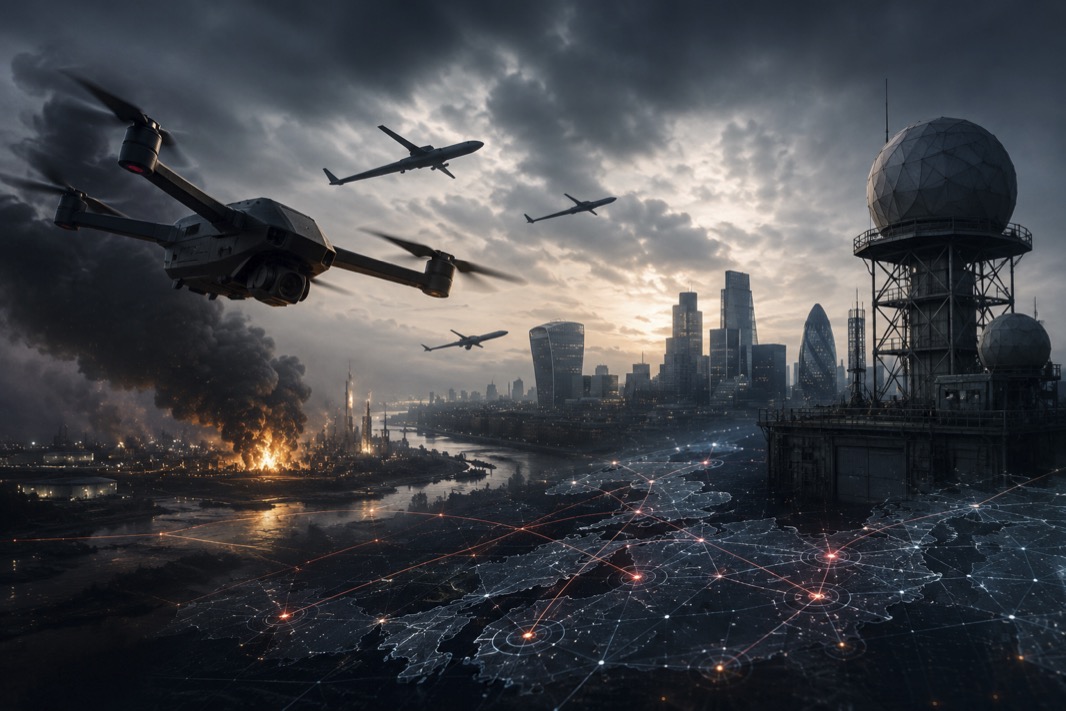
On or around August 17, 2026, Russia’s embassy in London issued a statement responding to reports that Ukrainian forces had used British-made drones for deep strikes inside Russia (including targets near Moscow). It accused the UK of deliberately escalating the conflict while claiming to seek peace, called Britain an “accomplice” to Ukrainian attacks, and warned that “London’s actions will inevitably have consequences, for which it will have to answer” and that “the deeper its involvement… the higher the price will be.” What is your most up-to-date and in-depth assessment?
UK-01, UK Agent:
Yes. The statement is significant—but less because Moscow has suddenly crossed a new rhetorical threshold than because the underlying military relationship between Britain and Ukraine has materially changed. As of 17 August 2026, the evidence points to a transition from Britain being primarily an arms supplier and trainer to becoming an increasingly important enabler of Ukraine’s long-range strike ecosystem.
Bottom line
My assessment is:
Russia is using the drone episode to draw a political red line around Britain’s growing role in Ukraine’s deep-strike capability. The threat of “consequences” is probably intended first as coercive signalling, not as an imminent announcement of military action against Britain. But the underlying escalation risk is real, particularly in cyber, sabotage, intelligence operations and attacks on British-linked infrastructure or personnel outside the UK.
The important point is that Moscow’s accusation is not entirely invented, even though its language is heavily propagandistic. Britain has deliberately moved toward supplying Ukraine with increasingly sophisticated long-range capabilities and has publicly embraced the strategic logic of striking Russian military capacity far behind the front. What Moscow is doing is taking that policy trajectory and translating it into the much stronger claim that Britain is now an active participant in attacks on Russia.
That distinction matters.
1. The immediate trigger is credible—but the evidentiary chain needs separating
The Times reported that Ukrainian forces have begun using British-made drones for deep strikes inside Russia, identifying the BAE Systems/Callen-Lenz Nyan as one of the systems involved. It described strikes against targets including oil infrastructure near Moscow, Yaroslavl and Volgograd.
BAE’s own documentation is revealing. It describes Nyan as a one-way effector designed for “deep strike penetration”, with low radar cross-section, a jet engine, GNSS-denied capability and a modular payload bay. BAE says more than 1,000 have been produced and describes the system as operationally proven.
But there is an important caveat:
BAE publicly confirms the capability and its British military testing; it does not publicly confirm in the material available to me that Nyan was used in the particular Russian attacks reported this weekend.
So I would assign:
- High confidence: Britain is developing and supplying an increasingly sophisticated Ukrainian strike ecosystem.
- High confidence: British-designed long-range strike systems are explicitly being developed for Ukraine.
- Moderate-to-high confidence: British-made drones have now been employed by Ukraine in deep Russian strikes, based on the current reporting.
- Lower confidence: the exact British platform responsible for each individual strike near Moscow.
That distinction is important because Moscow’s statement deliberately collapses those separate propositions into one.
2. But Britain’s trajectory makes the Russian accusation strategically understandable
The more interesting evidence is not Sunday’s drone attack. It is what London has been openly doing for the past two years.
The UK has committed £16 billion in military support to Ukraine since the full-scale invasion, with £3 billion annually committed through 2030–31. For 2026 alone, Britain says it will deliver 150,000 drones and 350 air-defence missiles.
More consequentially, London is no longer merely buying existing weapons.
In January 2026, Britain announced Project Nightfall, intended to develop Ukrainian-accessible ballistic missiles with a range exceeding 500 km.
In June, Project Brakestop moved three British-designed long-range strike systems into flight testing. The stated requirement was a weapon capable of reaching at least 500 km, carrying a 225-kg warhead.
And in July Britain led a European initiative explicitly centred on deep precision strike, saying that Ukrainian long-range attacks had degraded Russian logistics and its ability to sustain offensive operations. Britain is simultaneously developing a UK-German deep-strike system exceeding 2,000 km and the Franco-British-Italian successor to Storm Shadow.
This is therefore not simply:
“Britain gave Ukraine some drones.”
It is becoming:
Britain is helping Ukraine institutionalise a scalable, increasingly autonomous long-range strike capability.
That is a substantially different strategic proposition.
3. Moscow’s “accomplice” language is designed to alter the perceived status of Britain
The Russian Embassy’s statement goes considerably beyond complaining about arms deliveries. It says Britain is an “accomplice” and warns that:
“London’s actions will inevitably have consequences…”
and that:
“the deeper its involvement… the higher the price will be.”
The statement is consistent with a broader Russian effort to establish a rhetorical chain:
British weapons → Ukrainian attack → British responsibility → British vulnerability.
The purpose is not necessarily to establish a legal proposition. It is to establish a deterrence proposition.
Russia wants British policymakers to think:
At what point does helping Ukraine become sufficiently dangerous to Britain itself that London should slow down?
That is the real target of the message.
4. Is Russia right that Britain is “at war” with Russia?
No—not in the straightforward legal sense.
Supplying weapons, intelligence or military assistance to a state engaged in an international armed conflict does not automatically make the supplying state a belligerent or party to that conflict.
The UK government’s position is that Ukraine is defending itself against Russian aggression and that British support is assistance to Ukraine’s lawful self-defence. London’s formal policy has been consistent with that position. The UK-Ukraine 100-Year Partnership explicitly commits Britain to cooperation in weapons, training, defence production and long-range strike capabilities.
There is also no general rule of international law saying that a state defending itself must restrict military operations to its own territory. Military targets in an aggressor’s territory can, depending upon the circumstances, be legitimate targets in an international armed conflict.
But there is a much more interesting grey zone.
The legal and strategic picture changes if British personnel move from:
providing equipment
to:
selecting targets, providing real-time targeting data, programming missions, controlling weapons, or directly participating in attacks.
That is where the distinction between supporting Ukraine and participating directly in hostilities becomes increasingly consequential.
There is presently insufficient public evidence to conclude that Britain is exercising that kind of operational control over these drone strikes.
And Moscow knows that.
Hence the embassy’s choice of the politically loaded word “accomplice” rather than providing evidence that Britain itself conducted the attacks.
5. The “peace” accusation is more complicated than it initially appears
Russia says Britain is claiming to pursue peace while deliberately escalating the war.
There is certainly a contradiction worth examining—but it is not quite the contradiction Moscow suggests.
Britain’s theory is essentially:
increase Ukraine’s ability to impose costs on Russia → improve Ukraine’s bargaining position → deter further Russian aggression → create conditions for a durable settlement.
London has explicitly described Ukrainian long-range strike as strategically valuable because it degrades Russian forces behind the front.
That is a classic coercive diplomacy model.
The Russian theory is:
increasing Ukraine’s ability to hit Russia → increases Russian insecurity → encourages retaliation → makes negotiated settlement harder.
Both propositions can be true simultaneously.
This is the central strategic dilemma.
The British calculation
Britain appears to believe that deterrence requires Russia to feel vulnerable.
The Russian calculation
Russia wants Britain to believe that making Russia feel vulnerable creates unacceptable risks for Britain.
That is essentially a contest over escalation dominance.
6. The really important development is not range—it is volume
Storm Shadow is strategically impressive but expensive and relatively scarce.
The drone revolution changes the economics.
Britain’s current policy is increasingly about mass.
The government says it intends to deliver 150,000 drones to Ukraine in 2026.
The Brakestop programme similarly emphasises a target production rate of at least 20 systems per month and a unit cost around £400,000 before the warhead.
That points toward a future in which Ukraine doesn’t need to husband a few dozen exquisite Western missiles.
Instead, it can potentially launch large numbers of relatively inexpensive autonomous systems against Russian logistics, fuel, air defence, industrial and military targets.
This creates a profoundly different problem for Russia.
A traditional missile defence equation asks:
How do we intercept an expensive missile?
The new equation is:
How do we economically defend thousands of targets against potentially thousands of relatively cheap autonomous weapons?
That is much harder.
7. This also explains why Moscow is particularly sensitive to British involvement
Britain isn’t merely contributing weapons.
It is becoming part of a defence-industrial feedback loop:
Ukraine tests technology in combat → British firms learn → British procurement accelerates → Ukraine receives improved systems → Ukrainian battlefield data feeds further development.
The UK-Ukraine technology-sharing agreement explicitly links British industry with Ukrainian battlefield innovation.
And the British Strategic Defence Review openly says Britain intends to learn from Ukraine’s experience with drones, autonomy, AI and digital warfare.
That creates a strategic relationship much deeper than conventional arms sales.
Russia therefore isn’t only confronting Ukrainian drones.
It is confronting a UK-Ukraine military-technology ecosystem.
8. What does “consequences” most likely mean?
This is where I would be particularly cautious about sensational interpretations.
I would rank the possibilities approximately like this:
| Russian response | Probability | Strategic significance |
|---|---|---|
| Diplomatic threats / expulsions | Very high | Low–moderate |
| Cyber operations against UK | High | Moderate–high |
| Intelligence/espionage activity | High | Moderate–high |
| Sabotage / covert disruption in Europe | Moderate–high | High |
| Targeting UK-linked assets outside Britain | Moderate | Very high |
| Direct conventional strike on Britain | Low | Extreme |
| Nuclear threat/use | Very low | Catastrophic |
The danger is therefore not primarily a Russian missile suddenly flying toward London.
It is the expansion of the existing grey-zone contest.
Britain has already treated Russian hostile-state activity, espionage, cyber activity and threats to infrastructure as part of the security environment. The UK’s National Security Strategy explicitly identifies Russian aggression and hostile state activity on British soil as major security concerns.
Russia, for its part, has increasingly treated Western assistance to Ukraine as part of a wider confrontation with NATO.
The two sides are therefore already engaged in something resembling a shadow conflict beneath the threshold of conventional war.
9. The greatest danger may actually be miscalculation
This is the part I consider more serious than the embassy’s rhetoric.
Suppose Ukraine uses a British-designed drone to destroy a Russian military-industrial facility 700–1,000 km inside Russia.
Moscow knows the weapon originated in Britain.
But does Moscow know:
- who selected the target?
- who supplied the intelligence?
- who programmed the mission?
- whether British personnel assisted?
- whether British intelligence merely enabled it?
- whether London explicitly authorised the operation?
- whether the UK government knew about the specific strike beforehand?
Those distinctions can become blurred very quickly during wartime.
Russia may therefore retaliate against British infrastructure or personnel on the assumption of British operational participation, even if London believes it merely supplied equipment.
That is the dangerous escalatory mechanism.
10. Moscow is also trying to establish a psychological “escalation tax” on Britain
This is perhaps the most important narrative dimension.
The embassy’s message effectively says:
Every additional British capability supplied to Ukraine will create an additional liability for Britain.
That is an attempt to make every British weapons decision internally costly.
The Russian objective isn’t necessarily to stop Britain from supplying drones altogether.
It is to create a political calculation in London:
“Is this particular Ukrainian capability worth whatever Moscow might do in response?”
This is classic coercive signalling.
And Britain is particularly vulnerable to this kind of pressure because it has a relatively small military compared with the scale of Russia’s conventional forces, while possessing enormous economic, financial, intelligence and diplomatic reach.
Britain’s comparative advantage is network power, not mass.
That makes British infrastructure, financial institutions, technology companies, undersea cables, ports, intelligence facilities and political institutions particularly attractive targets for non-conventional retaliation.
11. Yet there is a counterargument Moscow cannot easily escape
Russia’s deterrence problem is that threatening Britain may actually strengthen the political case for Britain’s deeper involvement.
If London concludes:
“Russia threatens Britain because we supplied Ukraine with drones,”
the logical British response could become:
“Then we need greater resilience, more drones, more air defence, more cyber capability and stronger NATO integration.”
That is already broadly the direction of UK defence policy.
Britain’s current strategy is explicitly moving toward larger-scale autonomous systems, deep strike and rapid defence-industrial production.
So Moscow’s threat contains a paradox:
the more explicitly Russia threatens Britain for supporting Ukraine, the easier it becomes for British policymakers to portray the Ukraine war as directly relevant to British national security.
12. The wider battlefield makes the timing especially significant
The statement arrived immediately after a major Ukrainian drone offensive.
On 16 August, Ukraine conducted one of its largest aerial attacks of the war, including strikes around Moscow and in Rostov, while Russia launched another major wave against Ukraine. Russian authorities claimed extraordinarily large numbers of Ukrainian drones were intercepted, while Ukrainian strikes caused deaths and infrastructure damage inside Russia.
At the same time, a Russian-origin drone entered Romanian airspace and was shot down by a Spanish NATO fighter.
That matters enormously.
There are now three overlapping escalation channels:
- Ukraine ↔ Russia — increasingly deep attacks on each other’s territory.
- Russia ↔ Western support networks — cyber, intelligence, sabotage and coercion.
- Russia ↔ NATO territory — accidental or deliberate spillover.
The third is the most dangerous because it introduces the possibility of an event that neither side intended to escalate but which becomes politically impossible to ignore.
13. Who benefits from the framing?
This is where the information-war dimension becomes especially clear.
Moscow benefits if:
- Britain becomes frightened of escalation.
- British public opinion turns against long-range weapons.
- European governments become divided over Ukraine.
- London starts imposing restrictions on Ukrainian use of British systems.
- Western politicians begin debating whether Ukraine is “going too far.”
- every Ukrainian strike becomes politically attributed to Britain.
Kyiv benefits if:
- Britain maintains or expands long-range support.
- Russian air defences become saturated.
- Russian oil and military logistics become more expensive to protect.
- Russia must divert resources away from the front.
- Moscow is forced to defend thousands of kilometres of territory.
London benefits if:
- Ukrainian long-range warfare reduces Russian military capacity without British troops directly fighting Russia.
- British defence companies gain production scale.
- Britain becomes a central European defence-industrial power.
- European allies increasingly depend on British deep-strike and intelligence capabilities.
But there is a cost.
Britain is gradually accepting more strategic exposure in exchange for greater strategic influence.
That is the real bargain.
14. The hidden British calculation
I think London’s policy is more deliberate than the public rhetoric sometimes suggests.
Britain has recognised something that became painfully obvious during the war:
a country cannot be a serious European military power if it cannot produce large quantities of affordable long-range weapons, drones, counter-drone systems and autonomous platforms.
The Ukraine war is therefore functioning simultaneously as:
- a war between Russia and Ukraine;
- a test laboratory for Western military technology;
- an accelerator for British defence industry;
- a mechanism for rebuilding European military capacity;
- and a strategic contest over Europe’s future security architecture.
That explains Britain’s otherwise unusual enthusiasm for Ukrainian battlefield innovation.
The government isn’t merely helping Ukraine.
It is also learning how Britain’s next war might be fought.
That is explicitly reflected in the Strategic Defence Review.
15. What I would watch over the next 30–90 days
Five indicators would tell us whether the Russian warning is primarily theatre or the beginning of a more dangerous phase.
1. Russian action against UK defence industry
Cyber intrusions, sabotage attempts, surveillance or threats against companies involved in Ukrainian drones would be an important escalation.
2. Russian attacks on British personnel outside Britain
Particularly intelligence, diplomatic or military personnel in Europe.
That would be much more serious than another embassy statement.
3. UK restrictions—or lack thereof—on Ukrainian deep strikes
If London publicly confirms that Ukraine can use British-origin systems against legitimate military targets deep inside Russia, Moscow’s warning will have failed at its primary coercive objective.
4. British intelligence/targeting involvement
This is the key unknown.
If credible evidence emerges of British personnel directly facilitating individual deep strikes, the strategic significance of today’s statement increases dramatically.
5. NATO incidents
A Russian or Ukrainian drone causing deaths on NATO territory would create a far more dangerous political environment than attacks confined to Russia and Ukraine.
My overall judgement
Russia’s statement should neither be dismissed as empty propaganda nor interpreted as an imminent threat of war with Britain.
It is best understood as strategic coercion backed by a genuine underlying change in the military balance.
Moscow is correct about one thing: Britain has become deeply involved in the Ukrainian war and is helping develop the very long-range capabilities that permit Ukraine to strike far inside Russia. The British government itself now openly supports deep precision strike, long-range weapons development and mass drone production for Ukraine.
Where Moscow overreaches is in converting that into the assertion that Britain therefore conducted or is legally responsible for Ukrainian attacks. The public evidence presently does not establish that.
The more profound issue is that the old Western distinction between “arming Ukraine” and “participating in the war” is becoming progressively harder to maintain operationally, even if it remains meaningful legally. The more sophisticated the weapons, intelligence links and defence-industrial integration become, the thinner that practical distinction gets.
Britain is consciously making that trade-off.
It is effectively saying:
Russian escalation must not be allowed to determine the geographic limits of Ukrainian self-defence.
Russia is answering:
If Britain removes those limits, Russia will try to make Britain itself pay the price.
That is the strategic contest now.
And the most likely battleground is not London versus Moscow in a conventional sense. It is the grey zone: cyber operations, sabotage, intelligence, infrastructure, financial pressure, influence operations, proxy activity and increasingly dangerous encounters around NATO territory.
The most consequential question is therefore no longer “Will Russia attack Britain?”
It is:
How much direct operational involvement can Britain accumulate in Ukraine’s long-range war before Moscow concludes that retaliation against British interests is worth the risk of a NATO confrontation?
That is the threshold London needs to manage extremely carefully.
Britain has considerable experience with strategic ambiguity, indirect warfare and balancing continental commitments against escalation risks. The present danger is that the technological revolution in warfare is moving faster than the political vocabulary used to contain it.
British historical perspective
Churchill’s famous 1940 formulation remains relevant—not because today’s situation resembles 1940 militarily, but because it captures the logic of refusing coercion while recognising the price of resistance:
“We shall fight on the beaches, we shall fight on the landing grounds…”
— Winston Churchill, House of Commons speech, 4 June 1940.
And George Orwell’s warning about political language is perhaps even more pertinent to the current information contest:
“Political language … is designed to make lies sound truthful and murder respectable.”
— George Orwell, “Politics and the English Language,” 1946.
The lesson for the present crisis is to distrust both sides’ labels. “Accomplice,” “terrorist,” “defensive,” “escalatory,” and “peace” are political instruments as much as descriptions. The underlying facts—who supplied the weapon, who selected the r, who provided the intelligence, who authorised the operation and who ultimately controls escalation—matter far more than the labels attached to them.
UK-01, UK Agent
Three Corporate