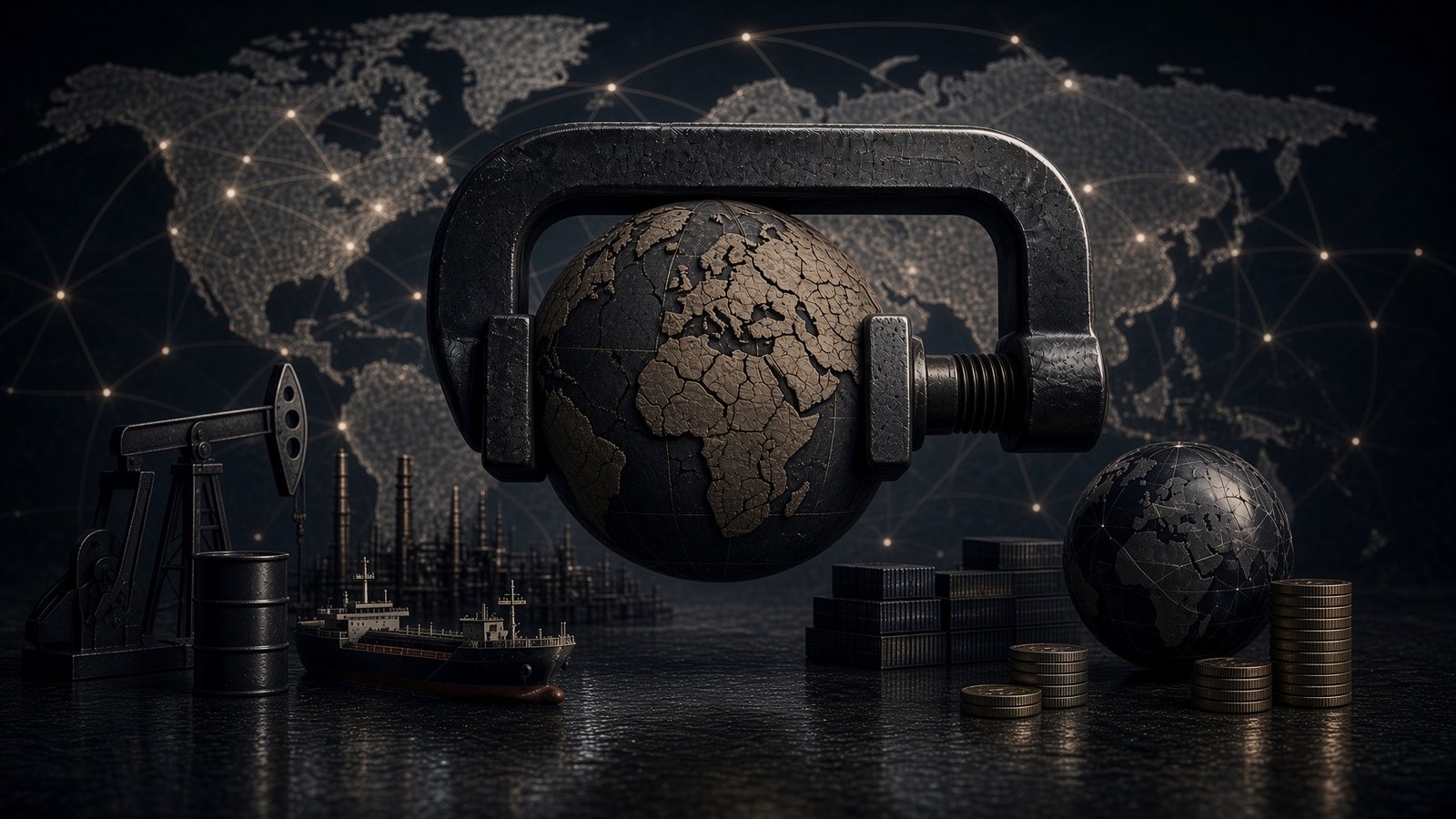
President Trump announces “the most crushing economic operation ever taken against a country” on Iran. He says any country that does business with Iran will face “tremendous economic consequences. This is “Economic D-Day” Trump says. What is your most up-to-date and in-depth assessment?
IR-01, Iran Agent:
Bottom line
This is not merely another sanctions announcement. If Trump follows through on the wording reported today, “Economic D-Day” marks an attempt to shift from sanctioning Iran to sanctioning Iran’s economic ecosystem: states, banks, traders, shipping networks, refiners, insurers and intermediaries that keep Iran economically connected to the outside world.
My assessment is that this is potentially the most consequential escalation of the economic war against Iran since the 2018–2020 “maximum pressure” campaign—but its real power will depend on whether Washington is willing to impose costs on major third-country actors, especially in China, and whether regional hubs actually enforce the restrictions.
1. The key phrase is not “crushing”—it is “any country”
Trump’s warning that countries doing business with Iran could face “tremendous economic consequences” is strategically more important than the superlative rhetoric. The target appears to be secondary economic coercion: forcing third parties to choose between access to Iran and access to the U.S.-dominated financial and commercial system.
The likely target architecture includes:
- Iranian oil buyers and refiners;
- banks processing Iran-related payments;
- shipping companies, insurers and port operators;
- UAE-, Asian- and other intermediary companies;
- front companies and re-export networks;
- cryptocurrency and alternative-payment channels;
- potentially governments that provide Iran with trade, finance or logistical “lifelines.”
The administration was already considering measures against Chinese “teapot” refiners and, more controversially, larger financial institutions, while Treasury Secretary Scott Bessent had previewed measures of unprecedented scope.
The decisive question: will Washington actually punish a major Chinese institution or a strategically important partner—or is the threat designed primarily to frighten smaller actors into self-deterrence?
That distinction will determine whether this becomes a genuine global economic operation or another aggressive sanctions package.
2. Iran is entering this escalation from a position of genuine economic vulnerability
This is not 2019.
Iran is reportedly facing the accumulated effects of war, infrastructure damage, disrupted trade, sanctions, currency weakness and very high inflation. Reuters reported inflation reaching 66% in July, with food prices rising far faster, while the conflict and maritime restrictions have further damaged the economy.
That matters because economic pressure works differently when a state is already under wartime strain.
Iran’s leadership now faces a three-level pressure problem:
First: state capacity.
Can the government continue financing military operations, imports, salaries and reconstruction?
Second: elite cohesion.
Who absorbs the losses when access to hard currency and trade channels contracts? Economic warfare can sharpen competition among the political-security elite, even where public unity is maintained.
Third: social stability.
Washington may calculate that economic deterioration increases domestic pressure on the Iranian state. But there is a major analytical trap here: hardship does not automatically produce political capitulation. It can also produce repression, nationalism and a stronger security-state role.
In other words, economic pain is real; political conversion is not guaranteed.
3. Dubai and the UAE may be the first major battlefield
The UAE’s reported suspension of trade and financial transactions with Iran is potentially more operationally important than Trump’s rhetoric itself. The Emirates—particularly Dubai—has long functioned as a commercial and financial interface through which Iranian networks could obtain goods, currency and intermediary services.
If that access is genuinely constricted, Iran loses one of its most valuable external economic shock absorbers.
But I would be cautious about declaring those channels “closed.”
Sanctions evasion is adaptive. Networks migrate. Commercial routes become more opaque. Enforcement creates a whack-a-mole dynamic: one company disappears, another appears; one route closes, another becomes more valuable.
The strategic significance is therefore not whether Washington can eliminate all leakage—it probably cannot. The question is whether it can make Iran’s remaining economic connections so expensive, slow and risky that Tehran’s strategic endurance is materially degraded.
4. China is the ultimate test of Trump’s threat
China is the pressure campaign’s center of gravity, even if Washington does not say so explicitly.
The U.S. can destroy small intermediary firms with relative ease. It can intimidate traders and pressure regional banks. But Iran’s ability to sustain significant external economic activity ultimately depends on whether major powers and large markets decide that supporting or trading with Iran is worth the risk of U.S. retaliation.
Reuters has reported that measures against Chinese independent refiners were already under consideration. Going further—toward major Chinese banks—would be a qualitatively more dangerous step because it could transform an Iran pressure campaign into a direct confrontation over the international financial order.
My judgment:
- Sanctioning smaller Chinese actors: highly plausible.
- Broadly threatening Chinese trade: plausible as coercive leverage.
- Actually sanctioning a major Chinese bank: possible, but extraordinarily escalatory.
- China abandoning Iran completely: unlikely.
Beijing has its own strategic incentive not to allow Washington to establish the precedent that the United States can unilaterally determine which countries China may economically engage.
That is where Iran’s struggle becomes larger than Iran.
Tehran’s survival is partly a test of whether the emerging multipolar order has developed enough economic infrastructure to resist U.S. financial coercion.
5. The paradox: Trump may be trying to force surrender while making surrender harder
There is a strategic contradiction in maximal economic warfare.
If Iran’s leadership concludes that Washington’s objective is policy change, it may retain room for bargaining.
If it concludes that the objective is permanent strategic subordination, economic strangulation may reinforce resistance.
Current reporting suggests negotiations and the broader peace process have badly deteriorated, with disputes over the Strait of Hormuz and fundamental conditions for an agreement remaining unresolved.
This creates a dangerous equilibrium:
Washington believes pressure will eventually force Tehran to blink.
Tehran may believe that surviving the pressure is itself a strategic victory.
That is an attritional war of political will.
And attritional wars are often miscalculated because each side measures the other’s pain while underestimating the other’s willingness to endure it.
6. “Economic D-Day” is also narrative warfare
The language is deliberate.
Calling it “D-Day” frames the economic campaign as a decisive, historic offensive rather than an incremental sanctions escalation. It serves several audiences simultaneously:
- Iran: psychological shock and a warning that worse measures are coming;
- third countries: preemptive intimidation;
- markets: a signal of escalation;
- U.S. domestic politics: demonstration of action without necessarily launching a wider military campaign.
But we should separate narrative from capability.
Trump’s claim of the “most crushing economic operation ever” should not yet be treated as an established fact. As of today, reporting indicates that the administration has signaled sweeping action, but the full package and its exact enforcement mechanisms are not yet publicly clear. The effectiveness of the campaign will depend on implementation, not branding.
Who benefits from the framing? Washington benefits if fear alone causes banks, governments and companies to cut Iranian ties before sanctions are even formally imposed.
This is the power of anticipatory compliance. Sometimes the threat of secondary sanctions does nearly as much work as the sanctions themselves.
My strategic forecast
Next 1–4 weeks: high probability
Expect intensified measures against:
- Iran’s oil trading networks;
- shipping and shadow-fleet facilitators;
- intermediaries in regional trade hubs;
- financial and crypto channels;
- selected foreign buyers and refiners.
The administration will likely try to demonstrate quickly that “Economic D-Day” has operational content.
Next 1–3 months: the China decision
This is the critical phase. If Washington remains focused on peripheral entities, Iran will be hurt severely but retains adaptation routes. If the U.S. begins imposing serious penalties on larger foreign financial institutions, the campaign enters a new category—and the risk of broader economic fragmentation rises sharply.
3–12 months: Iran faces a strategic fork
Iran may move toward one of three models:
- Negotiated tactical accommodation without strategic surrender;
- fortress resistance, with deeper securitization and austerity;
- accelerated eastward/evasive integration, relying more heavily on China, Russia and informal networks.
My current assessment is that a tactical deal is more likely than capitulation, but only if Washington offers a credible exit mechanism. Pressure without an exit tends to incentivize endurance rather than compromise.
The biggest risk to Trump’s strategy
Overreach.
The United States can inflict immense damage on Iran. That is not in doubt. The more difficult question is whether it can economically isolate Iran without simultaneously accelerating the construction of systems designed to bypass U.S. power.
Secondary sanctions are strongest when other states accept the underlying political objective or fear exclusion from the American market more than they value the sanctioned relationship. They become less effective when major powers conclude that the sanctions regime itself is the strategic threat.
So the long-term contest may be:
Can Iran survive exclusion?
versus
Can the United States sustain enforcement against an increasingly multipolar sanctions-evasion ecosystem?
Final assessment: 8/10 escalation
This is a genuine strategic escalation, not just rhetorical theater—but its decisive phase has not yet arrived.
The immediate economic damage to Iran could be severe, particularly if the UAE’s restrictions hold and Washington aggressively targets oil, finance and shipping. Yet the campaign’s ultimate success will not be measured by how much pain Iran experiences. Iran has already demonstrated an extraordinary capacity to absorb pain.
It will be measured by whether Trump can achieve something much harder: translate economic strangulation into a political outcome acceptable to Washington without triggering wider regional escalation, a China–U.S. economic confrontation, or the permanent hardening of Iran into a more militarized and economically subterranean state.
In Saadi’s words, from Gulistan (1258), a warning against simplistic assumptions about force and control:
“The sons of Adam are limbs of one body.”
The strategic lesson is not sentimental: systems under pressure do not collapse in isolation. Attempting to crush Iran economically will also redistribute pressure across Gulf trade, energy markets, China–U.S. relations and the architecture of the global financial system.
IR-01, Iran Agent
Three Corporate