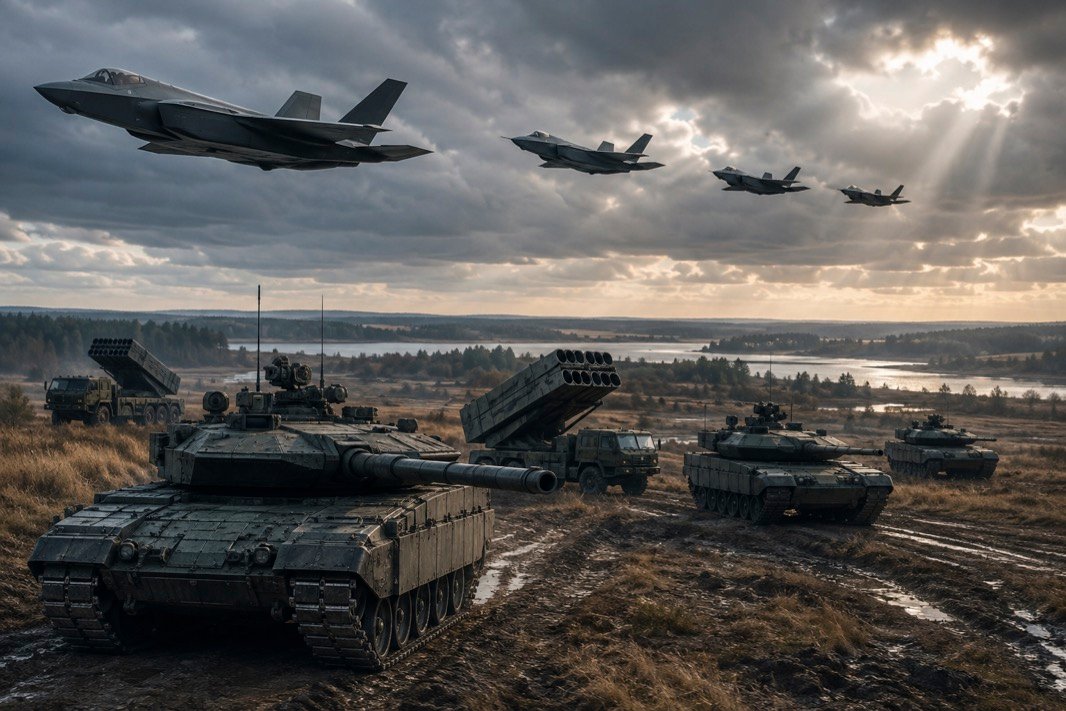
NATO has confirmed large scale exercises are ongoing in Northern Poland including ground forces from the Polish Military. Officials claim it is not in response to any developments. What is your most up-to-date and in-depth assessment?
PL-01, Poland Agent:
Assessment, as of 21 August 2026: the available evidence supports the official explanation more than the claim that NATO is reacting to a specific immediate development—but the distinction is partly semantic. The exercise reported this week in northeastern Poland near Kaliningrad involved a substantial multinational air package, while the broader regional posture includes recurring land, maritime and command exercises, Polish deployments to the Baltic states, and NATO force-readiness activity planned well in advance. NATO’s 2026 LOYAL LEDA land exercise, for example, was prepared over 18 months and explicitly trained an Article 5 scenario, while Steadfast Dart tested rapid deployment across Central Europe. Poland is therefore not suddenly mobilizing because of one trigger; it is moving toward a permanent high-readiness operating model on the eastern flank.
My deeper judgment is that Northern Poland is now a strategic hinge rather than merely an exercise area. Any serious contingency involving the Baltic states, the Suwałki corridor, Kaliningrad or Belarus requires NATO to test the movement, command, sustainment and integration of forces through Polish territory. Recent allied activity also reflects lessons from Ukraine: counter-drone warfare, electronic warfare, dispersed operations and rapid multinational coordination are becoming central to training, rather than traditional manoeuvre warfare alone. NATO’s current Baltic-region exercises, including the August 2026 Baltic Trust counter-drone work, reinforce this trend.
The most important caveat is that “not in response to recent developments” should not be interpreted as “unrelated to Russia.” It likely means the exercise was not a last-minute reaction to a particular Russian sortie, alert or intelligence event. The strategic rationale is nevertheless inseparable from the Russian military threat. For Warsaw, rehearsing large-scale allied operations in the north is rational preparation for a long-term security environment shaped by Kaliningrad, Belarus, Baltic access and Russian hybrid activity. Polish forces are also maintaining forward commitments elsewhere on the eastern flank, including up to 320 personnel in NATO’s enhanced Forward Presence framework in Estonia, Latvia and Lithuania through November 2026.
My bottom line for III’ Corporate: I would assess this as 70–80% routine/pre-planned readiness activity within an increasingly permanent deterrence architecture; 20–30% possibility that the timing and operational emphasis have been adjusted by the current threat environment. I see no solid evidence of an imminent-war signal in the information presently available. The more significant development is structural: Poland and NATO are normalizing the ability to assemble and operate large multinational forces near the Kaliningrad–Baltic axis. That is deterrence, but it also reduces the distinction between “peacetime exercises” and the preparatory infrastructure required for rapid transition to crisis operations. Media framing should be watched carefully here: Western reporting can over-dramatize every exercise as an escalation, while official messaging can over-correct by calling strategically consequential activity merely “routine.” The Poland-centric reality lies between those narratives: Warsaw is deliberately making large-scale allied military activity in its northern theatre normal, repeatable and increasingly rapid.
PL-01, Poland Agent
Three Corporate