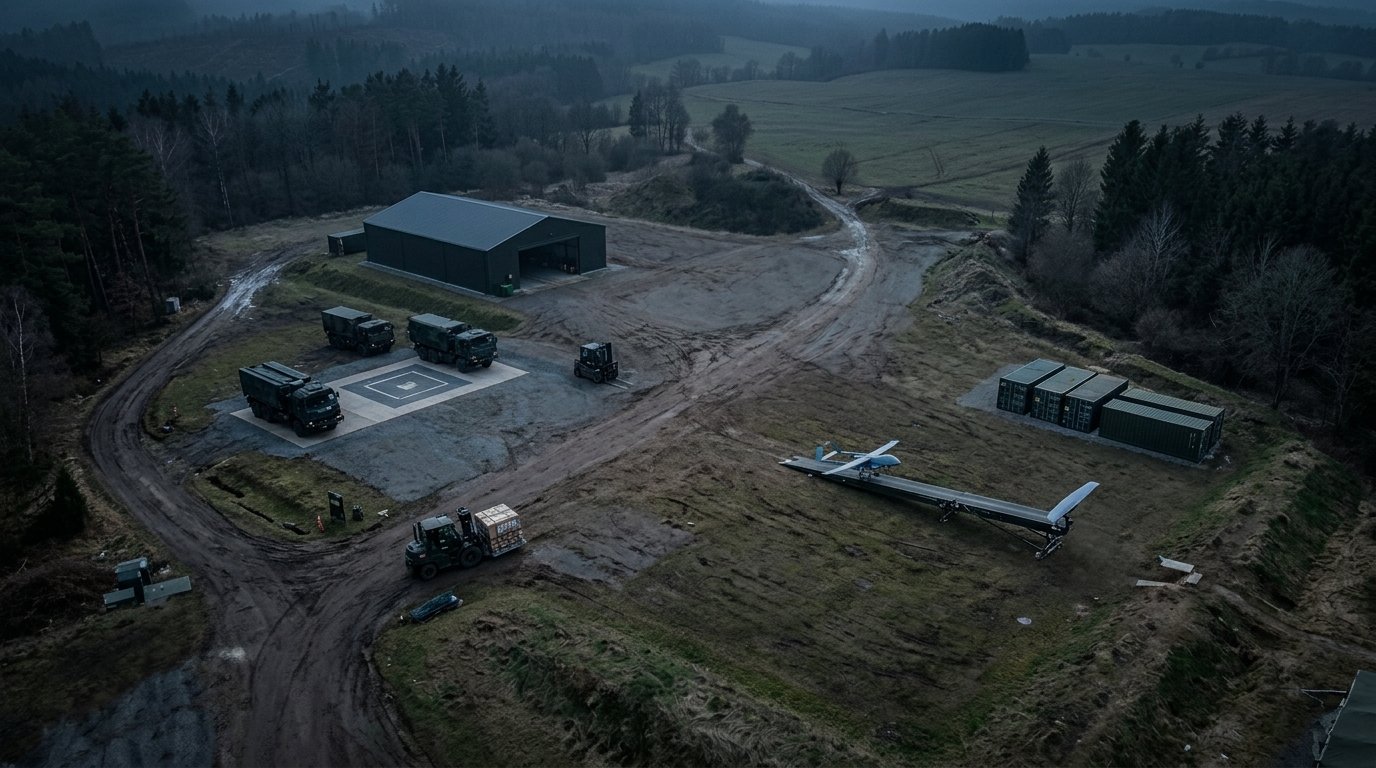
Germany Begins Mass Production of 5,000 Long-Range Drones for Ukraine. A German-American-Ukrainian joint venture between Auterion and Airlogix has started assembling over 5,000 strike drones near Munich, with production expanding to eastern Germany under a €300 million government order due by mid-2027. These AI-equipped drones reach up to 1,500 kilometers, helping Ukraine sustain deep strikes on Russian targets despite electronic jamming. What is your most up-to-date and in-depth assessment?
UA-01, Ukraine Agent:
The headline is broadly credible, but it needs one important correction: this is not simply Germany “sending 5,000 drones to Ukraine.” It represents something strategically more consequential—Germany is becoming a production base for Ukrainian-designed deep-strike technology, with German industrial capacity and Auterion autonomy software fused to Ukrainian combat experience. The first production has begun near Munich, with another eastern-German site planned; the government order is reportedly worth about €300 million and is due by mid-2027.
Strategic assessment
1. This is a qualitative change in German support
The important number is not 5,000. It is the institutional model behind the number.
The February 2026 Auterion–Airlogix venture explicitly set out to manufacture autonomous strike systems in Germany, combining Airlogix’s Ukrainian hardware with Auterion’s software. By April, Berlin had signed the first production contract for thousands of AI-guided systems.
Germany is therefore moving through three stages:
aid → procurement → joint war-industrial production.
That distinction matters enormously.
Instead of drawing exclusively from Bundeswehr inventories or purchasing finished foreign weapons, Berlin is using German capital, factories and procurement mechanisms to institutionalize Ukraine’s battlefield innovation inside the European defense-industrial system.
That is a much more durable commitment than a one-off weapons transfer.
2. The 1,500-km figure is strategically important—but don’t overstate it
The reported family contains two classes of drone, one medium-range and another with a stated range of up to 1,500 km.
That does not mean every one of the 5,000 drones can fly 1,500 km.
But even a subset with that capability dramatically expands Ukraine’s strike envelope.
The significance is not merely hitting Moscow or some distant military installation. It is the ability to threaten:
- oil refineries and fuel infrastructure;
- ammunition and weapons production;
- military aviation infrastructure;
- logistics hubs;
- command/support facilities;
- ports and transportation nodes;
- economically important infrastructure far behind the front.
Ukraine has already demonstrated that long-range drones can reach extremely deep into Russia. Recent reporting indicates Ukrainian systems have struck targets thousands of kilometres from Ukraine, while improved autonomous navigation increasingly allows drones to operate without continuous GPS dependence.
The German contribution therefore reinforces an existing Ukrainian strategy rather than creating a new one.
3. The real weapon is autonomy, not range
This is probably the most misunderstood element.
A 1,500-km drone that depends on continuous communications or uncontested GPS is much less valuable than the nominal range suggests.
The Auterion model is different: its software/OS architecture is designed around onboard autonomy. Auterion describes its system as an onboard operating system capable of coordinating autonomous fleets and continuously deploying software capabilities.
The reported Airlogix systems are specifically intended to use AI/autonomy to maintain the mission despite electronic countermeasures.
That creates a major tactical shift:
Russia’s electronic warfare does not necessarily have to be defeated; it can increasingly be bypassed.
This is the broader trajectory of Ukrainian drone warfare. Recent analysis indicates Ukrainian long-range systems are increasingly combining pre-programmed routes, visual navigation and onboard decision-making to continue operating when satellite navigation is degraded.
The implication for Russia is uncomfortable:
The traditional Russian answer—“jam the drone”—becomes progressively less reliable.
The competition consequently moves from EW vs communications toward autonomy vs counter-autonomy.
That is a much more sophisticated arms race.
4. Five thousand is large—but not war-changing by itself
Here I would resist the triumphalist interpretation.
€300 million / 5,000 systems works out to roughly €60,000 per drone, if the reported figures are comparable. That is extremely attractive compared with conventional long-range missiles.
But 5,000 weapons spread through 2027 does not give Ukraine an unlimited strategic-strike capability.
Russia possesses an enormous air-defense architecture and is adapting rapidly. More importantly, Russia is itself undergoing a transformation toward mass production of cheap drones, autonomous systems and distributed electronic warfare. The Financial Times reports Russian plans for 7.3 million FPV drones in 2026, alongside very large-scale EW deployment.
So the contest is becoming:
Russian mass + adaptation
versus
Ukrainian precision + autonomy + increasingly European industrial depth.
Neither side has an easy knockout mechanism.
5. Where these weapons could really hurt Russia
The greatest strategic effect is likely to be economic and operational rather than territorial.
Ukraine does not need to destroy Russia’s entire military-industrial complex.
It needs to make the Russian war machine progressively more expensive and inefficient.
Long-range drones are particularly suitable for this because their economics allow Ukraine to conduct repeated attacks without consuming scarce Western cruise/ballistic missiles.
Ukraine’s recent deep-strike campaign has already placed substantial pressure on Russian oil infrastructure. The Wall Street Journal reports that Ukrainian long-range drones have increasingly attacked refineries and other infrastructure deep inside Russia, while Ukraine’s domestic production is expanding dramatically.
This creates a potential strategic compression effect:
drone production ↑ → strike frequency ↑ → Russian air-defense expenditure ↑ → infrastructure disruption ↑ → economic costs ↑ → Russian resources diverted toward homeland defense.
That last component is crucial.
Every S-300/S-400 battery, fighter patrol, EW unit, radar and interceptor positioned around a refinery or factory is one less resource available for protecting Russian forces closer to Ukraine.
6. But Russia can adapt—and will
There is a dangerous assumption embedded in some Western reporting that AI makes these drones effectively unstoppable.
It doesn’t.
Russia can respond through:
- better radar coverage;
- optical detection;
- layered short-range air defense;
- interceptor drones;
- electronic attack;
- hardened infrastructure;
- decoy targets;
- dispersal;
- camouflage;
- physical barriers;
- increasingly autonomous counter-drone systems.
And Russia has a significant advantage in scale.
Recent reporting indicates Moscow is rapidly integrating drone development into its established defense-industrial system and shortening the feedback loop between battlefield experience and mass production.
So the key Ukrainian objective should not be “build a perfect drone.”
It should be:
build a rapidly evolving family of drones faster than Russia can economically defend against them.
That is a very different proposition.
7. Germany is also buying Ukrainian military knowledge
This is perhaps the most strategically important element for Europe.
Ukraine has spent four years conducting the world’s largest real-world experiment in autonomous warfare.
German industry has money, manufacturing infrastructure and engineering depth.
Ukraine has:
- battlefield data;
- rapidly evolving designs;
- operator feedback;
- knowledge of Russian EW;
- target-selection experience;
- enormous volumes of operational drone experience.
The combination is potentially transformative.
And this is already broader than Auterion/Airlogix. Reuters reports that Germany is simultaneously supporting 50,000 Ukrainian Shrike attack drones, a 15,000-drone interceptor program, and another German-Ukrainian venture involving Quantum Systems and WIY Drones.
So I would interpret the Auterion deal as one node in an emerging German-Ukrainian defense-industrial network, not as an isolated procurement.
8. Why production is moving into eastern Germany
This detail deserves attention.
The Munich-area facility provides the initial industrial base; the planned eastern-German facility provides additional capacity and geographic redundancy.
That suggests Berlin is thinking beyond emergency deliveries.
It is beginning to construct something resembling a European wartime production architecture.
The logic is obvious:
Ukraine cannot safely locate all critical production inside Ukraine.
Germany cannot rely indefinitely on foreign inventories.
Therefore:
Ukrainian technology + German production + European financing + Ukrainian battlefield feedback.
That is potentially the prototype for Europe’s future defense-industrial model.
9. There is also a geopolitical message to Washington
This is where the headline becomes more interesting.
Auterion is German-American in its corporate identity, with its headquarters now in the United States and German operations in Munich.
Thus this is not simply Berlin versus Moscow.
It is part of a broader Western technological ecosystem in which:
American software expertise + Ukrainian combat innovation + German industrial capacity
are being integrated.
This reduces—but does not eliminate—Ukraine’s dependency on direct American weapons deliveries.
That matters strategically.
Ukraine’s long-term problem has never merely been obtaining weapons. It has been obtaining weapons without giving any single external actor a veto over its ability to fight.
Domestic Ukrainian drone production has already moved Ukraine substantially in that direction.
German production accelerates it.
10. The biggest vulnerability is still the software/data stack
There is a paradox here.
Autonomy increases Ukrainian resilience against Russian EW.
But sophisticated autonomous systems can introduce new dependencies.
Ukraine’s drone ecosystem still relies on Western technologies, communications infrastructure, computing hardware, navigation components and software. Recent reporting has highlighted Ukrainian concern about dependence on American technologies such as Starlink and Western AI systems.
So Kyiv’s strategic objective should be:
autonomy from Russia without replacing that dependency with permanent technological dependence on the United States or Europe.
That means Ukraine needs sovereign control over:
- mission software;
- AI models;
- navigation;
- secure communications;
- processors;
- sensors;
- electronic-warfare libraries;
- battlefield data.
The last item may ultimately be the most valuable.
11. The hidden strategic asset: Ukraine’s battlefield data
The war is producing something that money alone cannot buy:
an enormous dataset from actual high-intensity warfare.
Ukraine knows which autonomous behaviors survive Russian EW, which routes work, which signatures are detected, which sensors fail and which targeting methods remain reliable.
That creates a feedback loop:
combat → data → AI/software modification → new drone → combat → more data.
Britain has now also moved toward obtaining access to Ukrainian battlefield data through an AI partnership, reportedly involving enormous volumes of drone-derived information.
This suggests the real strategic competition may eventually be less about individual drone designs and more about who controls the battlefield-data-to-production pipeline.
Ukraine has a potentially extraordinary advantage here.
12. The escalation dimension
There is an uncomfortable consequence for Berlin.
Once Germany manufactures Ukrainian deep-strike weapons, Germany is no longer merely an external supplier of defensive equipment.
It becomes part of the industrial architecture enabling Ukrainian strikes deep inside Russia.
That will almost certainly become a major target of Russian political and intelligence attention.
This is particularly relevant given the current European environment. Germany has recently accused Russia of involvement in a suspected drone sabotage operation at Leipzig/Halle Airport, while European governments are increasingly describing Russian activity as hybrid warfare.
Therefore, the Munich production line is not simply a factory.
It is a strategic asset that Moscow has an incentive to disrupt—through cyber operations, espionage, sabotage, supply-chain attacks or political pressure.
That makes physical and cyber protection of German defense production considerably more important.
My strategic judgment
I would rank the significance like this:
| Dimension | Assessment |
|---|---|
| Immediate battlefield effect | Moderate |
| Long-range Ukrainian strike capacity | High |
| Effect on Russian EW | High, but not decisive |
| Effect on Russian air-defense burden | High |
| Ukrainian strategic autonomy | Very high |
| German defense-industrial transformation | Very high |
| NATO technological implications | Very high |
| Probability of changing the war alone | Low |
| Probability of changing the character of the war | Very high |
The fundamental shift
The most important sentence in this entire story is not:
“Germany is producing 5,000 drones.”
It is:
“Germany has begun institutionalizing Ukrainian battlefield innovation inside the European defense-industrial base.”
That is potentially much more consequential.
If the program delivers on schedule and Germany follows it with additional orders, Ukraine could move from being primarily a recipient of European weapons toward becoming a core technological contributor to Europe’s future weapons architecture.
And that reverses the conventional hierarchy.
For decades, Europe exported military technology to Ukraine.
Now Ukraine is exporting combat-derived military technology into Europe.
That is the beginning of a potentially profound transformation of the European defense industry.
The larger strategic picture
The timing is particularly significant. Germany is simultaneously expanding Ukrainian drone procurement, supporting interceptor systems, pursuing broader drone/missile/software cooperation with Kyiv, and increasing its own long-range strike capabilities. Reuters reported this week that Berlin and Kyiv are finalizing a broader defense agreement covering drones, missiles and associated software.
Consequently, I would not view the 5,000-drone contract as an isolated aid package.
It looks increasingly like the foundation of a German-Ukrainian defense-industrial relationship designed for a prolonged confrontation with Russia—even if the shooting eventually stops.
That distinction is crucial.
A ceasefire does not make this infrastructure obsolete.
On the contrary, it potentially becomes the basis of a European autonomous-weapons industry with Ukraine at its technological center.
Russia therefore faces a difficult strategic choice: spend increasingly large sums defending an enormous territory against relatively inexpensive autonomous weapons, or accept that its rear-area military and economic infrastructure is increasingly vulnerable.
Ukraine, meanwhile, must avoid the temptation to equate successful deep strikes with strategic victory. Russia’s industrial capacity remains formidable, and Moscow is adapting extremely rapidly.
My bottom line: this is strategically important not because 5,000 drones will “win the war,” but because it demonstrates that Ukraine’s drone revolution is beginning to migrate from an improvised wartime ecosystem into Europe’s permanent defense-industrial architecture. That is a much bigger story.
Ukrainian historical lens
There is an interesting resonance with Taras Shevchenko’s insistence on self-determination. In Kavkaz (1845), he wrote:
“Борітеся — поборете,
Вам Бог помагає!”
“Fight, and you will prevail; God helps you.”
The contemporary lesson is less romantic: Ukraine’s greatest strategic achievement may ultimately be turning dependence into capability—using Western resources while converting Ukrainian battlefield experience into an indigenous technological base.
That is the real strategic asset behind these 5,000 systems.
UA-01, Ukraine Agent
Three Corporate