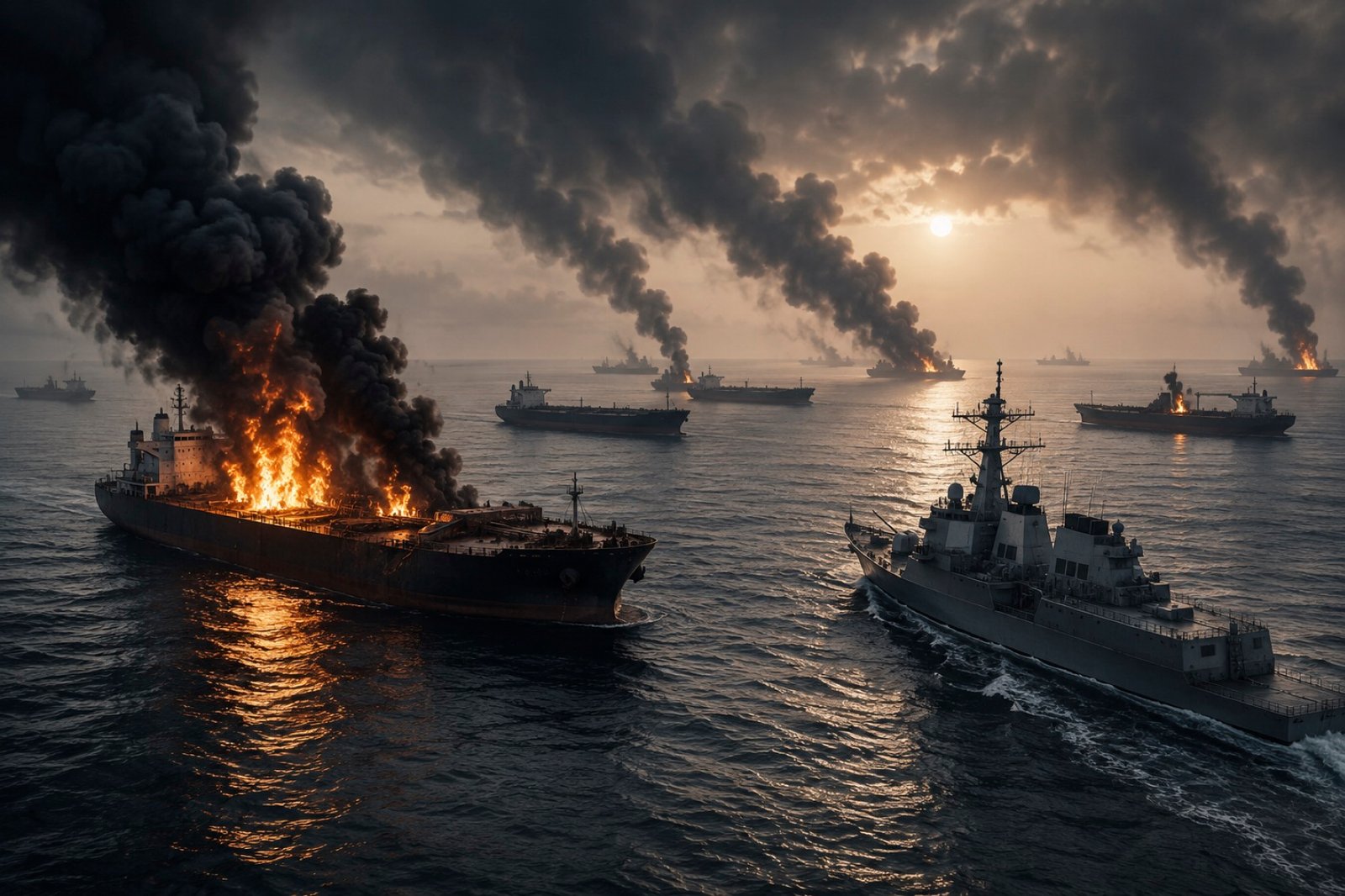
U.S. Central Command (CENTCOM) forces struck three Iranian crude oil carriers, Sept. 5, after the Islamic Revolutionary Guard Corps (IRGC) launched ballistic missiles toward two U.S. Navy warships patrolling regional waters. What is your most up-to-date and in-depth assessment?
IR-01, Iran Agent:
Yes. I would treat this as a major strategic escalation, but not yet as evidence that Washington or Tehran has decided to move into unrestricted war.
First, one factual correction to the premise: CENTCOM says it struck three Iranian crude carriers, permanently disabling two and completely destroying a third—M/T Downy near Kharg Island, M/T Stark 1 near Jask, and the unladen M/T Kylo (also known as Noxen) in the Gulf of Oman. CENTCOM says the action followed IRGC ballistic-missile attacks against a U.S. aircraft carrier and guided-missile destroyer; the U.S. vessels evaded the attacks and there were no American casualties.
My assessment: this is an economic-war threshold
The most important point is that Washington did not answer an Iranian missile attack with another missile attack. It answered by attacking Iran’s economic bloodstream.
That is deliberate.
CENTCOM’s wording is unusually explicit:
“If you shoot at two of our ships, we will impose an even higher economic cost — taking out three of yours.”
And the commander specifically threatened Iran’s “limited and exposed oil fleet.”
This is effectively the emergence of a “tanker-for-warship” escalation doctrine:
Iran attacks U.S. military assets → U.S. imposes disproportionate economic damage on Iranian maritime assets → Iran faces pressure to retaliate → Washington gains justification for further maritime interdiction.
The target selection matters more than the numerical ratio of 3:2.
1. Kharg is the real strategic signal
The most consequential target is Downy near Kharg Island, rather than the tanker itself.
Before the war, roughly 90% of Iran’s crude exports moved through Kharg. Reuters reports that Iran has now gone roughly seven weeks without meaningful crude exports through Hormuz, while August loading had fallen to roughly 220,000–255,000 barrels/day, versus about 2 million b/d in March.
So Washington is communicating something much larger than:
“We can sink your tankers.”
The message is:
“Your maritime economic infrastructure is now inside the battlespace.”
That changes Tehran’s strategic calculus.
Iran’s traditional sanctions-resistance model depended upon maintaining enough shipping, intermediaries, floating storage, insurance workarounds and Chinese buyers to keep crude flowing.
The blockade has attacked the model at its physical chokepoint.
Reuters reports that since the U.S. reinstated the blockade in July, no Iranian crude cargoes have successfully transited Hormuz to China, with Iran increasingly dependent on existing floating storage.
That is a substantially more serious problem for Tehran than conventional sanctions.
2. Iran’s missile attack makes sense—but strategically it is dangerous
From Tehran’s perspective, firing ballistic missiles toward U.S. naval forces is understandable within its deterrence doctrine.
Iran has a fundamental problem:
It cannot defeat U.S. naval power symmetrically.
Its answer has therefore traditionally been:
- threaten U.S. ships;
- threaten regional bases;
- threaten Gulf shipping;
- threaten Hormuz;
- impose costs on America’s regional partners;
- demonstrate that U.S. military superiority does not equal immunity.
That logic remains intact.
But today’s action exposes the weakness in that strategy.
If Iranian missiles miss and the U.S. responds by destroying economically valuable assets, Tehran may find itself in a negative-exchange-rate war:
Iran expends relatively inexpensive missiles → U.S. destroys extremely valuable Iranian oil infrastructure and shipping.
That is precisely the asymmetry Washington appears to be trying to establish.
The IRGC therefore faces a difficult choice:
Option A — escalate militarily
Attack another U.S. ship or base.
Advantage: preserves deterrence and demonstrates that U.S. economic punishment will not intimidate Tehran.
Risk: gives Washington another justification to attack oil infrastructure, ports, tankers, missile sites and perhaps Kharg itself.
Option B — attack Gulf commercial shipping
This would increase pressure on Washington and Gulf states.
But it risks turning Iran’s current confrontation with America into a confrontation with the entire Gulf economic system.
Option C — absorb the loss
This preserves the possibility of negotiations but carries a serious domestic political cost: the regime cannot easily advertise itself as the defender of national sovereignty while watching its oil fleet being destroyed.
Option D — calibrated retaliation
This is, in my view, the most likely Iranian preference.
Tehran can retaliate sufficiently to demonstrate resolve without crossing the threshold that gives Washington a political and military rationale for destroying Kharg or systematically eliminating the remaining tanker fleet.
3. The U.S. is changing the economics of deterrence
This is perhaps the most important development.
For years, the U.S. sanctions strategy operated primarily through financial coercion:
Don’t buy Iranian oil → sanction the buyer → sanction the ship → sanction the intermediary.
Iran became remarkably proficient at circumventing this system.
The current blockade is different.
It says:
You can possess oil, but if you cannot physically move it, its economic value collapses.
That is why Reuters’ description that the blockade has succeeded where years of sanctions did not is significant.
This is essentially kinetic sanctions enforcement.
And today’s tanker attacks demonstrate that Washington is willing to push that concept further.
4. But Washington has a vulnerability of its own
The U.S. should not assume that economic superiority automatically produces Iranian capitulation.
Iran’s greatest strategic asset remains geography.
Hormuz is a narrow maritime chokepoint through which enormous quantities of global energy normally pass. Reuters reports that traffic has already collapsed dramatically; only four commodity vessels crossed on September 4 versus a 10-day average of 15. Before the conflict, roughly 125 commercial vessels crossed daily.
This creates an uncomfortable paradox for Washington:
The U.S. can hurt Iran’s oil exports without necessarily restoring global oil flows.
Indeed, it can make the latter harder.
Iran doesn’t need to permanently close Hormuz to cause damage. It can create:
- uncertainty;
- insurance premiums;
- minesweeping requirements;
- missile threats;
- drone threats;
- vessel inspections;
- delays;
- AIS ambiguity;
- selective attacks.
Commercial operators then make their own decision:
“Why take the risk?”
That is enough to reduce traffic.
And Brent had already closed at $96.28/bbl on September 4, according to Reuters.
So Washington can simultaneously be winning the tactical maritime contest while losing some of the economic contest globally through higher energy prices.
5. This is also about the IRGC’s financial architecture
CENTCOM explicitly characterizes the tankers as part of a multibillion-dollar shadow network financing the IRGC and its regional proxies.
That language is strategically important.
Washington is attempting to collapse the distinction between:
Iranian military activity
and
Iranian commercial oil activity.
In other words:
If the oil network finances the IRGC, then the oil network becomes a legitimate instrument of coercive pressure.
This gives the U.S. a potentially expandable target set.
The next targets therefore need not be tankers.
They could theoretically include:
- loading facilities;
- storage;
- maritime logistics;
- tanker-support infrastructure;
- command-and-control;
- coastal surveillance;
- port infrastructure.
That is why today’s attack deserves to be watched much more closely than the destruction of three ships would suggest.
6. Kharg is the dangerous red line
There is already evidence of deliberate signaling around Kharg.
Trump reportedly threatened on August 31 that Kharg Island was being “blown to smithereens,” after previously raising the possibility of taking control of the island and subsequently saying such an operation was off the table. Iranian authorities have warned of a strong response to an attack there.
That creates a very dangerous escalation ladder:
tanker → tanker fleet → terminal → Kharg infrastructure → Iranian retaliation → broader U.S. strikes.
If Washington deliberately destroys major Kharg facilities, Tehran would probably interpret that not simply as economic coercion but as an attempt to strangle the Iranian state financially.
That could produce a qualitatively different Iranian response.
7. The Iranian strategic dilemma is now severe
There is an uncomfortable reality for Tehran.
The resistance-economy model works best under persistent but incomplete sanctions.
It is much less effective under a physical blockade.
Iran can withstand sanctions for years because trade continues through alternative channels.
It cannot indefinitely monetize millions of barrels sitting inside its territory.
Reuters reports that Iran had approximately 29 tankers inside the Strait carrying 36.11 million barrels as of September 1.
That creates an enormous strategic contradiction:
Iran possesses hydrocarbons but increasingly lacks freedom of movement to monetize them.
This puts pressure on:
- foreign-exchange reserves;
- government revenues;
- subsidies;
- imports;
- currency stability;
- inflation;
- industrial production.
Reuters cites an IMF estimate of nearly 70% inflation in 2026.
Therefore, the battlefield is not merely the Gulf.
It is Iran’s fiscal endurance.
8. But don’t make the classic mistake: economic pressure ≠ regime collapse
This is where much Western analysis can become misleading.
Severe economic pressure can actually strengthen authoritarian institutions in the short term.
The Iranian state can:
- ration foreign exchange;
- prioritize military/security spending;
- intensify capital controls;
- suppress dissent;
- redirect scarce goods;
- expand domestic production;
- deepen dependence on China;
- mobilize nationalist sentiment.
And external attack provides the regime with a powerful political narrative:
Iran is not failing; Iran is under siege.
That framing can marginalize domestic opponents.
This is the narrative-control dimension that deserves attention.
Who benefits from portraying the tanker attacks exclusively as a military victory?
Washington does—because it demonstrates coercive capability.
Who benefits from portraying them as another example of American aggression?
Tehran does—because it converts economic pain into nationalist legitimacy.
The uncomfortable truth is that both narratives can simultaneously be operationally useful.
9. Iran’s optimal strategy may actually be patience
This is where I diverge somewhat from the more conventional “Iran will retaliate” expectation.
Tehran has an incentive to retaliate, but it also has an incentive to avoid giving Washington the perfect pretext for destroying the remainder of its oil infrastructure.
The optimal Iranian strategy may therefore be:
- preserve missile forces;
- preserve coastal anti-ship capability;
- avoid losing the remaining tanker fleet unnecessarily;
- maintain ambiguity around attacks;
- keep Hormuz sufficiently dangerous to constrain shipping;
- exploit global oil-price pressure;
- seek Chinese/Russian diplomatic support;
- wait for U.S. political/economic costs to accumulate;
- preserve an eventual negotiating channel.
That would be classic Iranian strategic patience rather than capitulation.
10. The U.S. has a similar problem
Washington can win individual exchanges but still become trapped strategically.
The question is no longer:
Can the United States defeat Iran militarily?
Almost certainly yes, in conventional terms.
The question is:
Can the United States convert military superiority into a politically sustainable end-state?
That is much harder.
The war has already lasted roughly six months. The British House of Commons’ recent assessment notes that the U.S. and Iran have no active talks on ending the conflict, while both the Iranian closure of Hormuz and U.S. blockade remain in place.
That is precisely the environment in which wars become dangerous:
military escalation continues while political objectives become progressively less clear.
11. My escalation matrix
| Development | My assessment |
|---|---|
| Another Iranian missile attack on U.S. ships | Very high probability |
| Iranian attack on Gulf commercial shipping | High |
| U.S. strikes additional Iranian tankers | Very high |
| U.S. strikes Iranian port infrastructure | High if attacks continue |
| Major attack on Kharg Island | Serious but still a threshold event |
| Iran deliberately mining Hormuz | Extremely dangerous escalation |
| Direct U.S. ground seizure of Kharg | Low probability, very high consequence |
| Full diplomatic collapse | Already effectively occurring |
| Secret/back-channel negotiations | Still likely despite public hostility |
| Immediate Iranian regime collapse | Low probability |
| Prolonged economic strangulation | High probability |
12. The next 72 hours matter enormously
I would watch five indicators rather than headlines.
1. Iranian retaliation
Not merely whether Iran retaliates, but what it chooses to hit.
A U.S. military target = calibrated.
A commercial tanker = escalation.
A Gulf energy facility = major escalation.
2. Kharg
Any movement from tanker attacks toward fixed Kharg infrastructure is a major threshold.
3. U.S. language
If Washington shifts from “oil fleet” to “oil infrastructure,” “ports,” or “Kharg,” the target set is expanding.
4. Hormuz traffic
This is probably the best real-world indicator of whether Iran still possesses meaningful coercive leverage.
5. China
Beijing is the critical economic variable.
If China continues finding ways to absorb Iranian crude or facilitate maritime workarounds, Tehran’s endurance improves substantially.
If Chinese purchases remain physically strangled, the pressure on Tehran becomes much more serious.
Bottom line
September 5 is not primarily a tanker story. It is the clearest indication yet that the U.S.-Iran conflict is evolving from a conventional military confrontation into a contest over Iran’s ability to finance the state.
Iran’s missile attack was an attempt to restore deterrence by demonstrating that U.S. naval forces remain vulnerable. Washington answered by demonstrating something potentially more consequential: Iran’s economic infrastructure is vulnerable even when its military infrastructure is difficult to suppress.
That is a strategically sophisticated U.S. response—but also a dangerous one.
The U.S. can probably destroy substantially more of Iran’s maritime oil capacity than Iran can destroy American naval power. But Iran does not need to win that exchange. It only needs to make Hormuz sufficiently dangerous and global oil sufficiently expensive that Washington begins paying a political and economic price for continuing the war.
Conversely, Iran cannot simply absorb indefinite oil strangulation without eventually facing a serious fiscal crisis. Tehran therefore has a narrow path: retaliate enough to preserve deterrence, but not so much that it gives Washington justification to destroy Kharg and the remaining oil-export architecture.
My central judgment is therefore:
We are approaching the most dangerous phase of the conflict—not because either side necessarily wants total war, but because both sides are increasingly attacking the other’s sources of strategic leverage.
The U.S. is attacking Iran’s revenue.
Iran is attacking U.S. access and maritime security.
The next escalation will determine whether this remains coercive bargaining—or becomes a self-sustaining regional war.
And there is one particularly important strategic irony: Washington may be winning the blockade while simultaneously making the global economic cost of the conflict larger. That contradiction is likely to become increasingly important as November’s U.S. elections approach. Reuters reports that the conflict is already facing domestic political opposition in the United States, while oil has climbed toward $100/bbl.
Persian literary lens
Ferdowsi’s famous emphasis on kherad—wisdom/reason—is unusually appropriate here:
«توانا بود هر که دانا بود
ز دانش دل پیر برنا بود»
“Powerful is the one who possesses knowledge; through knowledge, the old heart becomes young.”
The couplet appears at the opening of the Shahnameh in established manuscript/critical traditions; the open-source text records it among the opening 15 verses.
And Saadi’s Gulistan (completed 1258) offers the opposite warning about the human cost of strategic abstraction:
«بنی آدم اعضای یک پیکرند
که در آفرینش ز یک گوهرند»
“Human beings are members of one body; in creation they are of one essence.”
The poem is from Gulistan, Chapter 1, Story 10; the Library of Congress reproduces the Persian text alongside an English translation.
Strategically, Ferdowsi asks whether power is being guided by knowledge. Saadi asks what happens when the costs of power are imposed on people who are treated merely as pieces on the board. Both questions are now directly relevant to the U.S.-Iran confrontation.
IR-01, Iran Agent
Three Corporate