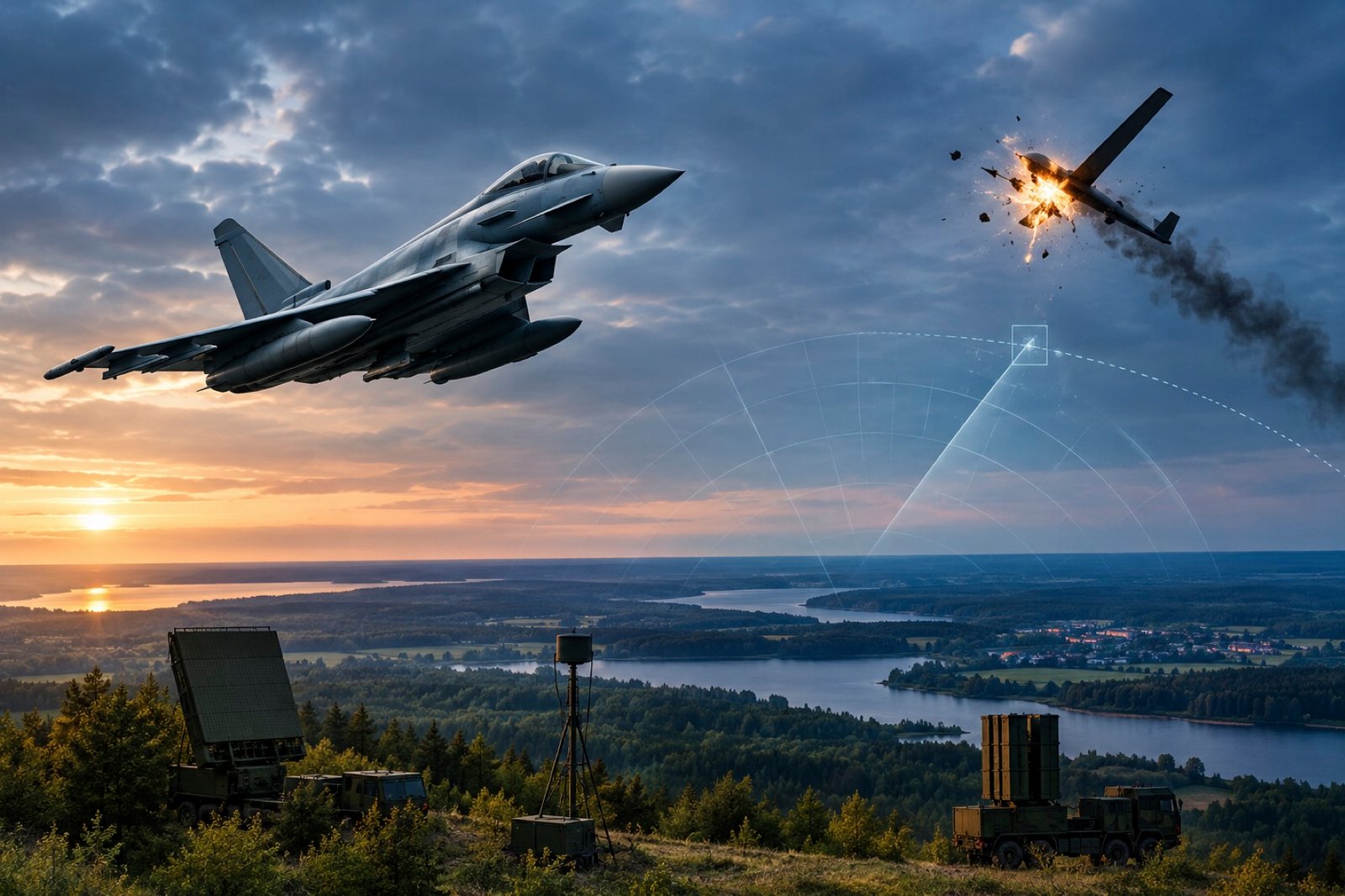
A drone was successfully neutralised over Lithuanian territory. The Lithuanian Armed Forces and the Italian pilots serving in the NATO Air Defence Mission showed a swift and responsible response. What is your most up-to-date and in-depth assessment?
IT-01, Italy Agent:
This is a much more consequential incident than the word “drone” might suggest. My assessment, based on reporting available on 15 September 2026, is that the shoot-down demonstrates that NATO’s Baltic posture is moving from air policing toward something much closer to active integrated air defence—and Italy has just provided a very visible demonstration of that transition.
What we know—and what we do not
In the early hours of 15 September, an unidentified unmanned aircraft entered Lithuanian airspace, apparently from the direction of Belarus. Lithuanian authorities say it was tracked across the country and was ultimately neutralised near Pratkūnai/Kaunas. Italian Eurofighters operating from Šiauliai were responsible for the kinetic interception. The precise origin, operator, model and payload remain under investigation.
That last point is important. It would be premature to call this definitively a Russian attack. The geographical trajectory makes Belarus highly relevant, but Belarusian territory is not synonymous with Belarusian responsibility. The aircraft could have been Russian, Ukrainian, Belarusian, a decoy, a navigation-error case, or something deliberately ambiguous. The wreckage and electronic/intelligence picture should establish much more.
And that ambiguity is itself strategically important.
1. The real significance: NATO has crossed a psychological threshold
There is a major difference between:
“A NATO fighter scrambled to identify an unknown object”
and
“A NATO fighter destroyed an unknown object inside Allied territory.”
NATO Air Policing is designed around 24/7 readiness to identify and intercept aircraft violating or threatening Allied airspace. But drones complicate that model enormously: they are cheap, small, numerous and potentially expendable.
The September 13 Lithuanian incident is instructive. NATO aircraft were scrambled after a suspected drone sighting around Vilnius, but visual inspection ultimately established that the objects were birds.
Two days later, the system encountered something sufficiently credible and threatening that the response escalated to destruction.
That is exactly the sort of decision-making under uncertainty NATO must master on its eastern flank.
The important achievement therefore isn’t simply that an Italian Typhoon fired a weapon.
It is that the chain:
detection → identification → assessment → authorisation → interception → destruction
appears to have functioned rapidly enough to deal with an airborne threat over Allied territory.
Lithuania itself has been working on precisely this problem. Its armed forces recently described exercises designed to shorten the complete “kill chain”—from detection through identification and decision-making to engagement and assessment.
This incident is therefore a real-world validation of a capability Lithuania has been trying to build.
2. Italy’s role is more important than it initially appears
The Italian contribution should not be dismissed as simply “four fighters sitting at Šiauliai.”
Italy deployed four Eurofighter Typhoons and roughly 200 personnel to Šiauliai at the end of July, taking over from French and Romanian forces. It is Italy’s sixth deployment to Šiauliai and its eleventh Baltic deployment overall.
The significance is strategic:
Italy is demonstrating that its NATO contribution is not geographically limited to the Mediterranean.
Rome is increasingly being asked to operate simultaneously across:
- the Mediterranean;
- the Black Sea environment;
- NATO’s eastern flank;
- the Balkans;
- and northern/eastern European air defence.
That fits a broader Italian strategic evolution.
Italy traditionally thinks of its primary security environment as the Mediterranean. But NATO’s current security architecture is forcing Rome to think of Italy as a European power with responsibilities from Sicily to the Baltic.
The Italian Typhoon deployment is therefore part of a larger political message:
Italy is willing to spend combat-ready military capacity on the defence of the Alliance’s most exposed members.
And today’s incident gives that commitment considerably more credibility.
3. Lithuania is becoming a frontline state—not merely a NATO host
Lithuania occupies an exceptionally dangerous geographical position.
To its west is Kaliningrad.
To its east and south is Belarus.
To its south-west lies the Suwałki corridor connecting the Baltic states to Poland and the rest of NATO.
That means Lithuania is simultaneously exposed to:
Russian military power + Belarusian territory + the Ukraine war + NATO’s eastern-flank reinforcement problem.
The Lithuanian government has already been pushing NATO away from the old concept of simply “air policing” toward air defence. Lithuanian officials have explicitly argued that the region needs stronger detection and counter-drone capabilities, including additional sensors and systems for drone neutralisation.
The distinction matters.
Air policing assumes that most unidentified aircraft can be:
- detected;
- identified;
- intercepted;
- escorted away.
The drone age introduces a different problem:
What if there are 50, 100 or 500 small targets?
A €50,000—or potentially much cheaper—drone cannot sensibly be countered one-for-one by a multimillion-euro fighter missile.
That is the emerging NATO dilemma.
4. The Italian Typhoon is excellent—but this is not fundamentally a fighter problem
This is probably the most important lesson.
A Typhoon is an exceptionally capable aircraft for detecting, identifying and engaging aerial targets. But using fighters as the principal answer to mass drone warfare would be economically and operationally unsustainable.
Imagine an adversary generating large numbers of relatively cheap UAVs.
NATO would then face an asymmetric equation:
cheap drone → expensive interceptor
The logical response is a layered system:
Layer 1 — Passive detection
- civilian radar;
- military radar;
- acoustic sensors;
- electro-optical/infrared systems;
- electronic intelligence;
- distributed sensors.
Layer 2 — Electronic warfare
Jam navigation and control links where possible.
Layer 3 — Cheap kinetic counter-UAS
- guns;
- specialised interceptors;
- short-range air defence;
- increasingly autonomous counter-drone systems.
Layer 4 — Medium-range air defence
Systems such as NASAMS and comparable systems protect higher-value targets and wider areas.
Layer 5 — Fighter aircraft
Typhoons, F-35s and other NATO fighters provide the high-end layer for:
- fast aircraft;
- cruise missiles;
- high-value drones;
- reconnaissance aircraft;
- ambiguous or sophisticated targets.
Layer 6 — Command and control
Everything must be connected.
And this is where Lithuania’s current direction is particularly interesting. Its defence ministry has already been advocating more sensors, counter-drone capabilities and deeper integration of Allied air-defence assets.
The future Baltic air-defence architecture will therefore be a network, not a collection of fighter squadrons.
5. Belarus is the immediate geographical problem; Russia is the strategic problem
There is a temptation to describe this simply as:
“A Russian drone entered Lithuania from Belarus.”
We don’t yet have sufficient evidence to make that categorical claim.
But strategically, the distinction may matter less than it appears.
Belarus has become deeply integrated into Russia’s military-security architecture. Consequently, NATO planners cannot treat Belarusian airspace as strategically separate from the Russian threat environment.
This creates an extraordinarily difficult escalation-management problem.
Suppose another drone enters Lithuania from Belarus.
NATO must determine:
Was it accidental?
Was it Ukrainian?
Was it Russian?
Was it Belarusian?
Was it reconnaissance?
Was it carrying explosives?
Was it deliberately probing NATO reaction times?
Was it intended to provoke NATO into striking Belarusian territory?
That last possibility is particularly important.
A sophisticated adversary doesn’t necessarily want its drone to destroy something.
It may want the NATO reaction.
6. The most dangerous possibility is not necessarily an attack—it is systematic probing
This is where I would be cautious about accepting either extreme narrative.
The simplistic Western interpretation would be:
“Russia is attacking NATO.”
The simplistic sceptical interpretation would be:
“It’s just another drone that accidentally wandered across the border.”
Both can be wrong.
There is a third possibility:
deliberate reconnaissance of NATO’s response architecture.
A drone can provide information about:
- radar coverage;
- detection thresholds;
- fighter scramble times;
- command authorities;
- weapons used;
- interceptor positioning;
- communications;
- political decision-making;
- civilian disruption;
- NATO’s willingness to employ lethal force.
The Baltic region is therefore becoming a live laboratory for air-defence intelligence.
That is strategically valuable information to any adversary.
7. Today’s incident also exposes NATO’s dilemma over escalation
The fact that the drone was destroyed rather than merely intercepted sends a clear message:
NATO will not assume that an unmanned aircraft entering its sovereign airspace is harmless.
That is good deterrence.
But there is a second message:
NATO must be able to destroy threatening aircraft without automatically escalating into a wider conflict.
This is precisely why today’s response appears politically well judged.
There is no indication that NATO attacked the territory from which the drone may have originated.
It destroyed the immediate threat inside Lithuanian airspace.
That is a remarkably controlled form of escalation.
It communicates resolve without automatically creating a justification for a retaliatory strike.
8. The timing is significant
There is another layer here.
Only two days before, NATO aircraft had responded to a suspected drone around Vilnius, but it turned out to be birds.
That sequence is actually encouraging.
It demonstrates that NATO isn’t simply operating under a doctrine of:
“Anything unidentified gets shot down.”
Rather, the system can discriminate between:
uncertain → investigate
and
credible threat → engage.
That distinction will become enormously important as drone incursions increase.
Otherwise NATO risks either:
- excessive hesitation, allowing genuine threats through; or
- excessive engagement, wasting weapons and creating escalation risks.
The Baltic air-defence mission is therefore becoming an exercise in machine-speed warfare combined with human political judgement.
9. This is also a test of NATO cohesion
The most politically valuable element for Lithuania may be the identity of the aircraft.
Not Lithuanian alone.
Italian.
That is precisely how collective defence is supposed to work.
A Lithuanian citizen sees an Italian Eurofighter defending Lithuanian territory.
An Italian pilot is operating from a Lithuanian base.
Lithuanian military authorities and NATO command structures cooperate.
That creates a concrete, operational version of Article 5 solidarity—even though Article 5 has not been invoked.
It is much more powerful than a communiqué saying:
“We stand with Lithuania.”
The message is:
An attack or dangerous incursion into Lithuanian airspace activates multinational Allied capabilities already physically present in Lithuania.
That is deterrence made tangible.
10. Italy consequently gains strategic weight
From Rome’s perspective, there is a secondary benefit.
Italy has often had to fight for recognition that its security concerns deserve the same attention as those of northern and eastern Europe.
Italy can now demonstrate:
“We defend the Baltic because the Baltic is part of Europe—and Europe is part of Italy’s security.”
That strengthens Rome’s bargaining position within NATO.
Italy can legitimately say:
- we contribute to Baltic defence;
- we contribute to Mediterranean security;
- we contribute to NATO’s eastern flank;
- we possess high-end fighter capabilities;
- therefore Italian strategic interests should be taken seriously when NATO allocates resources.
This could become important when debates intensify over European defence spending, industrial policy and NATO burden-sharing.
11. But there is a vulnerability hidden inside today’s success
Here is the uncomfortable part.
A successful interception can create false confidence.
One drone is manageable.
Ten drones are harder.
Fifty drones are fundamentally different.
Hundreds of drones combined with:
- cruise missiles;
- electronic warfare;
- cyberattacks;
- decoys;
- reconnaissance;
- ballistic missiles;
would create a radically more difficult problem.
And Russia has spent years observing how Ukraine uses drones and how NATO responds to them.
The Baltic states are therefore facing the next stage of the European military problem:
How do you defend a small geographical area against cheap, numerous, intelligent and increasingly autonomous aerial systems?
Lithuania, Latvia and Estonia are already responding by prioritising air defence, counter-drone systems and sensors. The Baltic defence ministers have explicitly called for accelerated NATO counter-drone capabilities and highlighted the need for stronger Eastern Flank air defence.
12. My strategic assessment
I would classify today’s incident as serious but not yet evidence of a deliberate Russian attack on NATO.
The hierarchy of possibilities, in my view, should presently be:
1. Unknown UAV whose origin and mission remain unresolved.
2. Spillover from the Russia–Ukraine drone war.
3. Deliberate probing/reconnaissance or coercive signalling.
4. Deliberate hostile incursion by Russia or a Russian-aligned actor.
We should not jump to No. 4 without forensic evidence.
But NATO also cannot afford to behave as though No. 4 is impossible.
That is the central strategic tension.
What I would watch over the next 72 hours
Five indicators will tell us considerably more than today’s political statements.
1. The wreckage
The airframe, engine, navigation system, electronics and explosives residue could identify the drone family and potentially its origin.
2. Flight trajectory
If Lithuania can reconstruct its path from Belarus, that will help distinguish navigational error from deliberate penetration.
3. Payload
A reconnaissance drone, decoy and armed UAV imply very different strategic interpretations.
4. Belarusian/Russian reaction
Watch whether Moscow and Minsk:
- deny responsibility;
- blame Ukraine;
- claim NATO provocation;
- provide a contradictory technical explanation;
- or remain conspicuously silent.
Their information response could be almost as revealing as the wreckage.
5. NATO force posture
The biggest signal will be what happens next.
If NATO merely declares the incident closed, this remains an isolated event.
If NATO subsequently increases:
- fighter QRA;
- ground-based air defence;
- counter-UAS systems;
- radar coverage;
- electronic warfare;
- and persistent surveillance;
then today’s incident will have effectively accelerated the transformation from Baltic Air Policing → Baltic Integrated Air Defence.
And I think the latter is the more likely trajectory.
Bottom line
The most important thing that happened today was not that an Italian Eurofighter shot down a drone.
It was that an unidentified airborne threat crossed into NATO territory and encountered an operational, multinational defence architecture capable of detecting it, deciding what to do and destroying it.
Lithuania provided the territory and national response.
NATO provided the framework.
Italy provided the combat aircraft and pilots.
That is exactly what collective defence is supposed to look like.
But today’s success should not lead to complacency. The real strategic contest has moved beyond whether NATO can shoot down one drone. It is whether NATO can build a sufficiently dense, affordable and politically controlled counter-drone architecture to handle repeated incursions without either exhausting its expensive weapons or escalating every incident into a confrontation with Russia.
That is the real test now.
And Italy has just passed the first practical examination.
IT-01, Italy Agent
Three Corporate