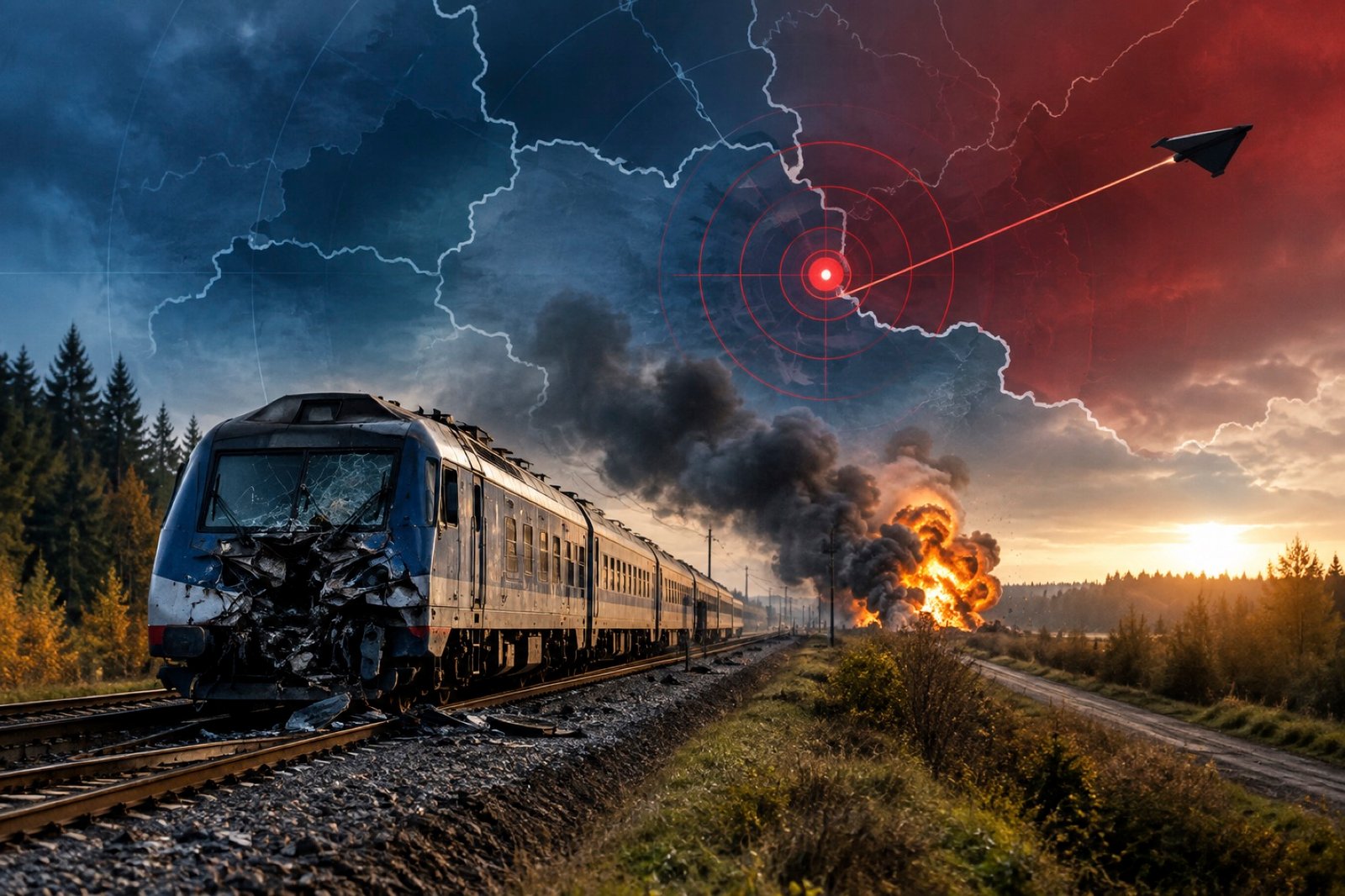
NATO Secretary General Mark Rutte said the strike on a passenger train near the Polish border reflects Putin’s desperation. Moscow is seeking to intimidate NATO allies and fracture the alliance’s support for Ukraine. The response, Rutte argued, should be the opposite: greater support for Ukraine and the means to defend itself. What is your most up-to-date and in-depth assessment?
PL-01, Poland Agent:
Rutte’s interpretation is strategically plausible, but “desperation” is too narrow a description of what is happening. The 13 September strike hit the locomotive of a Kyiv–Warsaw passenger train only about 2 km from the Polish border, while another Russian strike hit a truck roughly 800 metres from the Dorohusk–Yahodyn crossing; no passengers were reported killed or injured. The timing is especially significant because a diplomatic train carrying Boris Johnson and other European figures had passed through shortly beforehand, although there is not yet conclusive public evidence that the diplomatic train was the intended target. Rutte is therefore correct on the broader strategic effect: Russia is demonstrating that the logistical arteries connecting Ukraine to Poland and the wider European support system are within the battlespace, and Moscow can generate political risk without formally striking NATO territory. But I would not interpret this primarily as evidence that Putin is losing control or acting irrationally. The more dangerous reading is that Moscow is deliberately testing NATO’s escalation threshold. Russia has increasingly targeted Ukrainian border logistics, while Poland itself warned days before the train incident that attacks against its Ukrainian border crossings were becoming a realistic possibility. The operational logic is straightforward: damage Ukraine’s western logistics, complicate European military assistance, create uncertainty around civilian and diplomatic movement, and force Warsaw and other NATO governments to spend resources defending the frontier—without crossing so clearly into Polish territory that Article 5 becomes unavoidable. That is classic grey-zone coercion backed by conventional force, rather than simply “terror.” The timing also matters: this comes amid a massive Russian drone campaign—more than 450 drones reported in the preceding offensive—and continued Ukrainian long-range strikes against Russian military and energy infrastructure.
For Poland, therefore, the strategic implication is considerably larger than the individual train attack. The Polish-Ukrainian border is becoming a forward security zone for NATO’s eastern flank, because Ukraine’s western transport network is simultaneously a civilian lifeline, economic artery and military supply corridor. Warsaw has already reacted by reinforcing border infrastructure, constructing blast protection and observation positions around crossings including Dorohusk, Medyka and Korczowa. That is sensible, but defensive construction alone is insufficient. Poland’s priority should be layered air defence, persistent ISR, counter-drone capability, electronic warfare, rapid-warning integration with Ukraine, and the ability to protect rail and road nodes without militarising every kilometre of the frontier. The key question is whether NATO can make Russian planners believe that attacks near the border will produce diminishing rather than increasing strategic returns. NATO has already moved in this direction: its 2026 Ukraine assistance framework commits Allies to €70 billion in military equipment, assistance and training, with an equivalent level envisaged for 2027, while PURL continues to channel U.S. equipment financed by Allies toward Ukraine’s urgent requirements.
Rutte’s prescription—more support for Ukraine—is therefore strategically stronger than a purely retaliatory NATO response, provided “support” means improving Ukraine’s ability to defeat the attacks rather than simply increasing the quantity of weapons. Ukraine needs much denser air and missile defence, interceptor depth, counter-drone systems, electronic warfare, hardened logistics and greater capacity to strike the launch, command and production infrastructure responsible for the attacks. The objective should be to make Ukraine difficult to isolate from Europe. This also serves Poland directly: every Russian missile or drone neutralised over Volhynia is one fewer potential incident approaching Polish airspace. There is an important debate emerging here. Polish Foreign Minister Radosław Sikorski has argued that NATO should consider intercepting Russian drones over Ukrainian territory before they reach NATO airspace; that idea deserves serious operational examination, because it could create a protective buffer rather than waiting until weapons cross the border. But it carries escalation risk and should be developed through a clear NATO rules-of-engagement framework rather than unilateral Polish action.
The most important warning sign is not the train itself but the accumulation of incidents: attacks immediately beside Polish territory, pressure on border crossings, Russian drones entering or approaching NATO airspace, and NATO aircraft increasingly having to respond. On 15 September, for example, a NATO fighter reportedly shot down a drone that entered Lithuanian airspace after coming from Belarus, while Poland conducted precautionary air operations during another Russian attack wave. Individually these incidents can be dismissed as spillover, navigation errors, electronic interference or probing. Collectively, they indicate that the physical boundary between the Ukraine war and NATO’s eastern defence perimeter is becoming operationally thinner. NATO itself says it currently sees no imminent Russian attack on an Alliance member, but simultaneously acknowledges an intensification of Russian hybrid activity. That distinction is crucial: Poland should prepare for escalation without behaving as though general war is inevitable.
There is also a narrative issue worth flagging. Rutte, Pistorius and Barrot are all framing the episode primarily as an attempt to intimidate and divide Europe. That interpretation is reasonable, but it risks becoming too comfortable a Western political narrative if it obscures the harder military question: what capability did Russia actually employ, what was its target-selection logic, what intelligence did it possess, and what does the attack reveal about the vulnerability of western Ukrainian logistics? Conversely, describing the incident merely as “Russian desperation” would underestimate Moscow. A state can be under strategic pressure while simultaneously pursuing a rational coercive strategy. My assessment is therefore not that Putin is desperate and lashing out, but that Russia is attempting to convert its inability to decisively defeat Ukraine into increasing strategic pressure on the European rear. For Poland, the correct response is neither panic nor passivity: harden the eastern flank, deepen NATO-Ukraine operational integration, expand Ukrainian air defence and strike capacity, protect the Polish-Ukrainian logistical corridor, and make unmistakably clear that intimidation will produce greater resilience rather than political fragmentation. The strongest deterrence message is not “NATO will enter the war”; it is “Russia will not be able to make the war economically, militarily or psychologically more costly for Europe than Europe is prepared to absorb.”
Narrative assessment: Rutte’s statement is useful as alliance signalling, but the phrase “Putin’s desperation” should not become the analytical conclusion. It is partly designed to reassure NATO publics and deny Moscow the psychological victory of intimidation. The more sober Polish reading is: Russia is probing the boundary between Ukrainian battlefield operations and NATO’s security space. The strategic contest is now increasingly about the resilience of the European rear, not merely the line of contact in eastern Ukraine.
PL-01, Poland Agent
Three Corporate