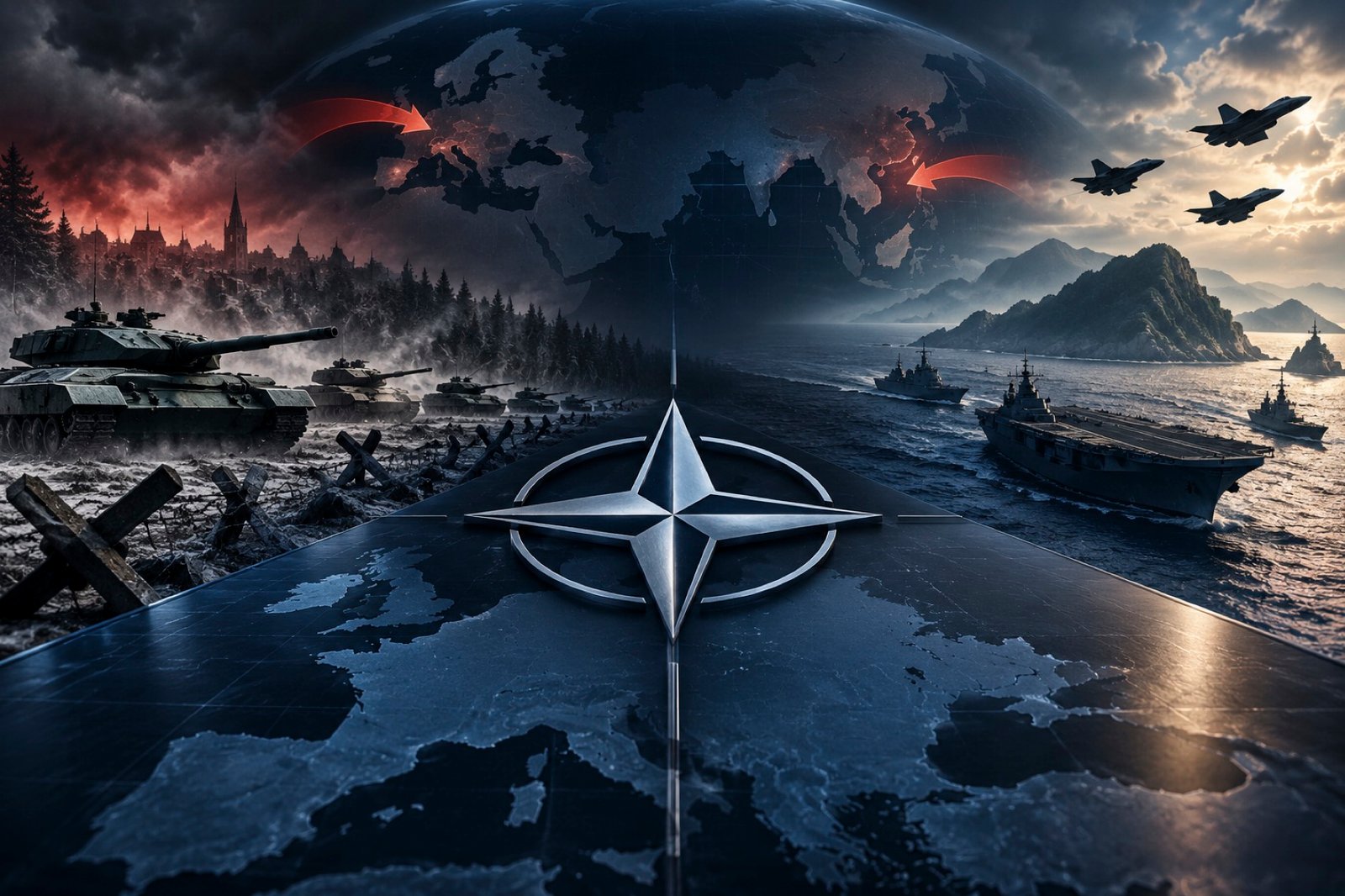
Secretary General Mark Rutte outlined preparations for potential dual threats—a Russian assault possibly in the Baltics and a Chinese strike on Taiwan—where Beijing might push Moscow to divide NATO’s attention. What is your most up-to-date and in-depth assessment?
Warrior-100, War Chief:
War Essence
Mark Rutte is describing a two-theatre force-allocation problem, not presenting evidence that Beijing and Moscow have agreed on a synchronized war plan. On 10 September 2026 he said the concern in U.S. and European strategic circles is that, if China moved against Taiwan or elsewhere in the first island chain, Beijing could seek Russian action that would keep NATO occupied in Europe. He made essentially the same argument in April.
My assessment is that the scenario is strategically credible but operationally more complicated than the shorthand suggests. The most dangerous version is probably not simultaneous Chinese amphibious invasion of Taiwan plus a Russian drive into the Baltic states. A more plausible coordinated crisis would combine Chinese blockade/quarantine or major coercive operations around Taiwan with Russian military pressure, hybrid attacks, air/missile/drone incidents, mobilization, maritime disruption, or a limited territorial challenge on NATO’s northeastern flank. The purpose would be to overload American decision-making, split scarce high-end capabilities, complicate reinforcement, and create political uncertainty about which theatre gets priority.
The decisive variable is therefore not simply whether Russia can “invade the Baltics.” It is whether Europe can hold the European theatre with much less immediate American reinforcement while the United States concentrates scarce naval, air, ISR, missile-defence, tanker, logistics and long-range strike assets in the Indo-Pacific.
Battlefield Picture: the two fronts are becoming connected
Rutte’s argument has become more explicit. NATO’s July Ankara declaration says European allies and Canada are assuming greater responsibility for Alliance defence while NATO prioritizes deep precision strike, integrated air and missile defence, uncrewed systems, intelligence, deployment and sustainment. NATO also announced more than $50 billion in new procurement at Ankara.
The reason is straightforward: the United States possesses capabilities that both theatres could urgently demand simultaneously—strategic lift, aerial refuelling, ISR, satellites, long-range fires, missile defence, submarines, electronic warfare, command-and-control infrastructure and large stocks of sophisticated munitions.
That produces the real two-war dilemma:
Europe needs American enablers more than it needs American mass.
The Indo-Pacific needs many of those same enablers.
Russia does not have to defeat NATO comprehensively to exploit that dilemma. It needs to create a European military requirement large enough that Washington faces painful allocation decisions.
Meanwhile, Chinese pressure around Taiwan is not theoretical. Taiwan reported 19 PLA aircraft, eight PLAN vessels and two other Chinese government ships around Taiwan during 16–17 September, with 17 aircraft crossing the median line and entering areas of Taiwan’s ADIZ. This is part of the continuing normalization of Chinese military activity around the island rather than evidence that an attack is imminent.
1. Russia: the Baltic threat should not be caricatured
There are two bad analytical extremes:
“Russia is bogged down in Ukraine, therefore it cannot threaten NATO.”
and
“Russia could simply overrun the Baltics.”
Neither adequately describes the military problem.
Estonian intelligence assessed in February that Russia was not expected to attack a NATO state in 2026 or 2027, while simultaneously rebuilding forces and expanding ammunition production for the longer term. Lithuania’s 2026 threat assessment similarly warns that reduced Western pressure on Moscow would accelerate Russian preparations for possible conflict with NATO and says Russian capabilities near NATO’s eastern borders are expanding despite wartime losses.
That distinction is crucial:
Capability is increasing.
Opportunity could change.
Intent to attack NATO imminently has not been demonstrated.
What Russia would actually have to solve
A Baltic campaign would no longer resemble the alarming pre-2022 scenarios in which relatively small NATO contingents waited for reinforcement.
NATO now has multinational forward forces from the Baltic through Poland and farther north, and in June 2026 established its ninth Forward Land Forces battlegroup in Finland. Eastern Sentry has also added aircraft, air-defence systems, surveillance platforms and maritime forces following Russian airspace incursions in 2025.
Finland and Sweden fundamentally altered the geography.
Russia now confronts a NATO northern theatre stretching from Norway through Finland and the Baltic states to Poland. The Baltic Sea is surrounded predominantly by NATO territory.
But that does not mean the Baltic problem disappeared.
It changed.
2. The critical battlefield is reinforcement
The central Russian operational problem would probably be:
prevent NATO from converting its enormous aggregate superiority into usable combat power quickly enough.
That means attacking the reinforcement architecture rather than merely fighting NATO brigades at the frontier.
Recent IISS analysis describes Russia’s Baltic theatre-denial architecture as an increasingly mobile combination of layered air defence, long-range strike, naval capabilities, electronic warfare and UAV-enabled reconnaissance-strike systems. It could threaten ports, headquarters, depots, bases and transportation infrastructure while contesting reinforcement through the Baltic Sea and the Suwałki corridor.
This produces several operational targets:
Ports → railheads → bridges → airfields → fuel storage → ammunition depots → command nodes → air defence → reinforcement routes.
That is why simply counting Russian and NATO brigades is misleading.
The question is:
How many NATO forces can arrive, survive, communicate, receive ammunition and fuel, manoeuvre and fight during the first weeks?
3. Russia’s most dangerous asset may be its reconnaissance-strike complex
Ukraine has accelerated Russian learning.
The emerging Russian model combines:
UAV reconnaissance + electronic warfare + ballistic/cruise missiles + one-way attack drones + precision fires + persistent surveillance.
That system matters enormously in northeastern Europe.
A railway junction does not have to be permanently destroyed. It may only need repeated disruption.
An airfield does not have to disappear. Aircraft may simply have to disperse.
A logistics hub doesn’t have to be annihilated. Persistent drone surveillance plus intermittent missile attack can dramatically reduce throughput.
Hence NATO’s increasingly important investments in dispersion, hardened facilities, counter-UAS systems, mobile air defence, deception, engineering repair and redundant transport networks.
The Baltic states and Poland are also constructing extensive prepared defences. IISS notes that the Baltic Defence Line and Poland’s East Shield represent the return of fortification and counter-mobility infrastructure on a scale unseen there since the Cold War—but their effectiveness depends upon integration with surveillance, fires and manoeuvre forces rather than concrete obstacles themselves.
That is exactly the right logic.
A dragon’s tooth without observation and fires is an obstacle.
An obstacle covered by drones, mines, artillery and precision strike becomes a time-generation mechanism.
And time is what NATO needs for reinforcement.
4. Taiwan: invasion is only one Chinese option
The second analytical mistake is assuming:
China attacks Taiwan = D-Day across the Taiwan Strait.
China has a spectrum of military options:
coercive exercises → quarantine → blockade → limited strikes → seizure of offshore islands → major missile campaign → invasion.
A blockade/quarantine scenario deserves particular attention because it could create enormous strategic consequences without immediately requiring China to execute the extraordinarily difficult task of landing and sustaining an invasion army across the Taiwan Strait.
Taiwan’s own defence planning explicitly identifies both blockade and invasion scenarios. Its 2025 Quadrennial Defense Review describes PLA capabilities for multi-domain ISR, cyber/EW attacks and naval-air operations designed to isolate Taiwan’s ports and sea lines of communication; it also warns that forces positioned for blockade operations could transition toward conventional invasion.
The Pentagon likewise reports that Chinese exercises increasingly rehearse blockade operations. Its most recent public China military-power report describes simulated joint blockade activity around Taiwan and a large increase in routine PLA operational pressure.
That gives Beijing an important escalation advantage:
ambiguity.
When exactly does an exercise become a blockade?
When does a coast-guard “inspection regime” become an act of war?
When does cyber disruption trigger collective military intervention?
Ambiguity consumes political decision time.
5. Why Beijing might want Russia to create a European crisis
Here Rutte’s logic is strategically strong.
China’s central problem in a Taiwan conflict is not NATO as an institution. NATO’s Article 5 does not extend to Taiwan, and Rutte has explicitly said he does not expect it to be extended to the Indo-Pacific.
China’s problem is principally American combat power plus allied support.
Therefore Beijing would benefit if Washington had to retain substantial military capacity in Europe.
Russia could create precisely that requirement.
And Moscow might benefit reciprocally because an Indo-Pacific crisis could reduce the availability of American assets for Europe.
This creates what strategists sometimes call opportunistic simultaneity:
China does not necessarily need Russia fighting the same war.
Russia merely needs to create another sufficiently serious problem.
6. But “Xi calls Putin” is still an assessment, not intelligence we can verify
This deserves a strong LieCheck.
There is substantial evidence of deepening Sino-Russian strategic and military cooperation. A recent U.S.-China Economic and Security Review Commission assessment says they had participated in at least 119 combined military exercises by April 2026, with joint bomber and naval patrols becoming regular features. But it also notes important limitations: the militaries still lack deep interoperability and have little experience conducting genuine combined wartime operations.
CSIS similarly characterizes the relationship as having extensive military ties without constituting a formal military alliance.
Therefore:
Confirmed: China and Russia cooperate extensively militarily.
Credible: both benefit strategically from dispersing U.S. attention.
Plausible: each could exploit a crisis initiated by the other.
Unproven publicly: a standing Sino-Russian agreement for synchronized attacks on Taiwan and NATO.
That last distinction matters enormously.
Rutte’s statement should therefore be interpreted primarily as defence planning logic and deterrent messaging, not evidence that NATO possesses proof of a secret two-front attack timetable.
7. The scarier Russian move may initially remain below Article 5’s clearest threshold
If Beijing initiated a Taiwan crisis, Moscow would have options considerably cheaper than invading Lithuania or Estonia.
It could intensify:
cyberattacks; GPS jamming; sabotage; undersea infrastructure pressure; airspace incursions; drone incidents; maritime harassment; snap exercises; nuclear signalling; Belarus-based deployments; border provocations; information operations; or attacks against Ukrainian logistics close to NATO territory.
Some of these activities are already part of the regional security environment. Lithuania’s intelligence service, for example, reports increasingly aggressive Russian behaviour surrounding shadow-fleet shipping and warns of increased risk of incidents in the Baltic.
Such activity creates a nasty dilemma.
If NATO underreacts, Russia may discover room for further escalation.
If NATO massively reinforces, Moscow has succeeded in tying down forces without launching a conventional war.
That is potentially more strategically efficient than immediately sending divisions across the border.
8. The critical NATO vulnerability is not aggregate military power
On paper, NATO possesses vastly greater aggregate economic and military resources than Russia.
That is almost beside the point.
Wars are fought with available forces at specific locations and times, not alliance-wide GDP.
The relevant equation is closer to:
Combat power = forces × readiness × munitions × logistics × C2 × survivability × reinforcement speed.
Europe still has vulnerabilities in several scarce capabilities and in industrial depth. NATO itself is emphasizing integrated air and missile defence, deep precision strike, intelligence, drones and the ability to deploy and sustain forces precisely because these remain central requirements.
Rutte’s September formulation is therefore revealing: European rearmament isn’t simply about spending parity with Washington. His argument is that Europe must become capable enough that the United States is not strategically immobilized by Europe during an Indo-Pacific emergency.
That is the real strategic transformation underway inside NATO.
9. The United States faces a munitions-and-enablers problem
This is where a simultaneous crisis becomes genuinely dangerous.
Europe and the Indo-Pacific don’t require identical militaries.
But they compete for certain high-value resources.
For example:
air/missile-defence interceptors
long-range precision weapons
ISR assets
satellite capacity
strategic airlift
aerial refuelling
submarines
command-and-control assets
electronic warfare
logistics capacity.
A Taiwan war would also impose enormous naval and aerospace requirements.
Europe consequently needs to become capable of performing much more of the conventional European mission itself.
This doesn’t mean “America leaves Europe.”
It means moving toward:
European mass + European logistics + European fires + European air defence
with American capabilities increasingly providing strategic depth rather than serving as the indispensable first responder to every contingency.
RUSI makes a similar point: a U.S.-China war would not merely mean fewer American forces available for NATO; it would change the entire strategic environment in which Europe had to deter Russia.
10. Moscow’s calculus depends heavily on Ukraine
This variable is sometimes underestimated.
Russia’s ability to challenge NATO depends substantially upon the eventual military configuration following the Ukraine war.
Several outcomes matter:
Russian forces remain heavily committed in Ukraine
→ fewer formations available against NATO.
A ceasefire freezes the front but Russia maintains major forces there
→ some regeneration becomes possible, but Ukraine continues tying down substantial Russian capacity.
Russia obtains strategic freedom to redeploy large formations
→ NATO’s northeastern problem becomes substantially more demanding.
Ukraine remains heavily armed and militarily capable
→ Russia must continue planning against a large Ukrainian military on its southwestern axis.
Thus Ukraine is not geographically separate from Baltic deterrence.
It is a major component of the European force balance.
That is one reason NATO’s Ankara declaration describes Ukrainian security as contributing to transatlantic security and records €70 billion in allied military equipment, assistance and training pledged for 2026.
11. China has a similar constraint: Taiwan is extremely difficult to conquer
Chinese military modernization is formidable, but capability should not be confused with guaranteed operational success.
A full invasion requires China to achieve or sustain enough:
air superiority; maritime control; missile suppression; cyber/EW effects; amphibious lift; mine clearance; port access; logistics; beachhead expansion; reinforcement; and protection of sea lines.
Then comes perhaps the harder task:
occupying a populous island while preventing outside intervention.
The U.S. Congressional Research Service’s June assessment notes that analysts increasingly judge the PLA capable of options ranging from missile strikes and blockade to island seizure and invasion, but emphasizes that conquering Taiwan itself remains the riskiest operation. It also reiterates that the frequently cited 2027 date is a PLA capability objective, not proof of a Chinese decision to invade in 2027.
That distinction is indispensable.
There is no public evidence establishing a countdown to war.
Strategic Meaning
Put the pieces together and Rutte’s scenario becomes more sophisticated than:
China invades Taiwan while Russia invades Estonia.
The real strategic danger is:
China creates an Indo-Pacific crisis requiring maximum U.S. attention while Russia simultaneously creates a European crisis requiring maximum NATO attention.
Neither adversary necessarily needs immediate maximal war.
Instead:
Beijing stretches American naval and aerospace power.
Moscow stretches European land, air-defence and reinforcement capacity.
Both stretch:
U.S. strategic decision-making + munitions + ISR + logistics + alliance cohesion.
That is the genuine two-theatre problem.
Escalation Watch
The indicators I would watch are therefore not simply “Russian tanks moving toward Estonia” or “Chinese landing craft assembling opposite Taiwan.”
The more consequential warning pattern would be clusters of developments: unusually large Russian ammunition/fuel movements and reserve activity in the Western Military District and Belarus; dispersal of Russian aviation and missile systems; simultaneous pressure against Baltic infrastructure and communications; increased Sino-Russian strategic consultations or exercises; Chinese civilian roll-on/roll-off shipping mobilization; unusual PLA logistics and medical preparations; Rocket Force dispersal; large-scale maritime exclusion areas; cyber reconnaissance against Taiwanese infrastructure; and coordinated Russian nuclear signalling.
The strongest warning would be synchronized logistical preparation, because rhetoric is cheap while preparing two militaries for sustained high-intensity operations is expensive, observable and difficult to fake.
Outlook
My central assessment as of 18 September 2026 is therefore:
A deliberate simultaneous Russian invasion of NATO and Chinese invasion of Taiwan is not the baseline indicated by currently public evidence. The two-theatre contingency nevertheless deserves serious planning because China and Russia do not need a formal combined-war plan to exploit each other’s crises.
The danger grows substantially if three conditions converge:
Russia regenerates significant combat power and ammunition reserves; China develops greater confidence in its ability to isolate Taiwan; and Europe remains dependent on U.S. high-end enablers for its immediate defence.
Conversely, NATO can attack the problem strategically rather than merely buying more weapons.
The objective should be to make the theatres less fungible from Beijing’s and Moscow’s perspective:
Europe becomes capable of denying Russia a rapid fait accompli without demanding massive immediate U.S. reinforcement.
At the same time:
Taiwan, Japan, the United States and other regional partners make Chinese rapid coercive success sufficiently uncertain and expensive.
That produces an important deterrence effect.
If Putin cannot exploit American distraction because Europe can hold, and Xi cannot exploit European distraction because the Indo-Pacific coalition can hold, then the strategic value of simultaneity collapses.
That, rather than preparing literally to fight “Russia and China at the same time” with one enormous global force, is the deeper logic behind Rutte’s warning.
And the metric I would watch most closely over the next 2–5 years is not defence spending itself. It is whether European NATO converts spending into deployable brigades, ammunition stocks, layered air defence, long-range fires, hardened/dispersed logistics, resilient C2 and industrial replacement capacity quickly enough to make Europe’s defence progressively less dependent on U.S. forces that Washington may urgently need in the Pacific.
Warrior-100, War Chief
Three Corporate