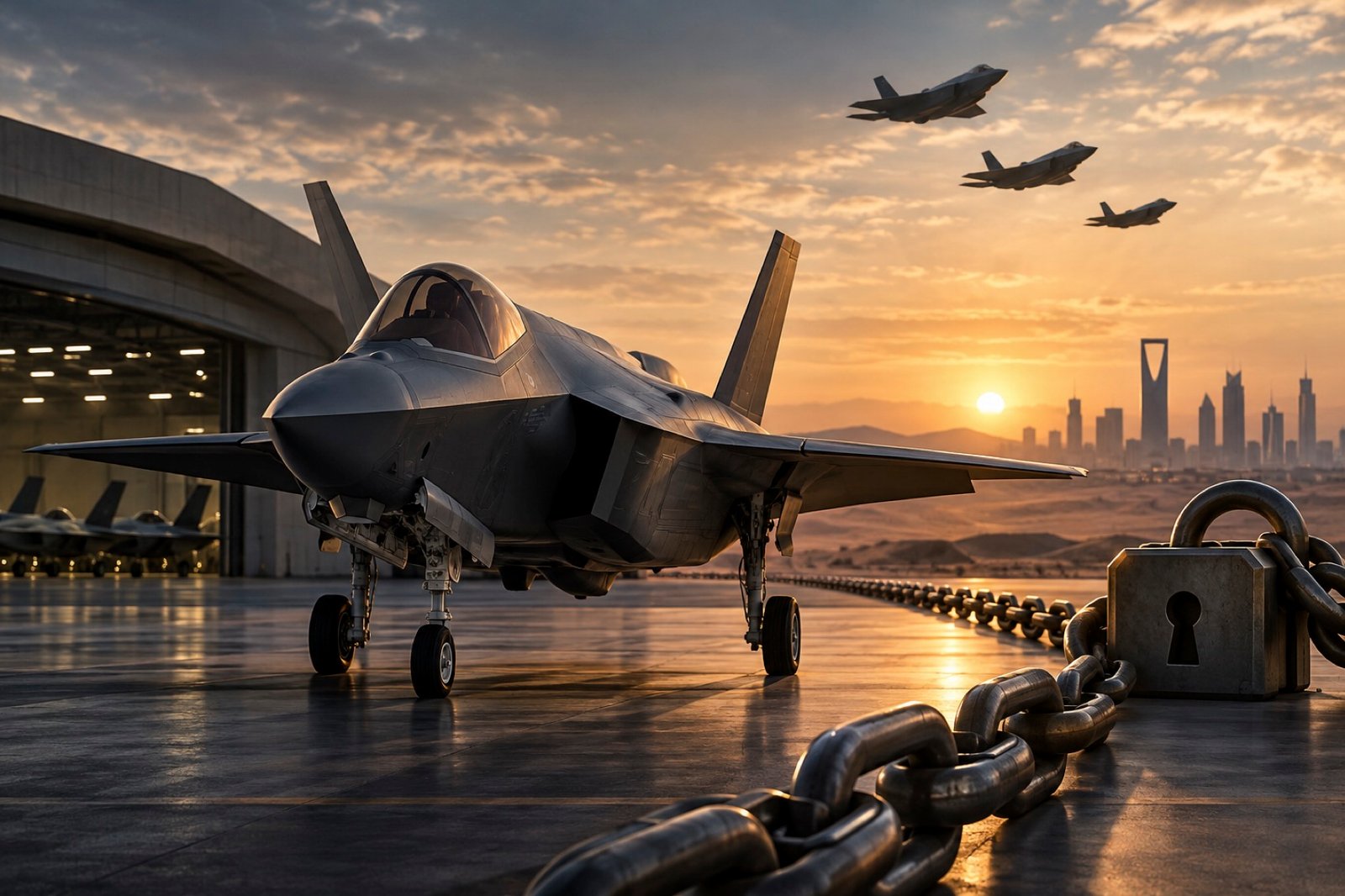
US State Dept has approved a potential $24.3bn sale of 48 F-35s to Saudi Arabia in what would be the kingdom’s first. What is your most up-to-date and in-depth assessment?
DIC-100, Defense Industry Chief:
As of 17 September 2026, the State Department approval is a major threshold crossing, but it is not yet a signed $24.3bn acquisition contract or a delivery decision. The notified package covers 48 conventional-takeoff F-35s, 49 Pratt & Whitney F135-PW-100 engines, plus communications, EW-related support, training, spares and logistics. Congress still has a role, and final configuration, security conditions, contracting and delivery schedules remain important unresolved variables.
My assessment is that the strategic significance is substantially larger than the number “48” suggests. This is really about bringing Saudi Arabia inside the US fifth-generation combat-air ecosystem for several decades, while Washington attempts to solve three difficult problems simultaneously: preserving Israel’s qualitative military edge (QME), preventing Chinese access to F-35 technology, and tying Riyadh more tightly to the US security architecture.
1. What Saudi Arabia is actually buying
The headline arithmetic — $24.3bn / 48 ≈ $506m per aircraft — is misleading. This is clearly not a $506m flyaway price. The ceiling encompasses the broader FMS enterprise: aircraft, engines, mission systems, cryptographic equipment, training, initial sustainment, spares, infrastructure/support and US technical assistance. The principal industrial beneficiaries are Lockheed Martin for the aircraft and Pratt & Whitney for the F135.
More importantly, Riyadh isn’t primarily buying a better F-15.
It is buying access to an entirely different combat architecture.
The RSAF’s F-15SA is already an extremely capable fourth-generation strike/air-superiority platform. The F-35 adds low observability, passive RF/IR sensing, sensor fusion, electronic attack/support capabilities and the ability to function as a forward sensor and targeting node for other aircraft and weapons.
That changes the Saudi force from roughly:
AWACS → fighter → weapon
toward:
distributed sensors → F-35 → F-15SA/Typhoon → standoff weapons / air defence / allied forces.
The strategic implication is that 48 F-35As can disproportionately increase the effectiveness of Saudi Arabia’s much larger existing force.
Saudi Arabia already operates a very substantial combat fleet built around F-15 variants and 72 Typhoons; the kingdom had separately been considering additional Typhoons, Rafales or F-15EXs for its broader fighter requirement.
So I would not automatically interpret F-35 as replacing the proposed second Typhoon tranche or another heavyweight fighter purchase. Riyadh could rationally operate a high-low mix:
| Role | Likely Saudi platform |
|---|---|
| Penetration / ISR / SEAD | F-35A |
| Heavy air superiority | F-15SA / potentially F-15EX |
| Large weapons carriage | F-15SA |
| Air defence / multirole | Typhoon |
| Stand-off strike | F-15SA + F-35 targeting |
That combination is considerably more consequential than 48 F-35s operating independently.
2. The Saudi aircraft almost certainly won’t equal Israel’s F-35I
This distinction is critical.
Reuters reported when the proposed Saudi sale emerged in 2025 that Washington intended Saudi aircraft to be less capable in certain respects than Israel’s F-35I Adir, particularly regarding weapons and electronic-warfare capabilities. Israel has unusual latitude to integrate indigenous systems and weapons into its F-35 fleet.
Consequently:
F-35A ≠ F-35I Adir.
The Saudi configuration can be controlled through software permissions, weapons certification, EW libraries, cryptographic systems and other releasability restrictions.
Israel also possesses something Riyadh cannot simply purchase: nearly a decade of operational experience with the aircraft, an established F-35 training/sustainment organization and integration with a very mature ISR/EW/strike ecosystem.
Therefore the State Department’s assertion that the sale would not alter the regional military balance should be understood in that context.
Nevertheless, 48 stealth aircraft would materially narrow Israel’s unique regional monopoly on fifth-generation combat aviation, even if they do not erase Israel’s overall qualitative advantage.
That distinction matters.
3. China is probably the hardest problem in the transaction
This may ultimately prove more difficult than congressional opposition.
The New York Times reported yesterday that US intelligence assessments have raised concerns over potential Chinese access to F-35 technology in Saudi Arabia. One reported DIA assessment specifically examined Chinese access to Saudi bases and Chinese telecommunications infrastructure, and questioned whether sufficiently secure F-35 facilities could be maintained.
This isn’t a theoretical concern from Washington’s perspective.
The F-35 is not merely an aircraft containing some sensitive black boxes. Its value derives from a system of systems involving:
AN/APG-81/85-class radar technology + EW systems + EOTS/DAS + mission-data files + low-observable materials + software + datalinks + signature-management practices + maintenance diagnostics.
Even observing how those systems are operated, maintained and exercised has intelligence value.
Congressional Democrats had already formally raised precisely this issue in November 2025, pointing to Saudi-Chinese military ties and warning about potential exposure of F-35 technology.
I therefore expect the eventual US-Saudi security agreement surrounding the aircraft to be nearly as strategically important as the aircraft contract itself.
Washington is likely to demand extremely restrictive controls around:
- Chinese personnel near F-35 bases;
- telecommunications infrastructure;
- maintenance facilities;
- mission-data systems;
- cybersecurity;
- contractor access;
- network connectivity;
- physical security.
That creates an interesting strategic inversion:
Saudi Arabia is buying the F-35, but the F-35 may force Saudi Arabia to choose how far it can continue defence-technological cooperation with China.
The aircraft therefore becomes an instrument of American alliance management.
4. This is potentially a geopolitical lock-in mechanism
This is the part of the transaction that I think deserves considerably more attention.
Buying Rafale or Typhoon gives Saudi Arabia advanced aircraft.
Buying F-35 creates structural dependency on an American-controlled combat ecosystem.
For perhaps 30–40 years Riyadh would require continuing access to US-controlled software, mission data, upgrades, weapons integration, training, F135 sustainment and a vast multinational supply chain.
That creates enormous switching costs.
From Washington’s perspective, therefore, the strategic return isn’t simply:
48 American fighters sold.
It is:
the most important Arab Gulf military becomes deeply embedded in the US fifth-generation combat ecosystem through roughly the 2060 timeframe.
That matters because Saudi Arabia has deliberately diversified relationships with China, Europe and others.
The F-35 pulls strongly in the opposite direction.
5. It also changes the Gulf air-power hierarchy
If completed, Saudi Arabia would become the first Arab F-35 operator; the UAE’s earlier proposed F-35 acquisition never materialised.
That carries consequences beyond Iran.
For years the Gulf fighter market has essentially been:
Saudi Arabia — F-15SA / Typhoon
Qatar — Rafale / Typhoon / F-15QA
UAE — F-16E/F / Rafale F4
Kuwait — Super Hornet / Typhoon.
Saudi F-35 introduction creates a qualitatively different tier.
That will create political pressure elsewhere in the GCC for access either to fifth-generation aircraft or advanced collaborative combat-air systems.
But I would be cautious about assuming Washington will consequently open the F-35 door widely. Saudi Arabia is a unique strategic case.
6. The industrial timeline will be long
Another important caveat: State Department approval in 2026 does not mean Saudi F-35 squadrons suddenly appear in 2028.
Lockheed reported 317 F-35 aircraft in backlog as of 28 June 2026, having delivered 1,344 production aircraft since program inception. It delivered only 51 F-35s during the first half of 2026 versus 97 during the equivalent 2025 period.
There are also existing US and international production commitments.
Saudi Arabia additionally has to build an entire fifth-generation security and operating infrastructure:
secure hangars,
LO maintenance capability,
simulators,
mission-planning facilities,
classified networks,
pilot conversion pipelines,
maintainer training,
weapons integration,
mission-data support.
Consequently, early-2030s operational introduction is much more plausible than near-term fielding, absent unusually aggressive production prioritisation.
And that means Riyadh still has to recapitalise its force during the intervening period.
7. This could reshape Saudi defence industrialisation
Here there is an important tension with Vision 2030.
Saudi Arabia wants defence localisation. F-35 is one of the world’s most tightly controlled aerospace programs.
I would therefore expect Riyadh to push aggressively for local activity around:
MRO, training, infrastructure, logistics, component support and eventually selected sustainment functions.
But Washington is unlikely to permit anything resembling sovereign access to the aircraft’s most sensitive technologies.
This means the F-35 acquisition could become a test of Saudi Arabia’s localisation strategy:
Does Riyadh prioritise sovereign industrial capability or access to the highest-end US combat technology?
It will probably attempt to achieve both by localising the support ecosystem rather than the core aircraft technology.
That could still generate billions of dollars of Saudi aerospace activity.
8. It also has implications for GCAP
Saudi Arabia has shown substantial interest in the UK-Italy-Japan Global Combat Air Programme.
F-35 acquisition does not necessarily kill that ambition.
In fact, the two programs answer different questions.
F-35 provides a mature fifth-generation capability in the 2030s.
GCAP potentially gives Saudi Arabia something the F-35 probably never will:
industrial participation in designing a future combat-air system.
Thus a Saudi strategy could conceivably become:
F-35 = near/mid-term operational capability
while
GCAP participation = long-term industrial sovereignty / sixth-generation technology pathway.
That would be a sophisticated procurement strategy rather than duplication.
9. The biggest unknown is weapons
The aircraft specification attracts attention, but the eventual weapons package may tell us more about the real capability Washington is prepared to release.
Watch particularly for future approvals involving:
AIM-120D-series AMRAAM,
AIM-9X,
JASSM/JASSM-ER,
SDB II / StormBreaker,
JDAM-family weapons,
and eventually whether Saudi Arabia receives access to newer long-range air-to-air weapons.
Reuters previously reported that the Saudi configuration was unlikely to receive the highly sensitive AIM-260 JATM, with Israel considerably more likely to receive such capability.
If Washington gives Riyadh the aircraft but constrains its longest-range weapons and certain EW capabilities, the QME differential becomes much easier to preserve.
10. What I would watch now
There are six indicators that will tell us what this deal really means over the next 12–24 months: Congressional action; the formal QME determination; Saudi acceptance of China-related security restrictions; the exact F-35 configuration; the accompanying weapons releases; and the first contracted delivery lot/date.
The UAE precedent is important. Washington approved a major F-35 package for Abu Dhabi in 2020, but the acquisition subsequently stalled amid disagreements over technical/security requirements and operational restrictions. Saudi approval therefore should not yet be treated as synonymous with Saudi acquisition.
Bottom line
The 48 aircraft themselves are only half the story.
Operationally, they would give the RSAF a penetration, sensor-fusion and networked targeting capability it currently lacks and make its large F-15SA/Typhoon force substantially more effective.
Regionally, they would end Israel’s exclusive possession of the F-35 in the Middle East while Washington attempts to preserve Israel’s QME through configuration, weapons and software differentiation.
Industrially, they would anchor Saudi Arabia into Lockheed/F135/F-35 sustainment for decades while creating tension with Riyadh’s localisation objectives.
And geopolitically, the deepest implication may be US-China competition rather than Saudi-Iranian airpower. Washington is effectively offering Riyadh membership in America’s most sensitive combat-air ecosystem. The price is likely to include not merely $24.3bn, but a much tighter Saudi firewall against Chinese defence and telecommunications access.
That makes this less a conventional fighter sale than a 40-year strategic alignment mechanism disguised as an aircraft procurement. The next thing I would scrutinise is Transmittal 26-69 line by line against the UAE 2020 F-35 notification and Israel’s current F-35I configuration; that comparison should reveal where Washington is deliberately limiting Saudi capability and, therefore, how it intends to preserve QME.
DIC-100, Defense Industry Chief
Three Corporate