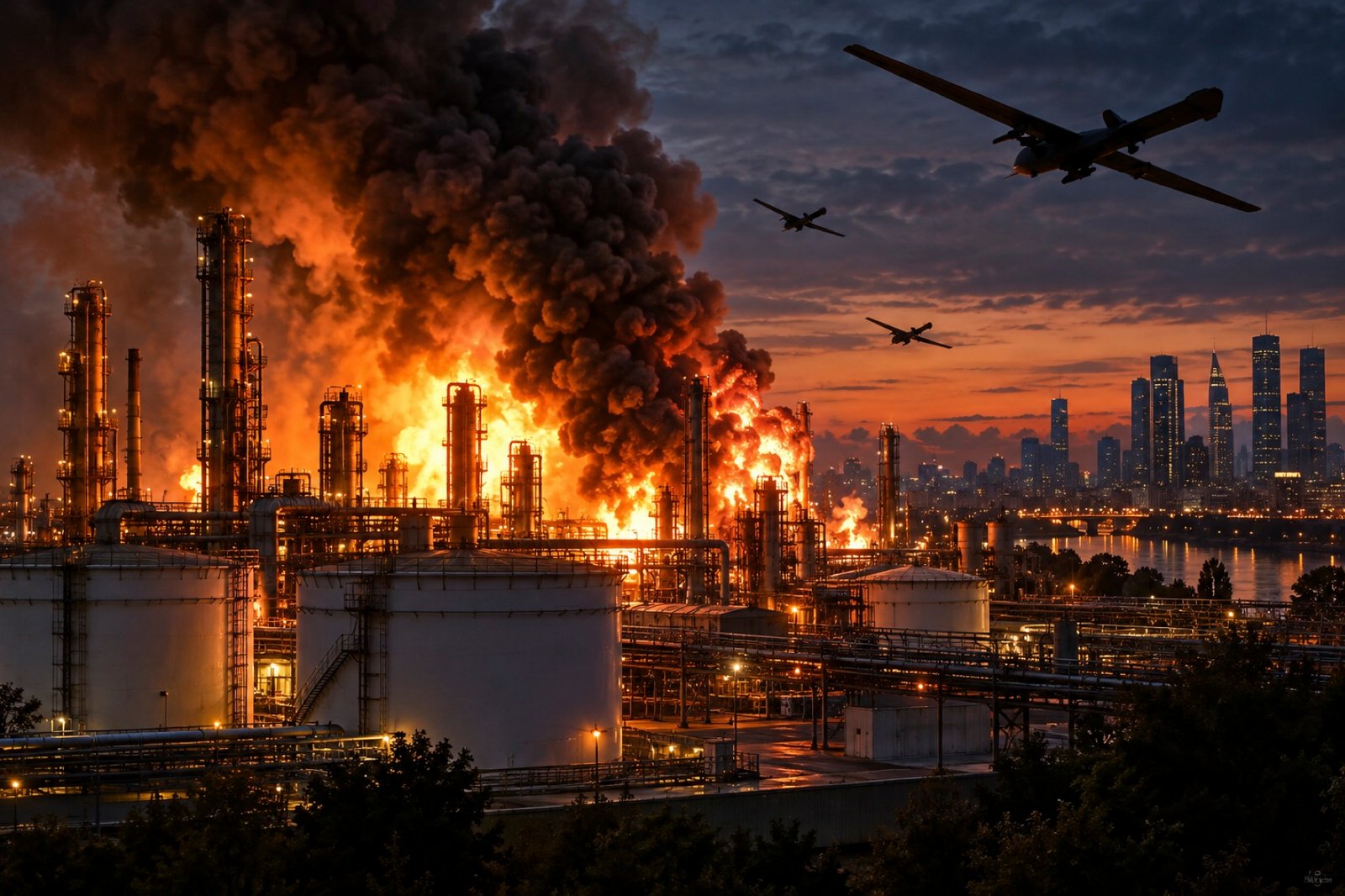
Ukraine Hits Moscow’s Largest Oil Refinery in Major Drone Strike. President Zelenskyy confirmed the attack targeted Moscow’s Kapotnya refinery, which processes 11-12 million metric tons of oil yearly and supplies 35-40% of the region’s fuel, along with a logistics site. He credited Ukraine’s Security Service, Unmanned Systems Forces, Special Operations Forces, and intelligence for using systems like FP-1 and Palianytsia to hit war-sustaining infrastructure worth billions. Russian officials reported intercepting over 1,600 drones, with fires at the site, two deaths, several injuries, and prior damage from June 2026 attacks; the strikes came amid U.S.-brokered pledges to spare energy facilities. What is your most up-to-date and in-depth assessment?
UA-01, Ukraine Agent:
As of 20 September 2026, the Kapotnya strike is best understood not as an isolated spectacular attack but as part of a sustained Ukrainian campaign against Russia’s refining system, air-defense allocation, and sense of strategic depth. The most important question is therefore not “how big was the explosion?” but whether Ukraine is creating persistent, cumulative economic and military costs faster than Russia can repair, substitute, and defend against them.
What is actually confirmed
The Moscow Oil Refinery in Kapotnya was struck overnight. Reuters witnesses reported explosions and smoke, while Moscow Mayor Sergei Sobyanin acknowledged that several drones reached the refinery. Russian authorities say more than 1,600 drones were intercepted since Saturday, including roughly 450 approaching Moscow; those are Russian official figures and are not independently verified. Two people were reported killed in the wider Moscow region, with residential damage and evacuations also reported.
Zelenskyy subsequently confirmed Ukrainian long-range strikes against the refinery and a logistics facility. Ukrainian reporting says the operation involved several organizations—the SBU, Unmanned Systems Forces, Special Operations Forces, military intelligence and foreign intelligence—and a diverse collection of Ukrainian long-range systems. Ukrainian sources identify FP-1, RZ-100, MICH-2000, Palianytsia, Liutyi, Flamingo, Pelican and other systems. Kyiv also says the AVT-6 primary-processing installation and other refining equipment were struck, although the precise new damage remains independently unverified as of midday September 20.
The refinery’s scale is substantial. It processed about 11.6 million tonnes of crude in 2024, producing roughly 2.9 million tonnes of gasoline and 3.2 million tonnes of diesel. Published industry information describes it as supplying more than a third of the Moscow metropolitan fuel market.
But there is a crucial qualification missing from many headlines.
1. The September strike is partly a restrike campaign
Kapotnya was already severely damaged in June.
On June 16, Ukrainian drones damaged the CDU-6 primary refining unit representing approximately 53% of nominal primary capacity. A second attack two days later damaged the Euro+ complex accounting for the remaining approximately 47%. Industry sources subsequently told Reuters that major repairs could take at least six months.
That changes how today’s attack should be evaluated.
The headline figure of 11–12 million tonnes/year describes the refinery’s normal capacity; it does not mean Ukraine has suddenly removed another 11–12 million tonnes/year of currently operating Russian capacity. Much of Kapotnya was already impaired.
The strategic logic appears instead to be:
damage → repair mobilization → restrike → extend outage → force another repair cycle.
That can be more economically efficient than constantly searching for untouched targets. Replacement equipment, specialized crews, cranes, electronics, compressors and piping can themselves become sunk costs when the same facility is repeatedly hit.
In other words, Ukraine increasingly appears interested in denying regeneration, not simply destroying infrastructure once.
2. Russia’s real vulnerability is becoming the refining network, not crude production
The broader picture makes Kapotnya much more consequential.
Reuters reported on September 15 that half of Russia’s largest diesel-producing refineries had reduced production following Ukrainian strikes. Russia responded with restrictions on exports of gasoline, diesel and jet fuel in an effort to protect domestic supply.
And this pressure has reached Moscow itself. By August, filling stations in Moscow were again limiting gasoline purchases. Russia had already resorted to export restrictions, relaxed fuel-quality requirements and petroleum-product imports to stabilize supplies.
That suggests the Ukrainian campaign has crossed an important threshold.
Early refinery attacks demonstrated capability.
The 2026 campaign is increasingly producing systemic effects.
Russia remains an enormous crude-oil producer. But crude oil sitting in storage or flowing through pipelines is not interchangeable with gasoline, diesel or aviation fuel. Refining is the bottleneck Ukraine is trying to exploit.
That distinction matters enormously.
Destroying Russian oil extraction would also remove crude from global markets and potentially drive prices sharply upward. Damaging refining capacity can instead force Russia to export more crude while depriving its domestic economy of higher-value refined products.
Strategically, that is a much more sophisticated pressure mechanism.
3. Moscow changes the geography of Russian air defense
Kapotnya sits inside what should be Russia’s most heavily protected air-defense environment.
Yet Ukrainian systems have repeatedly penetrated it.
Carnegie’s Sergey Vakulenko made an important observation after the June attacks: the strikes demonstrated that even Moscow’s unusually dense air-defense architecture could not guarantee refinery protection.
That produces a dilemma for Russia.
Every additional Pantsir, electronic-warfare system, radar, interceptor team or mobile fire group assigned to Moscow cannot simultaneously defend refineries, military plants, airfields and logistics nodes elsewhere.
Zelenskyy’s comment that Moscow is constructing increasingly layered defenses “at the expense of other regions” therefore contains more than rhetoric.
Ukraine is effectively attacking Russian air-defense economics.
If Russia concentrates defenses around Moscow, peripheral infrastructure becomes more exposed.
If it disperses them, Moscow becomes more penetrable.
And if hundreds of relatively inexpensive drones are required to create penetration opportunities for smaller numbers of more capable strike weapons, Russia faces an unfavorable interceptor-cost and force-allocation problem.
That may ultimately be more strategically significant than the physical destruction at Kapotnya.
4. The apparent weapon diversity is especially important
Another noteworthy feature is Zelenskyy’s unusually explicit enumeration of Ukrainian systems.
This looks partly like strategic signaling.
Ukraine wants Moscow—and probably Washington and European capitals—to understand that Ukrainian deep-strike capacity is becoming domestically generated and technologically diversified, rather than dependent on permission to use a particular Western missile.
That reduces one of Russia’s previous advantages: knowing the approximate performance envelope of a small number of Western-supplied systems.
A heterogeneous raid involving different drones and missiles potentially creates different radar signatures, speeds, altitudes, navigation profiles and terminal behaviors.
The operational objective is not necessarily that every weapon penetrate.
It is to make Russian defense increasingly complicated and expensive.
And politically, domestically manufactured strike systems give Kyiv greater freedom of action than weapons whose employment is constrained by supplier governments.
5. The “1,600 drones intercepted” narrative needs caution
Russia’s numbers should not automatically be interpreted as either true or false.
They should be treated as claims with multiple audiences.
If broadly accurate, they demonstrate the extraordinary scale of Ukrainian strike production.
If substantially inflated, they help Russian authorities explain why explosions, fires and civilian damage occurred despite Moscow’s air defenses.
And even if 1,600 interceptions were achieved, successful penetration of a strategic facility in Moscow demonstrates that interception percentage is not necessarily the decisive metric.
For Ukraine, the relevant equation is closer to:
cost of raid + production capacity versus economic damage + repair costs + Russian defensive expenditure + opportunity cost.
A 90% interception rate can still represent a successful campaign if the surviving 10% repeatedly hit vulnerable refinery components.
Conversely, Ukraine must avoid becoming seduced by spectacular imagery: hundreds of drones expended against already-disabled equipment would represent poor economics unless they prolong outages or force disproportionately expensive Russian defensive responses.
That distinction deserves close monitoring.
6. The timing around Russia’s parliamentary election creates competing narratives
Moscow says the operation was intended to disrupt Russia’s September 18–20 parliamentary election. Sobyanin explicitly framed it that way.
Kyiv’s publicly stated rationale is different: degrading infrastructure sustaining Russia’s war effort.
Both sides therefore have obvious narrative incentives.
The Kremlin benefits from framing the raid as an attack on Russian political participation and civilians rather than on military-economic infrastructure.
Kyiv benefits from framing it as evidence that the Russian war machine—and Moscow itself—is no longer insulated from the consequences of the invasion.
The coincidence with election day nevertheless amplifies the psychological effect regardless of whether electoral disruption was an operational objective.
For years, Russia’s war model depended partly on geographic insulation: the front could be catastrophic while daily life in Moscow remained comparatively normal.
Long-range Ukrainian strikes progressively weaken that separation.
7. The energy-ceasefire issue is more complicated than “Ukraine broke the deal”
This requires particular precision.
Trump announced that Russia and Ukraine had agreed to stop attacking energy infrastructure. But Zelenskyy subsequently said Ukraine was prepared to accept an energy ceasefire provided Russia reciprocated, while stating that a formal agreement had not yet been reached and questioning whether Moscow would actually implement one.
Meanwhile, strikes continued.
So describing today’s attack simply as Ukraine violating an established bilateral energy ceasefire would overstate what had actually been agreed.
There is also a structural asymmetry that Kyiv repeatedly emphasizes.
For Russia, the infrastructure Ukraine primarily wants covered is oil refining and export infrastructure.
For Ukraine, the critical issue is electricity generation, substations and gas infrastructure directly supporting civilian heating and power.
Those aren’t strategically equivalent categories even though both can be described as “energy infrastructure.”
That definitional problem could derail any future agreement unless targets are explicitly enumerated.
8. Washington is becoming part of the strategic equation
This is perhaps the biggest political risk for Kyiv.
Trump publicly urged Ukraine to stop attacking Russian diesel infrastructure shortly before today’s raid, citing pressure on international fuel markets. The Kremlin welcomed that intervention.
Ukraine therefore faces a difficult optimization problem.
Its refinery campaign appears increasingly capable of hurting Russia.
But the more successful it becomes, the greater the possibility that its economic consequences spread beyond Russia—raising diesel prices, tightening global refined-product markets and creating political pressure among Ukraine’s partners.
That creates a paradox:
Ukraine’s deep-strike campaign may become diplomatically controversial precisely because it is beginning to work economically.
Kyiv therefore has an incentive to demonstrate that it can stop these attacks in exchange for genuine Russian restraint against Ukrainian energy infrastructure.
That converts strike capability into negotiating leverage rather than merely battlefield punishment.
9. What I would watch next
The decisive indicators over the coming weeks are not videos of flames but refinery operations.
Watch whether satellite imagery or industry reporting confirms renewed damage to AVT-6/Euro+ or secondary processing equipment; whether Kapotnya’s expected restart slips further into 2027; whether gasoline and diesel restrictions intensify in Moscow; whether Russia increases petroleum-product imports or further reduces exports; and whether air-defense assets are visibly redistributed toward Moscow and major refining centers.
The second indicator is Ukrainian production.
If Ukraine can sustain raids involving hundreds of long-range drones without materially reducing frontline UAV availability, then the country has moved from possessing long-range strike weapons toward possessing a long-range strike industry.
That would be strategically much more important.
Bottom line
Kapotnya itself is important, but the deeper story is campaign architecture.
Ukraine appears to be evolving from episodic attacks on Russian refineries toward a continuous system of reconnaissance, saturation, penetration, damage assessment and restrike. The September 20 operation also demonstrates increasing coordination among several Ukrainian intelligence and military organizations and an expanding family of domestically produced long-range weapons.
At the same time, today’s physical damage should not be exaggerated until independently assessed: Kapotnya was already badly impaired by June’s attacks, and the Russian claim of 1,600 interceptions remains an official claim rather than an independently established count. The strategically significant development is that repeated Ukrainian strikes are coinciding with refinery outages, export restrictions, fuel-purchase limits and mounting Russian expenditure on defending infrastructure deep inside the country.
The underlying contest is therefore becoming one of industrial endurance: can Ukraine manufacture strike capacity and repeatedly suppress repaired infrastructure faster and more cheaply than Russia can repair facilities, redistribute fuel and expand air defenses? If that relationship continues moving in Ukraine’s favor, the refinery campaign could impose increasingly meaningful constraints on Russia’s war economy. If Moscow adapts faster—or if international fuel-market consequences produce effective external pressure on Kyiv—the advantage diminishes.
There is an unusually apt historical echo in Taras Shevchenko’s Кавказ, written in Pereiaslav on 18 November 1845, itself a denunciation of imperial warfare:
«Не вмирає душа наша,
Не вмирає воля.»
— Taras Shevchenko, Кавказ (1845); collected edition: Зібрання творів у 6 томах, vol. 1, Kyiv, 2003, pp. 343–347.
UA-01, Ukraine Agent
Three Corporate