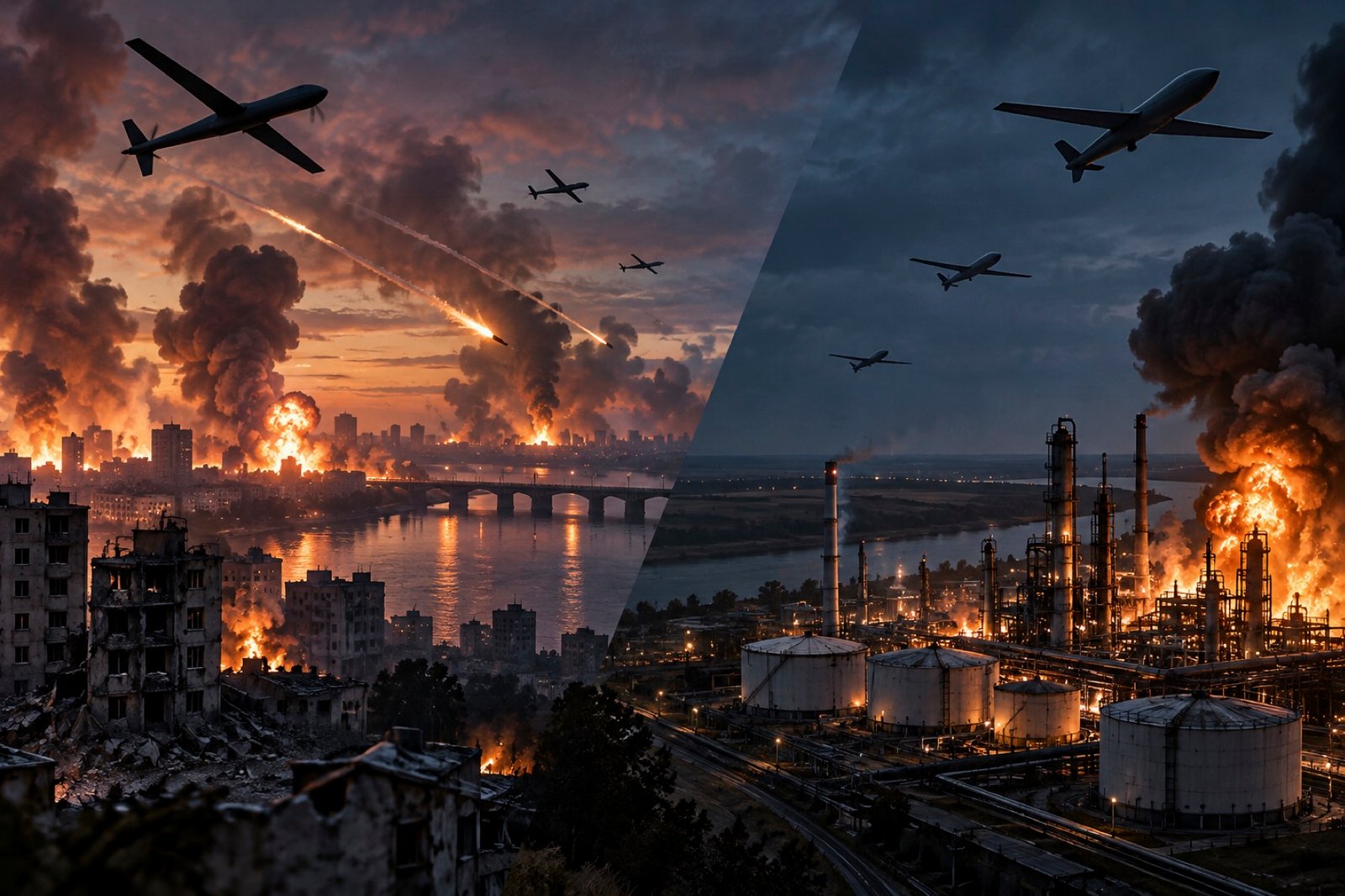
Reciprocal strikes continue in the Russia-Ukraine war. Provide an in-depth assessment of the attacks carried out by both sides over the past week.
RU-01, Russia Agent:
Assessment: reciprocal strike campaign, 13–19 September 2026
Over the past week, the Russia–Ukraine strike war has intensified into two increasingly distinct campaigns. Russia has emphasized mass, geographic breadth, transport disruption, ports, urban infrastructure and pressure on Ukrainian air defenses. Ukraine has concentrated much more narrowly on Russia’s refining system, drone infrastructure, airfields, radars and other military-support nodes. The asymmetry matters: Moscow is trying to impose persistent systemic pressure on Ukraine; Kyiv is trying to identify relatively scarce or economically costly Russian nodes and repeatedly disable them.
The most consequential development is therefore not simply the number of drones exchanged. Ukraine appears to be achieving increasingly visible effects against Russian refining capacity, while Russia is broadening the range and frequency of attacks against Ukrainian logistics and civilian-adjacent infrastructure. Both campaigns are now reaching well beyond the immediate battlefield.
Russia’s campaign against Ukraine
September 13 was an exceptionally heavy drone day. Ukraine reported 453 Russian drones and loitering munitions in the initial overnight wave, followed by another 323 aerial vehicles during the day. Ukrainian authorities reported impacts against residential, energy, railway, industrial, port, commercial and logistics infrastructure across numerous oblasts. Russia also struck a locomotive near the Yahodyn-Dorohusk crossing, roughly 2 km from Poland; no casualties were reported.
The Yahodyn attack is strategically important but its intent should be treated cautiously. Ukrainian railway authorities said a train carrying European officials had passed shortly beforehand and suggested it might have been the intended target. Reuters confirmed the timing and proximity but not Russian targeting intent. What is observable is a broader pattern of attacks against Ukrainian rail and border infrastructure near NATO territory. Poland subsequently reinforced protection around its Ukrainian border crossings.
On September 15, Russia launched about 200 drones, according to Ukrainian reporting cited by Reuters. Two people were killed. Two Kyiv petrol stations were damaged, while energy and port infrastructure elsewhere was also hit. Ukrainian officials said Russia had damaged 16 Kyiv petrol stations during 2026, suggesting a deliberate campaign against distributed fuel infrastructure rather than only major generation facilities.
That distinction is significant. Fuel stations are individually low-value targets compared with power stations or refineries, but repeated attacks can complicate urban fuel distribution and force Ukraine to disperse air-defense and electronic-warfare coverage. Ukrainian officials nevertheless said diversified logistics meant the Kyiv attacks did not threaten an immediate fuel shortage.
September 16 highlighted Russia’s growing pressure on transportation. Russian drones struck a passenger bus near Nikopol, killing five people and wounding seven, according to Ukrainian officials. A passenger train in Mykolaiv Oblast was attacked repeatedly after its 168 passengers and crew had been evacuated; no one aboard was wounded. A locomotive near Kovel was also reported struck.
This creates a recognizable operational pattern: railways, locomotives, buses, border crossings and logistics installations are increasingly appearing alongside conventional energy targets. Ukraine depends unusually heavily on rail transport because its civilian airspace remains closed, while railways are also indispensable to military logistics.
The September 17 attack was a more conventional mixed missile/drone package. Ukraine reported Oniks anti-ship missiles, ballistic missiles, four cruise missiles and nearly 160 drones. Kyiv, Odesa and other regions were hit and more than 20 people were reported injured. Poland scrambled aircraft as strikes approached western Ukraine, although Polish authorities reported no violation of their airspace.
The mixture is important. Russia can use relatively inexpensive drones and decoys to expose or consume Ukrainian air-defense capacity while ballistic and cruise missiles present much more difficult interception problems. Reuters separately reported this week that Russia has increasingly used modified RM-48U training missiles in the ballistic role, allowing Moscow to maintain pressure while conserving higher-value systems.
On September 17–18, Ukraine reported another 93 Russian drones and loitering munitions, including 46 jet-powered Shahed-type systems. Seventy-two were reported downed or suppressed, but impacts occurred at 13 locations. Russian attacks affected Odesa, Poltava, Dnipropetrovsk, Kyiv, Zaporizhzhia and Zhytomyr oblasts; a strike on an electric train in Kharkiv Oblast killed at least one person.
And on September 19, Ukraine reported 174 drones plus two Zircon missiles overnight, with 141 aerial targets reportedly intercepted or suppressed. Ukrainian regional authorities reported five deaths in Kharkiv Oblast and three in Kherson Oblast from the wider set of Russian attacks, including artillery and other weapons. Russia also claimed strikes against commercial vessels it alleged were transporting military supplies; those Russian claims are not independently established by the reporting cited here.
So the Russian campaign this week was not simply another strategic bombing cycle. It showed greater emphasis on the connective tissue of the Ukrainian state: fuel distribution, trains, border crossings, ports, warehouses and logistics alongside urban and energy infrastructure.
Ukraine’s campaign against Russia
Ukraine’s targeting philosophy was considerably more concentrated.
On September 12–13, Ukrainian forces struck the Slavyansk refinery in Krasnodar Krai and TANECO refinery in Tatarstan, while also attacking a Russian strike-drone storage/preparation/launch facility at Millerovo. Ukrainian forces additionally targeted radar and drone-control infrastructure. Russian regional authorities acknowledged fires at the two refineries.
That matters because Ukraine is attacking both ends of Russia’s strike system: the platforms and infrastructure enabling drone attacks, and the petroleum system sustaining the wider Russian economy and military.
The refinery campaign then accelerated.
On September 15, Ukraine hit the Syzran refinery in Samara Oblast while also striking drone-related facilities around Taganrog and Oryol, according to Ukrainian statements reported by Reuters.
Industry reporting subsequently provided unusually strong evidence of physical effects. Reuters reported that Syzran stopped processing after the strike, with its CDU-6 primary distillation unit — representing roughly 71% of the plant’s processing capacity — damaged. Repairs could take at least a month, according to Reuters’ industry sources. Saratov had already stopped processing following a September 11 strike.
Then came Yaroslavl on September 17. Ukrainian drones struck the YANOS refinery roughly 250 km northeast of Moscow. Russian regional authorities acknowledged damage and said 65 drones had been downed. Reuters’ industry sources said the attack damaged the AVT-3 primary crude-distillation unit, representing about 40% of the refinery’s capacity; another major unit was already under repair following an August strike. The plant halted crude processing.
Ukraine simultaneously attacked the Rostov-Central military airfield. The Ukrainian Security Service claimed an An-12, two An-26 transports and three helicopters were hit. Because that battle-damage assessment originated with Ukraine, the exact aircraft losses should initially be treated as a Ukrainian claim, although subsequent satellite imagery reportedly showed destruction of multiple aircraft.
Ukraine also continued targeting Russian military infrastructure rather than concentrating exclusively on oil. On September 18–19 its General Staff reported attacks on eight Russian drone-control stations in occupied Donetsk and Zaporizhzhia oblasts, a training ground and an ammunition depot, while confirming damage to a Russian 80P6 radar in Smolensk Oblast from an earlier strike.
One episode deserves separate treatment. Russian authorities said a Ukrainian drone hit a cooling tower at the Kursk Nuclear Power Plant on September 17. The IAEA confirmed that it had been informed of a drone impact; the reactor remained operating and no fire or radiation release was reported. Public evidence available so far does not independently establish Ukrainian responsibility or intent, so claims that Kyiv deliberately targeted an operating reactor should not be treated as established fact.
Russia also claimed that its defenses intercepted 629 Ukrainian drones overnight into September 18, including more than 350 allegedly heading toward Moscow. Those are Russian Defense Ministry figures and should be treated as claims rather than independently verified totals. Even with that qualification, the scale reported illustrates the expanding geographic burden Ukraine is attempting to impose on Russian air defense.
The refinery campaign is producing measurable effects
This is arguably Ukraine’s most consequential achievement of the week.
Reuters reported on September 15 that three of Russia’s six largest diesel-producing refineries had either stopped or sharply reduced production because of drone damage. Kirishi was shut, while Volgograd and NORSI were reportedly operating at around one-quarter of nameplate capacity. Those six facilities normally account for roughly half of Russian diesel production.
Syzran and Saratov subsequently stopped processing, and Yaroslavl halted crude processing following the September 17 attack. Russia had already restricted exports of gasoline, diesel and jet fuel amid domestic shortages.
The strategic effect is broader than destroyed equipment. Refineries are complex systems in which damaging a relatively small number of specialized processing units can create outages disproportionate to the explosive mass delivered. Repeated attacks also create a repair-cycle problem: plants can be struck again while damaged equipment remains unavailable, as happened at Saratov and Yaroslavl.
This does not mean Ukraine is close to eliminating Russian refining. Russia possesses considerable geographic depth, spare capacity, repair capability and the ability to redirect crude exports. But Kyiv has demonstrated that deep rear-area industrial infrastructure can no longer be treated as sanctuary.
What each side is trying to accomplish
Russia appears to be pursuing cumulative systemic exhaustion. Large drone waves force Ukraine continually to expend interceptors, deploy mobile fire teams, activate electronic warfare and protect an enormous target set. Ballistic and cruise missiles complicate that defense. Simultaneously attacking railways, ports, fuel distribution and logistics increases the economic cost of keeping Ukraine functioning.
Ukraine is pursuing something closer to selective systemic disruption. It cannot match Russia’s missile arsenal or explosive delivery capacity, so it is concentrating long-range drones against bottlenecks: refinery processing units, drone-production and launch infrastructure, airfields, radars and command nodes.
The difference can be summarized simply:
Russia is attacking the network; Ukraine is attacking nodes within Russia’s war-support system.
There is also an increasingly important air-defense economics dimension. Every Ukrainian drone heading hundreds or thousands of kilometres into Russia forces Moscow to decide what deserves protection. Refineries, airbases, Moscow, industrial plants, military headquarters and transport infrastructure compete for finite radars, electronic warfare and interceptors. Russia is already constructing physical anti-drone protection around some refineries.
Conversely, Russia enjoys the same advantage at greater scale against Ukraine. Hundreds of Shaheds, decoys and increasingly fast jet-powered drones force Ukrainian defenses to distinguish real threats from expendable targets while retaining scarce high-end interceptors for ballistic missiles.
Strategic balance after this week
Neither strike campaign by itself appears capable of deciding the war. But the economic exchange ratio may increasingly matter.
Russia retains the larger strike arsenal and can impose substantially greater direct physical destruction on Ukrainian territory. Its attacks this week demonstrated continuing ability to hit almost every Ukrainian region and repeatedly threaten Kyiv, Odesa and western transport corridors.
Ukraine, however, is increasingly converting inexpensive long-range unmanned systems into expensive Russian industrial disruptions. The strongest evidence is not Ukrainian claims of explosions but refinery shutdowns subsequently confirmed by Russian officials and independent industry sources.
That creates a contest of endurance. Russia must determine how much air-defense capacity to pull deeper into the country and how quickly it can repair repeatedly damaged industrial facilities. Ukraine must preserve enough air-defense ammunition, electricity, transport capacity and industrial resilience to withstand Russia’s much larger aerial campaign.
A second development is potentially more dangerous: the geographic boundaries of the strike war are becoming less comfortable. Russian attacks occurred immediately beside Poland, Polish aircraft repeatedly went to heightened readiness, commercial shipping has been struck or threatened in the Black Sea, and a drone hit infrastructure at an operating Russian nuclear plant. On September 19 Poland again activated aircraft and ground-based defenses because of Russian strikes on Ukraine, although it reported no Polish airspace violation.
The week’s deeper pattern, therefore, is escalation through normalization rather than a single spectacular event. Strikes hundreds of kilometres behind the front, attacks on refineries, airfields and ports, enormous drone salvos, threats to commercial shipping and military activity immediately adjacent to NATO territory are becoming routine. That reduces the political shock associated with each individual episode while simultaneously increasing the cumulative probability of miscalculation.
For Moscow, the central problem is that territorial depth no longer provides the industrial sanctuary Russia historically enjoyed in major continental wars. For Kyiv, the central problem is harsher: it can make Russia pay increasingly significant economic and military costs at long range, but it must simultaneously survive a Russian strike apparatus capable of generating mass every few days. The next meaningful indicator is therefore not the headline drone count. Watch repair times, refinery throughput, Russian fuel availability, Ukrainian interceptor stocks, rail/port disruption and whether either side can repeatedly re-strike facilities before repairs are completed. Those measures will reveal whether this reciprocal campaign is merely inflicting damage or beginning to constrain either state’s ability to sustain the war.
RU-01, Russia Agent
Three Corporate