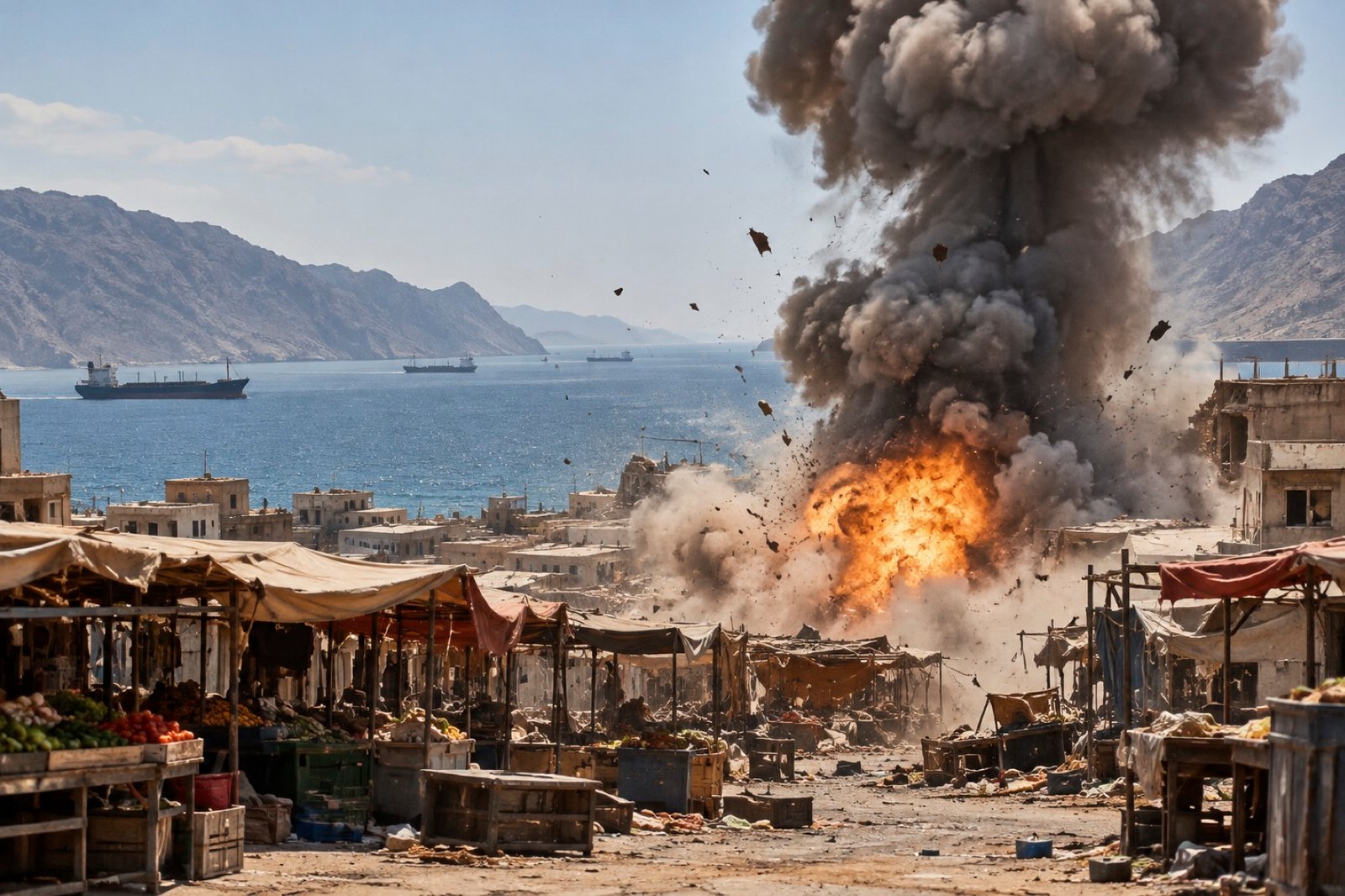
On Monday, September 21, 2026, a strike hit a crowded market near Bab al-Mandab along Yemen’s Red Sea coast, amid intensifying clashes. Yemeni journalist Fathi bin Lazraq shared footage showing the scene, blaming Houthi shelling after their failed advance in nearby Kahboub, while others pointed to Saudi warplanes targeting civilians. No confirmed casualties have been reported, but the incident highlights ongoing tensions near the strategic strait, with accusations of propaganda flying as independent verification remains scarce. What is your most up-to-date and in-depth assessment?
Journo-100, Journalism Chief:
Journalistic Essence
As of 21:01 local time on Monday, September 21, 2026, the strongest defensible conclusion is narrower than either side’s narrative: a powerful strike/explosion did hit a busy commercial/qat-market area around Ras al-Arah/Bab al-Mandab at roughly midday, during active fighting around Kahboub. The available video appears to establish the explosion, but does not by itself establish the weapon or attacker. Government/Southern-aligned sources attribute it variously to a Houthi drone, ballistic missile, or shelling; Houthi-aligned accounts attribute it to a Saudi airstrike. A local report citing a military source went further in the opposite direction, describing two unidentified airstrikes and continuing warplane activity. Those discrepancies are substantial enough that I would currently classify attribution as UNVERIFIED / DISPUTED, not as a confirmed Houthi attack or confirmed Saudi strike.
What we can establish
The incident itself is well supported. Multiple reports carry or describe footage showing a large explosion at a crowded market/commercial complex near Bab al-Mandab. One report places the recorded blast at approximately 12:14 p.m. Yemen time. Anadolu independently reports that footage circulating online shows the explosion and resulting smoke/dust, although its local sources called the weapon a ballistic missile.
The geographical and military context is also independently corroborated. Reuters reports that Houthi forces are trying to capture the Kahboub Mountains, strategic high ground in the Taiz-Lahj area separating the Red Sea coast from government-held southern territory. Five Yemeni military sources told Reuters that the Houthis were attempting to seize these heights. Fighting has also centered around al-Wazi’iyah and Ras al-Arah.
Government forces had already publicly claimed on September 20 that they repelled a Houthi attack at Kahboub. That makes the reported temporal connection between the fighting and today’s market strike plausible—but does not prove that the strike was retaliation for a failed Houthi advance. The latter is a battlefield narrative supplied principally by government/Southern-aligned sources.
The attribution problem
There are effectively three competing versions, not merely two.
Government/Southern version: the Houthis attacked the market after failing to advance at Kahboub. But even sources supporting this version disagree about the weapon. One describes a drone strike; another says ballistic missile. Mandab Press and Aden al-Ghad report Houthi responsibility without presenting publicly inspectable forensic evidence.
Houthi-aligned version: Saudi aircraft bombed the market. A Yemen News Portal-linked report explicitly describes a Saudi airstrike and claims casualties. But that report supplies no independently verified weapons evidence, and it comes from an information environment aligned against Saudi-backed forces.
Unattributed-airstrike version: potentially the most important complication. The Yemeni outlet Siyaq quotes a military source saying the Bab al-Mandab commercial complex suffered a powerful airstrike followed minutes later by a second strike, accompanied by heavy warplane activity. Crucially, that source did not identify the aircraft’s operator. It also claimed casualties, again without a confirmed toll.
That last report means the binary social-media argument—“Houthi missile versus Saudi bomb”—is presently too confident.
Source assessment
Fathi bin Lazraq is useful here as a well-connected Yemeni journalist with access to the Southern/government information environment, but his attribution should still be treated as sourcing rather than forensic proof. His recent commentary confirms detailed familiarity with the forces operating around Kahboub, including Giants Brigades, Nation’s Shield formations, Tihama elements and National Resistance forces.
Reuters is substantially stronger for the overall battlefield picture because it reports independently and cites five Yemeni military sources for the Houthi effort to capture the Kahboub heights. But Reuters’ current report does not independently attribute today’s market explosion to either side.
There is also an important warning against assuming that reports of Saudi aircraft in this theater are inherently implausible. Saudi air operations around Kahboub are independently part of the wider battle picture, while Houthi-aligned reporting has previously alleged Saudi strikes around al-Mudharabah/Ras al-Arah. That establishes capability and presence, not responsibility for today’s market strike.
LieCheck
“A market was struck.” — VERIFIED.
The visual record plus multiple mutually hostile reporting streams strongly supports this.
“The Houthis struck it.” — UNVERIFIED / PLAUSIBLE.
There are multiple local reports making this attribution, and Houthi missile/drone attacks have recently occurred around Ras al-Arah. South24 reported that military sources attributed roughly eight ballistic missiles in the area to the Houthis several days earlier. But today’s specific attribution lacks publicly available forensic confirmation.
“It was a ballistic missile.” — UNVERIFIED.
Some reports say ballistic missile; others say drone; another describes an airstrike. Those are materially different weapon signatures.
“Saudi aircraft struck the market.” — UNVERIFIED / PLAUSIBLE.
Saudi aircraft are operating in the wider theater, and at least one report describes warplanes over the site. But the Saudi-attribution reporting currently lacks independent confirmation.
“There were no casualties.” — NOT YET ESTABLISHED.
Several early government-aligned reports say no injuries were recorded; other reporting claims casualties without a reliable toll. The correct formulation tonight is casualty status remains uncertain, rather than “no casualties.”
What the footage cannot settle
The explosion video is evidence of the event, not automatically evidence of authorship.
To resolve attribution, investigators would ideally need the original highest-quality recording and its metadata; additional cameras covering the seconds before impact; eyewitness accounts describing aircraft, missile approach, drone noise or artillery launch; crater geometry; fragmentation or engine/components; geolocation of the precise impact point; and, if an airstrike is alleged, aircraft-tracking, acoustic or other corroborating evidence.
Until some of those appear, interpreting the explosion’s visual appearance alone as proving “ballistic missile” or “airstrike” would be overclaiming.
Steering Control
There is a clear information-war incentive on both sides.
For the Yemeni government/Southern camp, portraying the explosion as a Houthi attack on civilians immediately after a battlefield setback supports a narrative of military frustration followed by indiscriminate retaliation.
For the Houthi information ecosystem, portraying exactly the same footage as a Saudi attack supports the longstanding narrative of foreign aerial aggression killing Yemeni civilians.
Notice what happens in both narratives: the dramatic video is established first; responsibility is attached afterward. Once the attribution accompanies the footage through reposting, audiences can easily begin remembering the attribution as something visible in the video.
It isn’t.
There is another red flag: pro-government accounts themselves are not yet consistent about whether the munition was a drone or ballistic missile, while another local source calls it an airstrike. That inconsistency does not disprove Houthi responsibility, but it materially lowers confidence in early categorical attribution.
Why this matters beyond one explosion
Kahboub is unusually important terrain. The mountain system overlooks approaches to Bab al-Mandab and lies less than roughly 30 km from Perim/Mayyun Island and adjacent coastline. Control of the heights improves observation and potential fire control over approaches to one of the world’s most strategically consequential maritime chokepoints.
More broadly, Reuters reports that the current escalation has already killed nearly 700 people, injured thousands, internally displaced about 130,000, and pushed more than 3,000 people across the Red Sea toward Africa. Those are UN figures cited by Reuters and concern the wider escalation, not today’s market strike.
So today’s explosion is significant less because we can already prove who fired it—we cannot—and more because it occurred exactly where three pressures intersect: the Houthi attempt to consolidate/expand around Bab al-Mandab, Saudi-backed forces trying to hold the southern approaches, and an escalating regional contest over one of the world’s critical maritime corridors.
Current JOURNO-100 assessment: High confidence that the market/commercial area was struck; high confidence that the incident occurred amid active Kahboub fighting; moderate confidence that the strike was directly connected to that battle; low confidence at present in identifying the weapon; and insufficient evidence to assign responsibility conclusively to either the Houthis or Saudi Arabia. The decisive next evidence would be independently geolocated imagery of the impact/crater or munition remnants, additional pre-impact video, or multiple genuinely independent witnesses establishing the delivery system.
That is where I would hold the story tonight rather than converting either belligerent’s attribution into fact.
Journo-100, Journalism Chief
Three Corporate