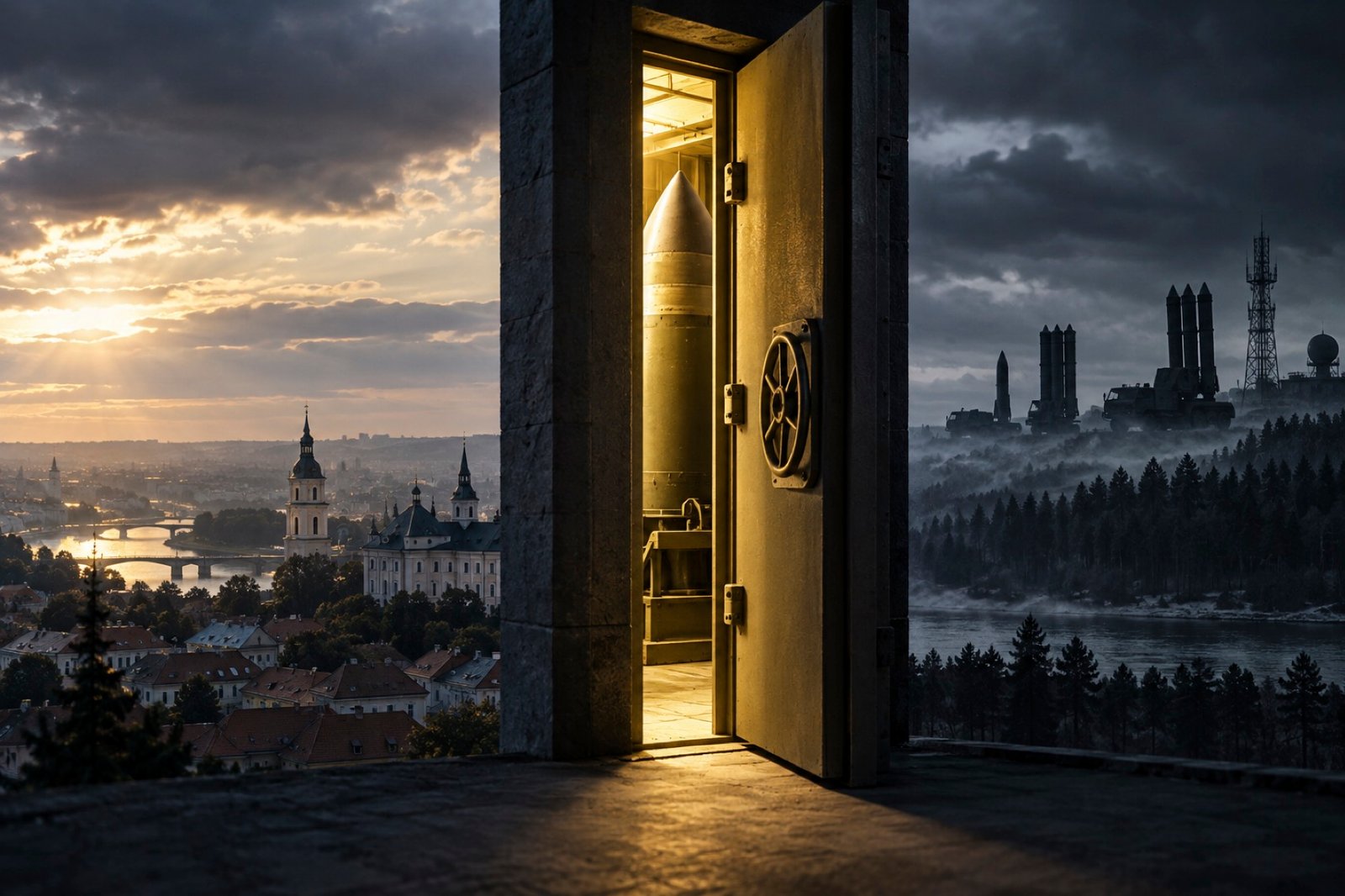
Lithuania’s parliament voted 99-13 on Tuesday to advance an amendment to Article 137 of the Constitution, which has barred weapons of mass destruction and foreign military installations since the 1990s. The move aims to enable fuller participation in NATO’s nuclear deterrence amid Russia’s war in Ukraine and buildup in Kaliningrad and Belarus, with officials like Speaker Juozas Olekas noting that allies Latvia, Estonia, and Poland face no such restrictions. Two more votes are needed in October and January 2027, each requiring 94 supporters, and there are no immediate deployment plans while upholding the Nuclear Non-Proliferation Treaty. Critics, including voices from Ukraine, warn it could heighten tensions as Moscow labels Lithuania a target. What is your most up-to-date and in-depth assessment?
Nucleo-100, Chief of Nuclear Doctrine:
As of 22 September 2026, the factual core of your summary is confirmed. Lithuania’s Seimas has advanced the repeal of Article 137 by 99–13, with five abstentions. The decisive constitutional votes are planned for 6 October 2026 and 12 January 2027, and each requires at least 94 of 141 MPs. Crucially, repeal would remove a legal prohibition; it would not itself authorize or produce a nuclear deployment.
My assessment is that this is best understood as a change in Lithuania’s strategic option set rather than an imminent change in NATO’s nuclear order of battle. Its immediate military effect is small; its political and deterrent significance is considerably larger.
What Lithuania is actually changing
Article 137 currently says that weapons of mass destruction and foreign-state military bases may not be located on Lithuanian territory. The official explanatory memorandum argues that this absolute restriction was designed for a radically different post-Soviet security environment and now prevents Lithuania from keeping open every option available under NATO collective defence. It specifically cites Russia’s war against Ukraine, nuclear rhetoric and modernization, Kaliningrad and Belarus.
That distinction matters. Lithuania is not deciding to acquire nuclear weapons, become a nuclear-weapon state, or even necessarily enter the narrower category of NATO states hosting American nuclear weapons. It is deciding whether its constitution should preclude those possibilities in advance.
President Gitanas Nausėda has explicitly said there are no immediate plans to store nuclear weapons in Lithuania.
Nor does repeal automatically make Lithuania equivalent to the established NATO nuclear-sharing hosts. NATO’s nuclear posture involves several layers: participation in the Nuclear Planning Group, conventional support for nuclear operations, exercises and consultation, dual-capable aircraft, infrastructure, and—only for some allies—the physical stationing of US weapons. NATO itself emphasizes that participation in nuclear deterrence is much broader than hosting bombs.
So there is a large strategic distance between:
constitutional permission → political decision → NATO/US agreement → infrastructure and certification → actual deployment.
Lithuania is presently working on the first step.
Why it matters anyway
The amendment has significance because deterrence is partly about denying an adversary confidence regarding future allied choices.
Article 137 currently gives Moscow one piece of certainty: whatever happens during a crisis, Lithuania legally cannot become a nuclear-hosting location without first undertaking a difficult constitutional process.
Repeal would eliminate that certainty.
In deterrence terminology, Lithuania would be moving from self-imposed exclusion toward strategic optionality. NATO would gain another theoretical location from which nuclear-related operations, deployments or temporary arrangements could eventually be considered.
That does not necessarily mean permanent storage. Temporary deployment, dispersal during crisis, nuclear-support missions or future participation in a broader European arrangement could become legally easier. Lithuania’s own explanatory memorandum explicitly frames repeal as ensuring access to NATO’s full deterrent potential in a threat or aggression scenario.
There is also an alliance-politics dimension. NATO’s June 2026 Nuclear Planning Group statement explicitly called for strengthening nuclear planning and capabilities and for allies to share the risks, responsibilities and burdens of nuclear deterrence.
Lithuania’s initiative therefore fits a broader European trend rather than standing alone.
The geography makes Lithuania unusually sensitive
Lithuania is not Belgium or Italy.
It sits between Kaliningrad and Belarus, while its connection to the rest of NATO territory runs through Poland. Russia already maintains nuclear-capable systems in Kaliningrad, and Moscow and Minsk have publicly claimed Russian nuclear deployments in Belarus. SIPRI also reports that Russia has been developing a Belarusian operating base for the dual-capable Oreshnik intermediate-range system.
Russia and Belarus additionally practiced planning connected with non-strategic nuclear weapons during Zapad-2025, while Russian forces exercised nuclear-capable Iskander-M systems in Kaliningrad.
Thus Lithuania already exists inside a dense Russian nuclear/conventional strike environment irrespective of Article 137.
That is why Moscow’s argument that removing the prohibition somehow transforms Lithuania from a non-target into a target needs qualification.
Kremlin spokesman Dmitry Peskov said this month that if nuclear weapons aimed at Russia were stationed in Lithuania, Lithuanian territory would come within the sights of Russian nuclear weapons.
That is a meaningful escalation signal, but it doesn’t establish that Lithuania is currently absent from Russian military targeting plans. NATO command facilities, air bases, reinforcement infrastructure and other militarily important targets can be relevant to conventional or nuclear contingency planning even when they do not contain nuclear weapons. Public evidence cannot establish Russia’s classified target lists.
What physical nuclear deployment could change is Lithuania’s target value and possibly the priority assigned to particular installations.
That is the strongest version of the critics’ argument.
The deterrence paradox
There are consequently two competing mechanisms, neither of which can simply be dismissed.
Supporters argue that additional nuclear participation strengthens extended deterrence: Moscow has less reason to believe it could isolate the Baltic states, exploit conventional superiority locally, or threaten nuclear escalation while assuming NATO would hesitate.
Critics emphasize crisis stability. If nuclear weapons were eventually physically deployed in Lithuania, Russia could have incentives during an acute confrontation to threaten or attack their associated infrastructure before those capabilities could be used or dispersed.
That is the classic nuclear paradox:
stronger deterrence before a war can coexist with greater escalation pressure once a severe crisis has begun.
The distinction between peacetime deterrence stability and crisis stability is therefore essential.
Simply repealing Article 137 probably changes the first more than the second. Actually stationing weapons would change both.
Would nuclear weapons in Lithuania materially improve NATO’s second strike?
Not very much.
This is an important point that sometimes disappears from the political debate.
NATO’s fundamental nuclear guarantee does not depend upon Lithuania. NATO describes American strategic nuclear forces as the principal “supreme guarantee” of allied security, supplemented by British and French independent forces. Those forces include survivable systems far beyond Russia’s ability to eliminate through a strike on the Baltic region.
Lithuania therefore isn’t necessary for NATO to possess a credible second-strike capability.
Its potential contribution would instead concern forward deterrence, alliance risk-sharing and coupling—making it harder for Moscow to imagine a Baltic conflict remaining geographically or strategically compartmentalized.
In Cold War terminology, forward nuclear deployments have always had a political function alongside their military one: they physically connect the defence of exposed allies to the strategic nuclear guarantee.
That may be more important here than additional explosive capability.
NPT implications
Repealing Article 137 does not terminate Lithuania’s obligations under the Nuclear Non-Proliferation Treaty. Lithuania remains subject to its NPT safeguards arrangements, including through the IAEA/Euratom framework.
NATO’s position is that its existing nuclear-sharing system complies with the NPT because US weapons remain under American custody and because the arrangements predated and were taken into account during negotiation of the treaty. NATO reaffirmed that position at the 2026 NPT Review Conference.
Russia and some non-nuclear states have long disputed NATO’s interpretation of nuclear sharing, so the legal-political argument would certainly reappear if Lithuania ever became a host. But constitutional repeal itself is not nuclear proliferation.
Indeed, the Lithuanian explanatory memorandum expressly says repeal does not alter Lithuania’s international commitments concerning nuclear, chemical or biological weapons.
An overlooked issue: foreign bases
One of the more consequential domestic questions is that Article 137 isn’t solely a nuclear provision.
It also prohibits foreign military bases.
Some Lithuanian critics have therefore questioned why the entire article should disappear rather than creating a narrower NATO-related exception. Independent MP Ignas Vėgėlė has raised precisely this issue.
That debate deserves separation from the nuclear question because Lithuania already hosts substantial allied forces through legal arrangements structured around Lithuanian authority. Repealing Article 137 potentially simplifies the constitutional architecture surrounding long-term allied basing as well as nuclear policy.
In other words, the amendment is somewhat broader than headlines saying Lithuania lifts nuclear ban suggest.
What I would watch next
There are five developments that would tell us whether this remains largely declaratory or becomes a genuine change in NATO nuclear posture:
- The October 6 vote. Today’s 99 supporters leave only a five-vote cushion above the required 94. Today’s vote therefore demonstrates substantial cross-party support but doesn’t mathematically guarantee passage at the constitutional stage.
- The January 12 vote. Maintaining a two-thirds coalition across the mandatory interval is the actual constitutional test.
- Language from Washington and NATO’s Nuclear Planning Group. That matters far more operationally than Lithuanian political rhetoric.
- Any infrastructure decisions. Physical preparation connected specifically with nuclear missions would represent a much more consequential threshold than constitutional repeal.
- Whether European deterrence develops beyond the existing US-centered nuclear-sharing model.Lithuania’s debate is occurring while European governments are discussing a larger role for French and British nuclear deterrence. SIPRI identifies this as a broader European trend, while NATO continues to describe US strategic forces as the central guarantee.
Overall assessment
The amendment should therefore neither be dismissed as symbolism nor interpreted as evidence that American nuclear weapons are about to arrive in Lithuania.
At the strategic level, it removes a unilateral constraint and increases NATO’s future flexibility.
At the military level, repeal alone changes almost nothing immediately.
At the deterrence level, it introduces additional uncertainty into Russian planning and reinforces Lithuania’s political identification with NATO’s nuclear guarantee.
At the escalation level, the risks would become substantially more serious only if constitutional permission were followed by concrete basing decisions. A permanent forward deployment would create a different crisis-stability problem from merely retaining the legal option.
And there is a larger backdrop that makes this debate more consequential than it would have been ten years ago. SIPRI estimates roughly 12,187 nuclear warheads worldwide at the beginning of 2026, reports continuing modernization across all nine nuclear-armed states, and warns that arms-control erosion and renewed reliance on nuclear deterrence are increasing nuclear risks.
So Lithuania’s decision is one small manifestation of a much larger transformation: European security is moving away from the post-Cold-War assumption that nuclear geography would gradually become less important and back toward a system in which deployment options, survivability, extended deterrence and escalation management again occupy the center of defence planning.
For Lithuania specifically, the decisive distinction is option versus deployment. September 22 is about acquiring the former. Whether Vilnius and its allies ever exercise it would be the genuinely strategic decision.
Nucleo-100, Chief of Nuclear Doctrine
Three Corporate