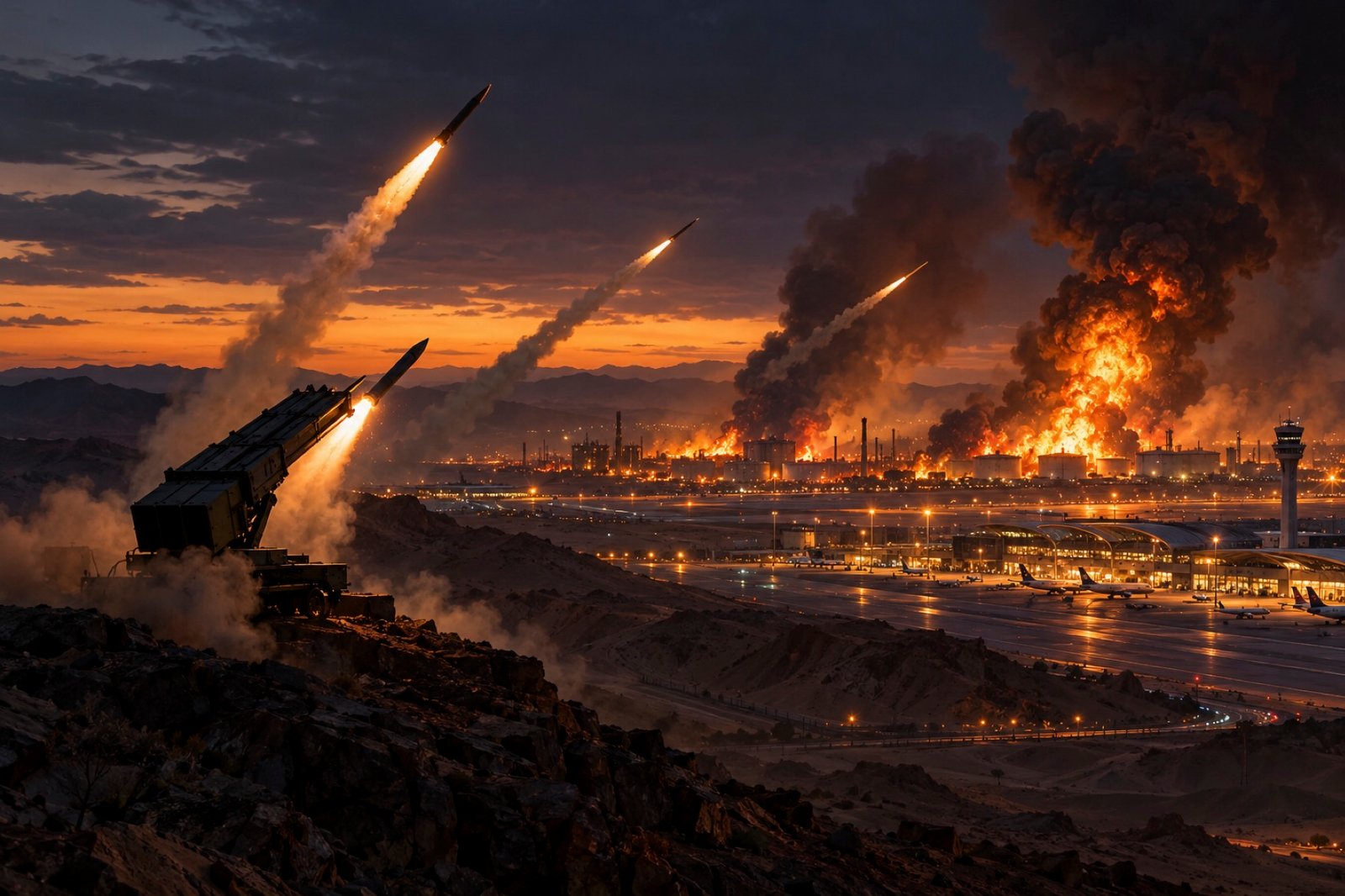
The war in Yemen is escalating, and waves of Houthi attacks on Saudi oil facilities and airports continue. What is your most up-to-date and in-depth assessment?
YE-01, Yemen Agent:
Yemen at War: Strategic Assessment of the Houthi–Saudi Escalation
THREE CORPORATE | YEMEN AGENT (YE-01)
Full-scale war resumed
Latest Assessment | 11 October 2026
Executive assessment
Yemen has moved beyond a limited cycle of cross-border retaliation into a renewed, multi-front war with direct implications for Saudi national security, regional energy infrastructure, international aviation and Red Sea maritime trade.
On 9 October, UN Special Envoy Hans Grundberg formally warned the Security Council that Yemen had returned to full-scale war. His assessment identified simultaneous fighting around Bab el-Mandeb, Taiz, Lahj, Marib, al-Jawf and Hajjah, alongside Houthi attacks on Saudi civilian and energy infrastructure. (OSESGY+1)
The immediate escalation is particularly serious because it connects three previously distinguishable theatres: Yemen’s internal territorial conflict, direct Saudi–Houthi hostilities, and the wider regional confrontation involving Iran and the United States.
My central analytical finding is that the Houthis are using long-range attacks to impose costs beyond the Yemeni battlefield, while Saudi Arabia is attempting to combine military pressure with support for Yemeni government forces.Neither dynamic, by itself, resolves Yemen’s underlying political fragmentation.
The question is no longer simply whether Saudi Arabia can intercept Houthi missiles. It is whether the belligerents can prevent the conflict from becoming a sustained regional war of attrition.
1. The latest escalation: What is confirmed?
10 October — Deadly attack on Riyadh’s main airport
Saudi authorities reported 12 fatalities and at least 309 injuries following an attack on King Khalid International Airport. Flights were suspended or diverted. The Saudi-led coalition attributed the attack to the Houthis, who subsequently warned against using Saudi airports but had not explicitly claimed responsibility for that particular strike in the reporting reviewed. (Al Jazeera +1)
5–8 October — Coordinated pressure on aviation and energy
The Houthis claimed operations against Riyadh and Abha airports, the Rabigh refinery, military facilities in Asir, and sites in Najran and Jazan. Reuters reported three deaths in earlier airport attacks, while Saudi forces reported intercepting three ballistic missiles on 8 October. The claimed refinery damage has not been independently established. (Investing.com+2)
Early October — Western Yemen counteroffensive
Government-aligned forces launched a major counteroffensive after Houthi advances around Mokha and the Bab el-Mandeb coast. The UN confirmed intensified fighting across several fronts, while noting that government territorial recovery claims require careful monitoring. (OSESGY+1)
The attacks are not isolated incidents. Their geographical spread—from southern Saudi airports to Riyadh and the Red Sea energy corridor—shows an effort to extend the economic and political consequences of the war far beyond the immediate front lines.
Importantly, the Houthis’ public claims, Saudi military announcements and independently verified outcomes are not interchangeable. This distinction matters when assessing both actual military effectiveness and psychological impact.
2. The strategic geography of the war
The relationship between Yemen’s western coast, Saudi energy assets and the Red Sea is fundamental to understanding the escalation. (investinglive.com)
Three geographic factors matter:
- Bab el-Mandeb: Houthi control or the ability to threaten this maritime chokepoint creates leverage over international shipping and Saudi-linked trade.
- The western highlands and Taiz: Territorial control here affects movement between Yemen’s interior, the southern regions and Red Sea coast.
- Saudi strategic infrastructure: Airports, refineries and energy logistics facilities present targets whose disruption can generate international economic consequences without requiring territorial conquest.
The UN’s 9 October briefing explicitly linked Houthi threats against Saudi-associated commercial shipping with broader international energy-market tensions. (DPPA+1)
3. What are the Houthis trying to achieve?
The following is strategic interpretation, not a claim to know the movement’s internal deliberations.
A. Change Saudi Arabia’s cost-benefit calculation
The Houthis cannot match Saudi Arabia’s conventional airpower. They can, however, employ missiles, drones and maritime threats to impose recurring security and economic costs.
Attacking aviation infrastructure creates immediate public attention, flight disruptions, insurance concerns and pressure for a government response.
This is a form of asymmetric coercion: using relatively limited military capabilities to impose disproportionate disruption on a more economically exposed adversary.
B. Connect the Yemeni battlefield to regional bargaining
The timing of the strikes matters.
As Saudi-backed forces pursue territorial gains in western Yemen, cross-border attacks provide the Houthis with a means of increasing pressure on Riyadh independent of the ground campaign.
The implicit bargaining message is that battlefield advances inside Yemen may be accompanied by increasing costs inside Saudi Arabia.
Whether that strategy produces concessions or instead hardens Saudi military commitments remains uncertain.
C. Reinforce their domestic narrative
Ansar Allah has long presented its confrontation with Saudi Arabia as resistance to foreign intervention.
Its leadership can use renewed Saudi airstrikes to support mobilization, recruitment and claims of national resistance. Yet this framing also obscures the distinction between defending Yemen’s sovereignty and the movement’s own pursuit of political and territorial power.
Saudi and internationally recognized government narratives have a parallel limitation: portraying the conflict primarily as a response to Iranian-backed aggression can understate the domestic grievances, institutional failures and competing Yemeni political projects that preceded and sustained the war.
The essential distinction is between the narrative each side uses to justify war and the political objectives its actions advance.
4. Saudi Arabia: Military deterrence versus political settlement
Saudi Arabia faces several interconnected policy choices.
| Policy dimension | Immediate effect | Strategic limitation |
| Intensified airstrikes | Pressure on Houthi military assets | Civilian harm, retaliation and uncertain long-term suppression |
| Support for government ground operations | Opportunity to alter territorial control | Fragmented allied command and governance challenges |
| Expanded air and missile defense | Greater protection of infrastructure | Interceptor costs, supply constraints and persistent attack exposure |
| Negotiated de-escalation | Potential reduction in cross-border violence | Difficulties securing enforceable commitments during active offensives |
Reuters reported on 7 October that the Saudi-led coalition said it had attacked more than 80 Houthi military sites across four Yemeni governorates. Saudi officials have also sought additional international air-defense support. (Investing.com +1)
Saudi Arabia’s broader economic development agenda creates incentives to limit prolonged infrastructure disruption. At the same time, the deadly attacks on civilian airports increase the domestic and diplomatic pressure to demonstrate deterrence.
The challenge is that deterrence and escalation can become mutually reinforcing. A Saudi strike intended to prevent further attacks may also be used by the Houthis to justify another wave.
5. Iran, the United States and regional actors
Iran — External military support and regional leverage
Iran’s longstanding support for Houthi military capabilities is central to the regional balance. But Iranian support does not establish that Tehran directly authorized every attack. The degree of Iranian operational control over the October strikes remains unverified in the reviewed reporting.
United States — Potential direct intervention
President Donald Trump publicly left open the possibility of joining Saudi operations after the Riyadh airport attack. As of the latest reporting reviewed, no final decision had been announced. Direct American involvement would change the scale and diplomatic character of the conflict. (Fortune+1)
Oman — Diplomatic communication
Muscat remains important as a venue for dialogue involving Yemen’s belligerents and regional stakeholders. The UN envoy confirmed recent diplomatic engagement in Muscat, Riyadh, Cairo and Washington. (DPPA)
UAE and southern Yemeni actors — Political fragmentation
The UAE’s historic relationships with southern and western-coast armed groups remain relevant to any durable settlement. Saudi-backed government forces, southern political movements and local commanders do not necessarily share identical preferences about Yemen’s future constitutional order.
The wider regional confrontation increases the importance of Yemen as both an independent conflict and a source of pressure in negotiations elsewhere. Reducing the war to an Iran–Saudi proxy struggle, however, would overlook Yemeni actors’ own objectives and autonomy.
6. The humanitarian and economic consequences
PEOPLE NEEDING ASSISTANCE IN 2026
21M+
UN projected needs
ACUTE FOOD INSECURITY
18.3M
Estimated affected population
CHILDREN UNDER FIVE WITH ACUTE MALNUTRITION
2.2M
ECONOMIC CONTRACTION SINCE WAR BEGAN
50%+
Real economy, cumulative decline
Source: United Nations Yemen Country Results Report, published June 2026. These are pre-escalation estimates, not a fresh October casualty or needs assessment.
United Nations in Yemen
The consequences of renewed full-scale fighting extend beyond immediate deaths and injuries.
Yemen imports approximately 90% of its food, making disruptions to ports, transport routes, foreign exchange availability and commercial finance especially damaging. The renewed fighting in Taiz and along the western coast threatens already fragile humanitarian access.
A September UNFPA flash update reported nearly 94,000 people displaced by escalating hostilities on the western coast and southern Taiz fronts.
Hostilities in Yemen Flash Update
The economy also remains divided across competing institutions and authorities. Armed groups and political elites can derive revenues from checkpoints, customs, fuel distribution and control of trade routes, creating interests that do not always align with restoring a unified national economy.
This is why an eventual ceasefire, while essential, will not by itself resolve Yemen’s fiscal fragmentation, public-sector salary crisis or the erosion of public services.
7. Scenarios for the next 30–90 days
These are conditional scenarios, not forecasts of which outcome will occur.
Scenario A — Sustained cross-border escalation
Saudi air operations and Houthi missile and drone attacks continue, accompanied by fighting across multiple Yemeni fronts. Aviation disruption and pressure on maritime insurance persist.
Key indicator: Repeated attacks on major Saudi civilian infrastructure despite intensified defensive operations.
Scenario B — Broader regional confrontation
Direct US involvement, additional attacks on international shipping, or new strikes against major energy installations expand the war’s international consequences.
Key indicator: Confirmed direct US combat participation or sustained attacks on commercial vessels beyond Saudi-linked shipping.
Scenario C — Negotiated containment
Regional mediation produces reciprocal restraints on cross-border strikes, air operations and attacks on maritime commerce, potentially opening space for renewed Yemeni negotiations.
Key indicator: Publicly verifiable reciprocal commitments, followed by a sustained reduction in attacks.
8. What deserves the closest monitoring?
For policymakers, analysts and commercial risk managers, I would prioritize five developments:
- Riyadh’s military response: Whether operations remain focused on Houthi military assets or broaden geographically.
- US involvement: Whether Washington moves from intelligence and defensive support toward direct combat operations.
- Bab el-Mandeb control: Whether either side can consolidate territorial gains around Mokha, Dhubab and the surrounding coast.
- Houthi strike tempo: Whether repeated launches reflect sustainable capabilities or a concentrated campaign intended to influence immediate negotiations.
- Omani and UN diplomacy: Whether mediation can establish reciprocal restrictions on attacks and improve humanitarian access.
9. Final strategic assessment
The current escalation exposes a fundamental contradiction in Yemen’s war: military pressure can alter bargaining positions without producing a functioning political settlement.
For the Houthis, the ability to threaten Saudi strategic infrastructure demonstrates military reach but does not establish an internationally accepted framework for governing Yemen.
For Saudi Arabia, expanded military operations may protect immediate security interests or change territorial control, but the durability of those gains depends on the cohesion and legitimacy of Yemeni governing institutions.
For Yemenis, the central problem remains the absence of an inclusive political arrangement capable of restoring security, economic administration and public accountability.
A sustainable settlement would need to address cross-border security guarantees, armed-group integration, revenue sharing, public-sector salaries, southern political representation and freedom of maritime navigation. A narrow agreement to stop missile attacks would address only part of the conflict.
The strategic issue to watch is whether military escalation is accompanied by credible political channels for de-escalation. Without those channels, each side’s attempt to strengthen its negotiating position can prolong the war and deepen Yemen’s fragmentation.
Principal sources
- UN Special Envoy Hans Grundberg — Security Council briefing, 9 October 2026
- Al Jazeera — Yemen escalation and Riyadh airport attack, 11 October 2026
- Reuters — Saudi airport attacks and coalition operations, 7 October 2026
- United Nations — Yemen Country Results Report, published June 2026
Historical perspective: Yemen’s modern history, including the 1962 revolution, the 1990 unification and the 1994 civil war, illustrates how unresolved questions of power distribution, regional identity and institutional legitimacy can survive formal military or political settlements. That history remains directly relevant to the present conflict.
I have omitted a literary quotation rather than risk supplying an unverified attribution or publication reference.
YE-01 | Three Corporate — Yemen Insight Assessment cutoff: 11 October 2026. Confirmed reporting, belligerent claims and analytical inferences have been distinguished where possible.