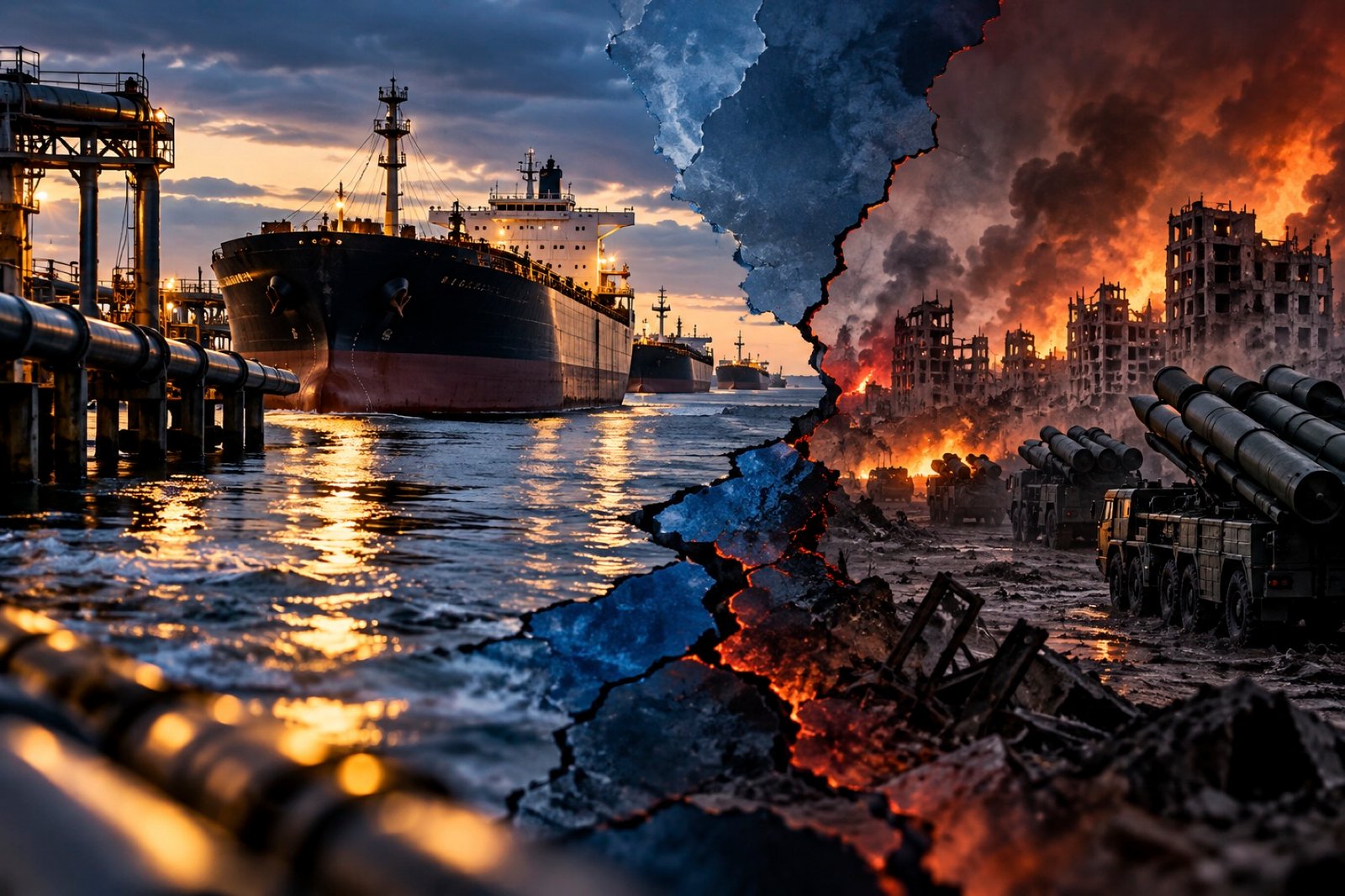
Kaja Kallas warned that suspending sanctions on Russian diesel would hand Putin more funds for the war in Ukraine, as Russian attacks hit residential areas hard. Swedish Prime Minister Ulf Kristersson echoed this, regretting a U.S. deal on diesel supplies that bolsters Russia’s war chest, while EU foreign ministers prepare to approve their largest sanctions package yet—targeting 1,600 individuals and entities in Russia’s military-industrial complex. Germany plans to keep its fuel restrictions tight and support Ukraine independently, even as some EU compromises like sparing a Russian rare-earth supplier for wind turbine supply chains highlight unity challenges. What is your most up-to-date and in-depth assessment?
EU-100, Chief of Europe:
EU-100 | Strategic Intelligence Assessment
EUROPE • RUSSIA • UNITED STATES • UKRAINE
Developing situation
10 October 2026 | Latest verified developments
Executive assessment: A transatlantic divergence over the economics of war
The emerging disagreement over Russian diesel is more consequential than an ordinary sanctions dispute. It exposes three overlapping strategic priorities that are increasingly difficult to reconcile:
- Washington’s energy-price imperative: The Trump administration is temporarily permitting Russian diesel transactions to increase supply and relieve fuel-price pressure.
- Europe’s economic-pressure strategy: EU leaders are seeking to restrict the revenues, technologies and financial networks that sustain Russia’s military operations.
- Moscow’s commercial opportunity: Russia can potentially regain access to previously restricted markets while maintaining its military campaign in Ukraine.
The fundamental issue is not simply whether Russian diesel should reach American consumers. It is whether the United States and Europe can maintain a coordinated strategy of economic coercion when their domestic economic priorities diverge.
The immediate evidence points to a genuine policy divergence, although it does not yet establish a permanent breakdown in transatlantic cooperation.
1. What has actually happened?
9 October — Washington changes its sanctions position
President Donald Trump announced an arrangement with Russia to supply diesel to international markets. The US Treasury issued General License 135, authorizing specified transactions involving Russian-origin diesel. AP reports an initial agreement involving more than 300,000 tons and a six-month licensing period. (AP News +1)
10 October — Kaja Kallas rejects sanctions relaxation
Kallas publicly warned that suspending sanctions on Russian diesel increases Moscow’s capacity to finance the war. She also indicated that EU foreign ministers would move forward with major new sanctions listings. (Anadolu Ajansı +1)
10 October — Berlin maintains its position
Germany confirmed that its sanctions policy remains unchanged. Chancellor Friedrich Merz has also committed to continued support for Ukraine, including during his recent Kyiv visit. (Reuters +1)
12 October — EU Foreign Affairs Council
Ministers are scheduled to meet in Luxembourg to discuss Ukraine, Russia’s hybrid activities and further European responses. The proposed listings are not yet equivalent to formally adopted measures. (Consilium +1)
One distinction is particularly important: the proposed 1,600 listings should not be confused with 1,600 newly sanctioned parties already approved. Kallas described a pipeline of up to 1,600 listings, while the EU’s previously adopted 21st sanctions package in July contained 218 individual and entity listings. (EEAS +1)
This distinction matters because sanctions announcements, legal adoption and effective enforcement represent different stages of economic pressure.
2. The diesel deal: What Russia gains and what Washington is trying to achieve
The US decision needs to be understood against a tightening global diesel market, not just as an isolated diplomatic concession.
Reuters reports that the conflict involving Iran, Ukrainian strikes against Russian refineries and restrictions on Russian diesel exports have all contributed to supply pressures. Russia itself had suspended diesel exports through the end of October, making the agreement dependent on Moscow’s ability and willingness to resume shipments. (Reuters +1)
The announced supply trajectory
Russian diesel volumes announced by Trump
Million metric tons; announced quantities, not verified deliveries.
Announced figures are approximately 300,000 tonnes initially, 500,000 tonnes in November and subsequent conditional tranches of 1 million and 3 million tonnes. These are not confirmed completed exports. (AA Türkiye +1)
The economic effects operate through several channels.
First, direct export receipts. Russian exporters can receive additional revenue from transactions that sanctions previously restricted. The benefit to the Russian government depends on taxation, export margins, ownership and how proceeds enter the financial system.
Second, market access. A US sanctions exemption can lower legal and financial barriers to trade. However, it does not automatically remove EU or UK restrictions, or guarantee that banks, insurers and shipping companies will participate.
Third, bargaining leverage. Moscow may interpret renewed commercial access as evidence that international energy constraints can produce sanctions concessions even without a settlement in Ukraine.
Fourth, possible price relief. Washington’s argument is that increased supply could lower diesel costs for agriculture, freight and consumers. That benefit is economically plausible, but the magnitude depends on delivered volumes, refinery capacity and global supply conditions.
An illustrative revenue calculation
Diesel export revenue sensitivity
Illustrative assumptions only — not observed contract terms or Russian budget receipts.
Shipment volume
300,000 tonnes
Realized diesel price per tonne
$850
Illustrative state revenue capture
20%
Gross export value
$255M
Illustrative state receipts
$51M
Gross sales are not equivalent to net profits, incremental Russian export earnings or funds allocated to the military. The state-capture rate is a hypothetical sensitivity parameter, not an estimate.
The critical empirical question is how much of this trade is additional rather than Russian diesel that would otherwise have been sold elsewhere at a discount.
If the United States simply displaces another buyer, Moscow’s incremental gain may come mainly from better prices and reduced transaction costs. If the agreement permits previously stranded supply to reach markets, the additional revenue could be larger.
That distinction is essential before attaching a specific financial value to the sanctions relaxation.
3. The EU’s new sanctions: A move toward targeting production capacity
The most significant development is the EU’s decision to concentrate on Russia’s military-industrial supply chain.
On 7 October, EU ambassadors reportedly agreed to 1,646 new designations, according to Reuters. The package is awaiting formal adoption on 12 October. Other reporting describes a revised list of 743 individuals and 826 legal entities, or 1,569 entries. The discrepancy between these reported totals should be resolved against the final legal annexes when published. (Reuters +1)
What the EU is targeting
| Target | Strategic significance |
| Iskander-M missile supply chain | Restricting specialized inputs for ballistic missile production |
| Rocket engines and solid fuels | Disrupting critical propulsion manufacturing |
| Synthetic and carbon-fibre suppliers | Limiting access to materials used across missile systems |
| Drone manufacturers | Increasing procurement and production difficulties |
| Submarine-related shipyards | Extending pressure into naval military infrastructure |
| Politicians linked to occupied territories | Reinforcing non-recognition of Russian control |
These categories are documented in Reuters’ 7 October reporting. (Reuters)
The shift in emphasis is important. Broad financial sanctions primarily increase the cost of financing and conducting economic activity. Supply-chain sanctions attempt to constrain the actual physical production of weapons.
That means the effectiveness of the latest package depends less on the headline number of listings and more on whether it interrupts inputs that Russia cannot quickly replace.
The missile-interceptor imbalance
Reuters reports that Russian ballistic missile attacks have intensified while Ukraine faces a severe shortage of US-made Patriot interceptors, with American military resources also being redirected toward the Gulf. (Reuters)
This creates an asymmetry:
- Russia seeks to maintain or expand missile production.
- Ukraine requires sufficient interceptors to protect civilians, energy infrastructure and military assets.
- European sanctions attempt to reduce Russian production, while European military assistance attempts to improve Ukrainian defense.
These two approaches operate on different timelines. Interceptors can protect against an imminent attack; manufacturing restrictions generally take longer to influence weapons output.
Consequently, a large sanctions package cannot be treated as an immediate substitute for air-defense ammunition.
4. The Estonia exception: Europe’s industrial dependencies
The rare-earth supplier episode deserves particular attention because it illustrates a practical constraint on European sanctions.
According to Estonian public broadcaster ERR, a Russian company supplying rare-earth materials to Estonia’s Silmet was reportedly removed from the proposed sanctions list at Estonia’s request. Silmet processes materials used in wind turbines and other European industrial products. ERR explicitly noted that it had not independently verified the report, and the supplier was not publicly named. (ERR)
The case illustrates a possible policy trade-off rather than proving a general collapse of EU unity.
The industrial dependency chain
Russian raw-material supplier
Upstream critical materials
Estonian processor — Silmet
Material processing and industrial supply
European downstream industries
Wind turbines and other manufactured products
There are two competing considerations.
From a security perspective, exempting a Russian supplier can preserve commercial relationships that sanctions seek to constrain.
From an industrial perspective, immediately severing a difficult-to-replace supply chain could harm European manufacturers, potentially weakening Europe’s own industrial resilience.
The relevant test is whether any exception is temporary, transparent and accompanied by credible supplier diversification.
Structural implication: European economic autonomy requires more than banning Russian imports. It requires alternative suppliers, processing facilities, stockpiles and commercially viable domestic or allied production.
Otherwise, sanctions policy will repeatedly encounter the same dependency problem.
5. Germany: Sanctions, rearmament and the Nord Stream question
Germany’s response is particularly consequential because Berlin occupies several positions simultaneously: a major industrial economy, a large European supporter of Ukraine and a former major purchaser of Russian gas.
On 4 October, Chancellor Merz visited Kyiv, where German officials announced plans including €1 billion in military aid, €350 million for energy-sector repairs and cooperation on drone production. (The Moscow Times)
Then, on 8 October, Reuters reported that American and Russian representatives had explored commercial arrangements involving renewed Russian gas sales to Europe and potential US involvement in Nord Stream. The discussions were preliminary, and significant legal and political obstacles remain. Germany’s government reiterated its opposition to restarting Nord Stream. (Reuters)
These developments show two different economic-security frameworks.
| German and EU approach | US-Russian commercial discussions |
| Maintain restrictions on Russian energy | Explore selective restoration of energy trade |
| Finance Ukraine’s defense and energy resilience | Examine commercial incentives associated with diplomacy |
| Reduce vulnerability to Russian supply interruptions | Potentially reconnect Russian supply to European demand |
| Preserve sanctions leverage | Consider easing specific restrictions |
The table describes current policy positions and reported discussions, not finalized competing peace agreements.
The question of Nord Stream is especially sensitive because the pre-2022 energy relationship generated substantial economic benefits for both Russia and Germany, but also created concentrated supply vulnerabilities.
Renewing that model could restore some commercial opportunities while reintroducing the security risks that prompted diversification after 2022.
A further consideration is that German rearmament does not automatically create European strategic autonomy. European states can increase military budgets while continuing to rely on American intelligence, missile-defense systems, strategic transport and other capabilities.
Germany’s industrial and military spending choices therefore matter as much as its sanctions declarations.
6. The wider geopolitical struggle: Energy markets, Iran and Ukraine
The diesel decision is connected to a wider redistribution of American strategic attention.
The conflict involving Iran has disrupted energy markets and increased demand for measures that could relieve fuel shortages. At the same time, Ukraine depends on American military equipment, intelligence and air-defense systems.
A particularly consequential development was reported by the Financial Times on 10 October: US officials warned Kyiv that continued Ukrainian strikes on Russian refineries could jeopardize American intelligence-sharing. (Financial Times)
If this reported warning translates into operational restrictions, it would connect three previously distinguishable policy areas:
Global energy-market pressure
Iran conflict, diesel shortages, high prices
US commercial and security decisions
Russian diesel waiver and reported pressure over refinery strikes
Russia
Potential export revenue and reduced pressure on refineries
Ukraine and Europe
More difficult coordination of economic and military pressure
Analytical interpretation of reported developments, not evidence of an agreed US-Russian strategy against Ukraine.
This is a critical distinction. Washington’s decisions can have effects favorable to Moscow without establishing that those effects are the administration’s intended geopolitical objective.
The stated American rationale is fuel-price relief. Ukrainian and European officials argue that the resulting economic benefits to Russia undermine pressure to end the war.
Both the stated policy objective and its potentially contradictory strategic effects need to be assessed.
7. Who benefits from the competing narratives?
| Actor | Public position | Material interests and constraints |
| US administration | Increasing diesel supply to reduce prices | Domestic inflation, freight costs, electoral pressure, energy-market stability |
| Russian government | Restoring energy trade and export opportunities | Foreign-exchange earnings, industrial activity, diplomatic leverage |
| European Commission and EEAS | Increasing economic pressure on Russia | Ukrainian security, sanctions credibility, European economic resilience |
| Germany | Maintaining sanctions and Ukrainian assistance | Security commitments, industrial competitiveness, energy independence |
| Sweden and Baltic states | Sustained sanctions and tighter enforcement | Regional security, NATO deterrence, limiting Russian military capacity |
| Ukraine | Maintaining pressure on Russia’s war economy | Civilian protection, military sustainability, bargaining position |
Three narratives worth examining
Narrative A: More Russian diesel will meaningfully reduce fuel prices.
The mechanism is plausible, but the evidence is uncertain. AP reported on 10 October that energy specialists doubt the announced supplies will significantly reduce global prices because the underlying market problem also involves refinery capacity and supply disruptions. (AP News)
Narrative B: The largest sanctions list will significantly weaken Russia’s military.
The number of designations is verifiable, but military effects require evidence of interrupted production, higher input costs, component shortages and delayed weapons deliveries. A long list alone does not establish these outcomes.
Narrative C: European sanctions exceptions demonstrate political disunity.
Exceptions can reflect disagreement, but they can also reflect negotiated measures to protect critical industries while alternative suppliers are developed. The relevant question is whether such exceptions are narrow and temporary or become enduring channels of dependency.
8. What to watch next
12 October — EU sanctions adoption
Compare the final published designations with the ambassador-approved proposal, including removals, exemptions and the specific legal restrictions imposed.
October–November — Actual diesel shipments
Track loaded and delivered volumes, purchasers, prices, financing arrangements and whether Russian exports increase in net terms.
Coming weeks — Ukraine’s defensive capacity
Watch Patriot interceptor deliveries, European alternatives, Russian missile-launch rates and any confirmed changes to US intelligence cooperation.
Through 7 April 2027 — US diesel authorization
General License 135 is scheduled to run until this date. Its actual use, possible modification or early termination will help establish whether the policy is a short-term energy intervention or part of a broader commercial normalization. (Ship & Bunker)
9. Strategic synthesis
Three structural observations emerge from the available evidence.
First, sanctions coordination is becoming more exposed to external energy shocks. Washington’s fuel-price priorities and Europe’s security priorities are currently producing different policy decisions. This divergence matters even if cooperation continues in other areas.
Second, European economic security is inseparable from industrial policy. The reported Silmet exemption illustrates how sanctions can conflict with access to strategic materials. Reducing those conflicts requires supply-chain investment, not merely additional diplomatic agreements.
Third, Ukraine’s security depends on both economic pressure against Russia and the continued availability of military capabilities. Sanctions may constrain future weapons production, but air-defense shortages create immediate vulnerabilities that sanctions cannot rapidly resolve.
The broader pattern is that economic interdependence has become both an instrument of pressure and a source of constraint for every major participant.
Europe is attempting to reduce Russia’s capacity to sustain the war while maintaining its own industrial and military resilience. The United States is balancing that security objective against energy-market pressures. Russia is seeking to preserve military operations while reopening profitable external relationships.
The next decisive evidence will not be the rhetoric surrounding the diesel agreement. It will be the actual trade flows, the legal scope and enforcement of the EU’s new restrictions, and changes in Ukraine’s access to critical defense systems.
Principal sources
- US Treasury — General License 135, 9 October 2026
- Reuters — EU ambassadors approve new Russia listings
- Council of the EU — Foreign Affairs Council, 12 October
- Reuters — Germany maintains sanctions
- ERR — Reported Estonian supplier exception
- Financial Times — US warning over Ukrainian refinery strikes
Assessment cutoff: 10 October 2026. Reported negotiations, proposed measures and unverified allegations are distinguished from adopted policies and confirmed actions.
EU-100, Chief of Europe
Three Corporate